


- Home
- Companies
- EP Aeration
- Products
- Model EP-2006 Uni-2 - Reservoir Systems
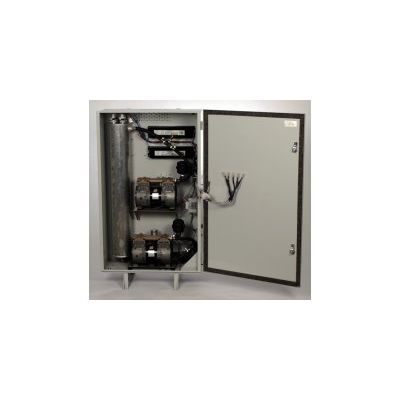
Model EP-2006 Uni-2 -Reservoir Systems
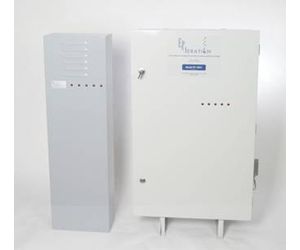
Made in San Luis Obispo, CA U.S.A with the best compressors and ozone generators available, all E P Aeration reservoir systems run on 120VAC, 20A household current. Compressors and ozone units are incredibly simple and inexpensive to maintain, generally requiring less than two hours per year to service. Internally cooled and weatherproof, E P Aeration units can be wall mounted or stand alone, indoor or outdoor.
The heart of the E P Aeration system is the patented tubing which we use for all of our applications. Whether it’s wastewater or a decorative water feature we use the same style of air diffusion, it’s just a matter of scale.
- The best ozone generators
- The best air-diffusion tubing
- The best compressors available
- The best bio-remediation products
- The best artificial littoral zone products
- The best shade and coloring products
Yet the E P Aeration difference is more than just equipment - it`s the experience we`ve gained in aerating lakes, ponds, and water features of all descriptions, in all sorts of climates, for more than 20 years. When we recommend a solution for your water problems, you can be sure that you`re getting more than a one-size-fits-all type of answer - you`re getting the E P Aeration difference.
E P Aeration utilizes bottom laid, fine bubble aeration:
- Increasing dissolved oxygen levels throughout the water column
- Eliminating thermal stratification
Because our lake and pond systems use standard household current (120 VAC, 15-amp circuit), and because we pump air, not water, our customers realize significant savings in installation, operation and maintenance costs. Our current, modular systems are the result of more than 10 years of development, and more than 20 years of ozone generation and lake and pond aeration experience. The modular nature of the systems allows us to recommend the most effective - and cost effective - solutions for your water problems.
E P Aeration utilizes proprietary air-diffusion tubing in its lake and pond ozonation/aeration system modules. In use for more than 45 years in the wastewater treatment industry, this keel-weighted, bottom-laid tubing features the highest documented oxygen transfer rates in the business. The keel weighting ensures that the tubing lies on the bottom, at the sludge layer, with the air release slits always upright. Available with air release slits cut on 6-inch centers, 3-inch centers, and 1 ½-inch centers, the tubing can also be manufactured in "triple cut", or three air release slits at each position, for more demanding jobs, as in wastewater treatment. The air release slits are precisely cut to produce a calculated bubble size and rate of rise (no more than .8 ft. per second). No other air diffusion system, including competitive tubing, has the proven performance of that used by E P Aeration, which is why it was selected originally more than 20 years ago, and why it is still in use today. The precise cut, and material memory ensure that the slits only open with 2 psi or more of pressure, and close immediately on shut-down. This ensures that minimal amounts of water and/or dirt can enter the tubing, minimizing cleaning and maintenance.
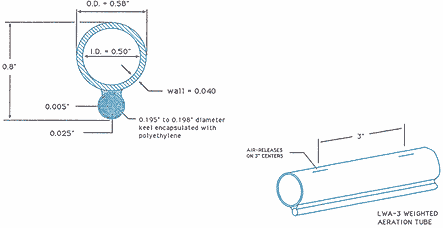
Made of low-density polyethylene copolymer with 2% carbon black for ultraviolet stabilization, the tubing has an interior diameter of .5". The tubing meets or exceeds Federal Specification L-P-3906, REA PE-200, and ASTM D1248. Although E P Aeration system modules often utilize tubing laid in a straight line on the bottom at the deepest part of the water feature, the tubing is also available on custom-made stainless steel diffusion disks (shown below & right) for deep holes or unusual lake or pond configurations.
- Dissolves into water 13 times faster than O2
- Kills viruses, bacteria, molds, spores, and cysts up to 3000 times faster than chlorine
- Keeps the inside of bottom-laid tubing clean and maintenance free
- Oxidizes organic nutrients, chlorohydrocarbons
- Precipitates iron, manganese, and heavy metals from water
- Produces increased water clarity
- Has been shown to affect soil absorption rates of salts and other compounds
E P Aeration systems generate ozone in two ways, each of which mimics the way ozone is produced in nature. Generally, our lake and pond systems utilize ultraviolet light to produce the small amounts of ozone appropriate to that application. In our recirculation, closed-loop water treatment systems, we utilize corona-discharge (high-voltage electricity) generators, which produce larger quantities of ozone which are usually injected directly into the recirculation or pump system. The availability of both types of ozone generators and the modular nature of our systems allows us to customize systems recommendations to solve the myriad of specific problems possible in a wide range of applications.
The use of ozone in most lake and pond applications is not intended to "kill algae" or sterilize the water feature. Instead, our lake and pond systems are designed to:
- Address the Biochemical Oxygen Demand (BOD) of the water with Aeration
- Use ozone to increase oxygenation in the water
- Oxidize hydrogen sulfide
- Precipitate out certain metals and suspended solids
- Keep the aeration tubing clean and maintenance-free
Of course, if circumstances demand larger quantities of ozone, we have the capabilities of meeting such demand with corona-discharge ozonators. E P Aeration`s aeration/ozonation systems are compatible with other non-chemical strategies, such as the use of bio-augmentation/remediation systems. While it is true that ozone will kill bacteria, (even beneficial ones) on contact, only a small number of sludge-eating bacteria, for example, might come into contact with the ozone at the point of bubble release. Ozone, with a half-life of 30 minutes in pure, distilled water, will usually be consumed by other substances in the water, and never reach the surface to be re-circulated. Increased oxygen at the sludge level is a positive environmental situation for micro-organisms and other small forms of life.
Ozone`s primary byproduct is oxygen. Ozone is unstable, and does not produce a long-term residual. It is an important adjunct component in our lake and pond aeration systems. Ozone is an appropriate primary treatment for closed-loop and/or recirculation systems.