

- Home
- Companies
- Geotek Ltd
- Products
- Model MSCL-S - Multi-Sensor Core Logger ...
Model MSCL-S -Multi-Sensor Core Logger (Mscl) Systems
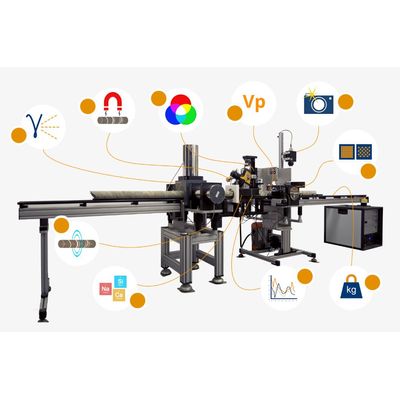
Geotek’s standard Multi-Sensor Core Logger (MSCL-S) is recognised as a crucial step in many geological coring workflows, including those for palaeoclimate, mineral exploration, geometallurgy, oil and gas, nuclear or geotechnical. The MSCL-S operates by automatically moving core samples past a series of sensors. The MSCL-S benefits from a modular configuration allowing for a range of petrophysical and geochemical sensor technology to be integrated onto one core scanning system, producing a single depth co-registered data set. The MSCL-S may accept either whole/split unconsolidated sediment cores in liners, or whole/slabbed rock cores with or without a liner. Depending on the requirements of the project, each MSCL-S system can be setup to take depth co-registered measurements for each sensor between 1 mm and 100 mm intervals downcore with a position accuracy of better than 0.1 mm.
Furthermore, if new technology becomes available, or research focus changes, the MSCL-S system can be upgraded with new sensors to ensure longevity of the scanning system.
The MSCL-S is field-proven with Geotek and many of our customers routinely installing their core scanner in remote onshore locations, or offshore laboratories aboard ships or platforms. Geotek can also provide containerised laboratory solutions for customers.
The MSCL-S accepts nearly any form of core material, including whole or split rock core samples and whole or split unconsolidated sediment samples in plastic or metal liners. The system is capable of logging core sections of up to 1.55 m with a maximum diameter of 150 mm.
-
WHOLE LINED SEDIMENT CORE
-
SPLIT OR SLABBED CORES
-
WHOLE UNLINED ROCK CORE
The simultaneous and depth co-registered acquisition of multi-sensor data provides the perfect foundation for the analysis of geological stratigraphy, and to uncover parametric relationships that define different geological units that might have previously been hidden or unidentified.
Whilst each individual dataset is equally valuable, the real advantage of acquiring multiple parameters is the ability to correlate between disparate data sets and deliver integrated vertical downcore profiles to aid in the identification of core lithology, heterogeneity, and facilitate analytical data comparisons of materials between core locations or between core and downhole data.
Importantly, MSCL-S data acquisition is entirely non-destructive and creates a permanent digital archive for future reference, permitting the investigation of archived core material or core material that is scheduled for future destructive testing.
Drill cores are a crucial part of any exploration program and mining chain evaluation. However, physical properties and geochemistry are often acquired separately using discrete methods of measurement or on different platforms. Here in this example from the Pary’s Mountain mine in the UK we show a high resolution (1cm) density and ultrasonic P-wave velocity (Vp) profile combined with depth co-registered geochemistry. Measurement intervals between points can be increased to 5 cm or 10 cm, enabling higher throughputs to characterise deposits for geometallurgy or geotechnical studies.