


- Home
- Companies
- Bentek Systems
- Products
- Model SCADALink IP100 - Modbus ...
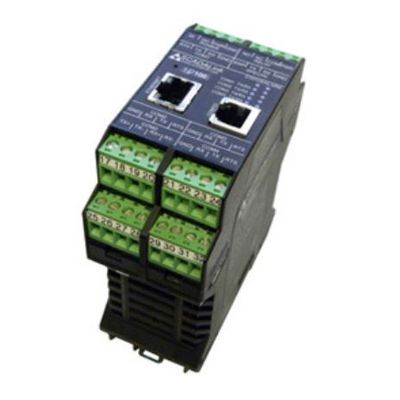
Model SCADALink IP100 -Modbus Multiplexer / Modbus Serial TCP Gateway / SCADA Terminal Server
The SCADALink IP100 is a Serial-to-Ethernet Gateway, Multiport Industrial Terminal Server and Modbus Multiplexer designed for SCADA and automation applications requiring serial connectivity of LAN/WAN and Internet Networks. The IP100 enables IP access to serially connected devices such as PLC’s, RTU’s, SCADA hosts, Flow Computers, Data loggers and Radio Modem systems. Unique features such as multiple host connections and simultaneous TCP, UDP and Modbus TCP ports gives it flexibility and scalability in automation and SCADA applications. To maintain system availability for critical operations, the IP100 can be set up to provide a redundant connection through a serial or Ethernet interface. The failover provides a backup link should the primary connection between the SCADA Host and the IP100 becomes unavailable.

A built-in Monitor tool enables serial communications diagnostics by providing users with real-time protocol analysis capabilities on selected serial channels. Configuration is done via simple windows GUI or ASCII Terminal. The IP100 is a compact replacement for the SCADALink IP Gateway with additional ports and expanded functionality.
The IP100 can be configured for the following Operating Modes. It also supports multiple, simultaneous operation of these Modes.
- Modbus TCP
- Modbus over TCP and UDP
- Virtual Serial Server
- Virtual Serial Client
- Connect
- Serial Multiplexer
- Serial Master
- Remote Ethernet and Serial Addressable I/O
Operating Modes
Modbus IP
Modbus IP mode allows multiple simultaneous IP connections to a single serial port. Ports can have multiple simultaneous protocols including TCP, UDP, Modbus TCP.
This mode enables an IP100 serial port to be connected from a remote device via a TCP socket connection, creating a virtual serial link. The connection is bidirectional; data can be initiated from either side. The remote serial port that establishes a connection with the IP100 can be another IP100 in Virtual Serial Client mode, a terminal server in Client mode or Serial-to-IP software in Client mode.
This mode enables an IP100 serial port to connect to a remote serial port via a TCP socket connection. The connection is bidirectional; data can be initiated from either side. The remote side serial port can be another IP100 configured as Virtual Serial Server, a terminal server in Server modem mode or serial-to-IP software in Server mode.

This mode is used to enable a remote ethernet host to periodically interrupt communication between two serial devices connected to the IP100. Under normal circumstances, there is a bidirectional communication between devices on the 2 IP100 serial ports. If the IP100 detects a TCP socket request, then it overrides the serial-to-serial communications. While the TCP socket is established, any data from the other serial device is discarded.
Modbus Multiplexer mode enables multiple serial Modbus Masters to communicate to a single serial Modbus Slave port. Up to 4 hosts can connect to a single serial port.
This IP100 mode enables a serial master to communicate to serial slaves using a variety of protocols. There are two modes for the Serial Master – UDP broadcast and RTU address based routing.
UDP Broadcast – In this mode, the serial message is broadcast to a list of UDP slaves (IP address and port number). The UDP broadcast mode is protocol independent.This mode can be used for SCADA system upgrades involving Leased Line Replacement by IP Communication. The IP Communications can be Cellular, Satellite, or ADLS.
IP100 Serial Master Mode Configured for UDP Broadcast
RTU Address Based Routing uses an RTU address lookup to route to an IP device. In the example below, gateway A routes the message using the lookup table. It extracts the Modbus address from the message and uses it to determine the output protocol, IP address, and port number.
IP100 Serial Master Mode Configured for RTU Address Based Routing
The IP100 supports DF1 protocol Multiplexing to allow the sharing of Allen-Bradley PLCs by multiple SCADA hosts. The IP100 also features mix protocol Multiplexing, allowing Modbus and DF1 protocol to be simultaneously multiplexed to the same port.
Remote Ethernet and Serial Addressable I/O
The IP100 supports connection of SCADALink I/O Expansion Modules via the I/O Expansion Bus. This enables the IP100 to provide Modbus Addressable (Modbus RTU,Modbus TCP, Modbus via TCP, Modbus via UDP) I/O.
Specifications
- 5 Configurable Serial Ports (4 RS-232, 1 RS-232/RS-485)
- Ethernet 100Base-T (Auto Detect)
- TCP, UDP, Modbus TCP
- Supports multiple Operating Modes
- Wide-range of industrial uses, such as:
- Modbus Gateway
- Multiplexer
- Multiple Modbus Masters
- DF1 Multiplexing for Allen-Bradley PLCs
- Failover Backup Link
- Configurable via GUI or ASCII Terminal
- Protocol Monitor displays Serial Port Traffic
- Digital I/O for remote Comm reset or control
- Wide Input Voltage Input: 10 – 30VDC
- Power Consumption: 0.6W: 50mA @ 12V or 25mA @ 24VDC
- Status, Alarm, TX/RX LEDs
- Industrial Temp (-40 Deg. C to 70 Deg. C)
- CSA Class I Div 2
- DIN Rail Mount
Optional Features
- I/O Capabilities when I/O Expansion Modules are used
- Expansion modules include AI4, A04, DI8, DO8, A8D4. and Combo I/o
- I/O Addressable as Modbus TCP, Modbus via TCP, Modbus via UDP, and Modbus RTU Protocol