


- Home
- Companies
- Malvern Panalytical B.V. - a Spectris ...
- Products
- Model WAVEcore - Next-Generation ...
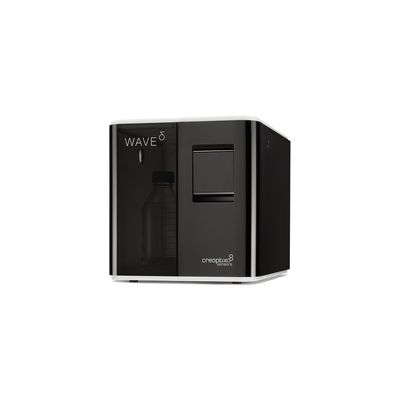
Model WAVEcore -Next-Generation Bioanalytical Instruments
The WAVEcore® houses our patented Grating-Coupled Interferometry (GCI) technology. Together with a temperature-controlled autosampler that can handle 2x 48-vial racks, 96- or 384-well plates or combinations thereof, the WAVEcore offers the sensitivity to work with low immobilization levels and large ligand-to-analyte molecular weight (MW) ratios.
GCI differs from SPR in how the refractive index change is read out. In SPR, the surface plasmon is quickly attenuated and can pick up signal only from few interactions. In GCI, each photon travels through the whole waveguide, and hence can pick up the signals from much more interactions, resulting in an intrinsically higher sensitivity.
In addition, the waveguide’s evanescent field penetrates less into the bulk, minimizing disturbances caused by bulk refractive index changes. Refractive index changes at the sensor surface are measured as time-dependent phase-shift signals. This allows for superior high signal-to-noise ratios, measurement of kinetics (ka, kd) and affinity (KD) from low pM to low mM, from signals below 1 pg/mm2 (equivalent to <1RU), for higher sensitivity and confident kinetic analysis.
Sensitivity is often limiting for accurate and reliable kinetic analysis of molecular interactions between large drug targets and small molecule inhibitors. Large target-to-analyte molecular weight ratios present a big challenge for traditional label-free interaction analysis and can significantly impact data quality. The Creoptix WAVE is compatible with the high ligand-to-analyte molecular weight ratios, providing outstanding resolution and reliable kinetics with at low immobilization levels for target-to-analyte molecular weight ratios for up to >1000:1. The outcome is increased sensitivity to accurately measure low-potency small molecules or fragments, or targets with low activity.
GCI produces an evanescent field that penetrates less deep into the bulk than SPR, minimizing the disturbance caused by bulk refractive index changes. This reduction in noise leads to superior signal-to-noise ratios.
Our patented GCI technology creates an interference readout in the time-domain and within the waveguide, instead of a space-domain signal being projected onto a CCD camera used with traditional waveguide interferometry methods. Measuring refractive index changes on the sensor surface as time-resolved phase-shift signals provides a more robust readout regardless of temperature drifts or vibrations, translating to superior resolution in signal and time.