


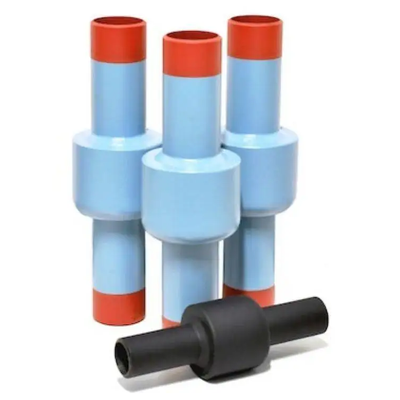
CPI Prodysol - Monolithic Cathodic Gasket
CPI-CATJOINT monolithic cathodic protection insulating joints for superior protection are a monolithic insulating assembly designed to provide cathodic protection for pipelines transporting highly corrosive products. Monoblock insulating joints are required to electrically isolate a buried or submerged pipeline that is to be cathodically protected from another pipeline or metallic structure that is not to be protected. Their contact with the ground may place significant demands on the protection current, rendering the desired protection unfeasible or causing the current consumption to be so high that it is preferable to isolate both structures.
On the other hand, when connected between two pipes (for example, a copper pipe and a grounding system, or in contact with reinforced concrete, which are cathodic relative to steel), they serve to prevent these galvanic couples. Their use is especially indicated when aiming to achieve maximum safety in terms of leaks and dielectric strength, as they can be buried more securely than insulating flange gaskets.
Unlike Dielectric Kits, CPI-CATJOINT monolithic cathodic protection insulating joints do not rely on the assembly of gaskets, sleeves, and washers on a flange at the installation site. Because CPI-CATJOINTs are welded as a single piece, field problems are virtually nonexistent, and the insulation integrity remains intact.
When designing these Monoblock or Insulation Joints, the fluid that will flow through the pipe (gas, liquid fuels, drinking water, etc.) must be taken into account, along with the pressure, the diameter of the pipe, the temperature (if not normal ambient), and the thickness of the pipe. Since they are completely airtight, they are especially suitable for use in explosive atmospheres due to their increased safety.
- Industrial pipeline networks and gas, hydrocarbon and water distribution stations.
- Before or after gas reduction stations.
- Storage facilities in oil and gas mines.
- Hydrocarbon and gas storage and transportation networks.
- Underground and/or near-water and/or on-surface facilities.
- It does not require much work, installation is simpler than with Dielectric Kits.
- It requires no inspection wells, valves, or maintenance – it is welded on site and buried.
- Reliable and worry-free cathodic isolation.
- Non-conductive epoxy coatings help prevent short circuits, both externally and internally.
- Insulated from eddy currents impressed on the tube by external forces such as electrical transmission systems, ground currents, and currents flowing from one point to another.
- Excellent flex and torsion resistance
ANSI 150 (PN 25)
- Maximum working pressure, bar – 25.0 (363 psi)
- Force Pressure Test, PT, bar – 37.5 (544 psi)
- Working temperature range TS, ° F – -4 °
- AC voltage 5kV (50Hz) in 1 min. Dry time
- DC voltage resistance 1kV (dry) R, MΩ – 5.0
ANSI 300 (PN 65)
- Maximum working pressure, bar – 63.0 (914 psi)
- Force Pressure Test, PT, bar – 94.5 (1370 psi)
- Working temperature range TS, ° F – -4 °
- AC voltage 5kV (50Hz) in 1 min. Dry time
- Resistance at voltage DC 1kV (in dry condition) R,MΩ – 5.0
ANSI 600 (PN 100)
- Maximum working pressure, bar – 100.0 (1450 psi)
- Force Pressure Test, PT, bar – 150.5 (2183 psi)
- Working temperature range TS, ° F – -4 °
- AC voltage 5kV (50Hz) in 1 min. Dry time
- DC voltage resistance 1kV (dry) R, MΩ – 5.0