


- Home
- Companies
- Cerex Monitoring Solutions, LLC.
- Products
- Cerex - Model Shepherd Series - ...

Cerex - Model Shepherd Series -Multi-Gas Micro FTIR Analyzer
Real-time laboratory quality measurements within a portable package. A true multi-gas analyzer, the Shepherd FTIR standard gas detection libraries are built for common applications, including: air toxics monitoring, hospital and anesthetic gas monitoring , and refinery monitoring. The Shepherd FTIR is also capable of simultaneous monitoring of more than 350 compounds in Cerex’s FTIR library.
Offering true part-per-billion (ppb) detection limits in a simple to operate portable package, the cryo-cooled system can reliably deliver unattended, continuous real time monitoring of ultra low ppb concentrations of individual gas species with absorption features spanning the IR spectrum from 2 to 14 microns.
There are no tedious ongoing calibrations, or additional costs for sample handling, wet chemistry, carrier gas, or sorbent filters. Additionally, are none of the constant maintenance costs or extra work associated with the handling of, or regulatory compliance issues arising from the use of, liquid nitrogen coolant, and with a three year routine maintenance cycle there is a low cost of ownership and time spent. Results are immediate, and the raw data containing all the information necessary for gas identification and quantification is always saved.
Cerex Shepherd FTIR
- 4 battery life
- 350+ gases to monitor simultaneously
- 3 parts that require regular maintenance
Weight: 80 lbs (36.3kg)
Measurements: 24.5″ x 18.5″ x 12″ (62cm x 47cm x 30.48cm)
Operating Temperature: Short term 0 – 40°C, long term 5 – 35°C, non-condensing
Minimum Detection Limits: Parts per billion (ppb)
Optical Path Length: 20 meters
Maintenance
- Recommend quarterly inspection and possible replacement of the air intake filters if operated continuously
- Fans are rated to 70,000 hours at 40°C
- IR source life time is approximately 2 years
- Stirling cooler (detector cryocooler) guaranteed for 2 years before refurbishment is required
Portable Point FTIR Technology
The Cerex Shepherd FTIR series operates using a process known as point monitoring. Surrounding ambient gases are channeled into the analyzer via a sample hose or attachment. Following this, an internal cell holds the gas sample for analysis.
Next, with FTIR technology, an infrared light passes through the gas sample contained within the cell. Thanks to an ultra sensitive spectrometer, a physics principle known as the Beer-Lambert Law, and Cerex’s proprietary software (CMS), the gas sample is translated into useable data.
The result of coupling our proven detection system with a 20 meter internal optical sample path and CMS real time analytic software is an industry leading FTIR multi-gas analyzer.
The most sensitive, portable, solution for ambient air monitoring
Offering real time identification and quantification of criteria pollutants, the Shepherd FTIR analyzers provide a sensitive yet cost-effective solution in easy to operate, all-in-one packages.
Low maintenance and low detection limits
Parts-per-billion (ppb) to parts-per-million (ppm) minimum detection limits, an MCT detector cooled to 77K, high spectral resolution, and a long optical path length maximize the sensitivity of the Shepherd FTIR; in other words, it provides laboratory quality results without the laboratory.
Individual species of prolific hazardous air pollutants
The Shepherd FTIR is offered fully configured to meet the requirements of your air quality monitoring application. Target gases are selected from Cerex’s library of 385 compounds.
Cerex has over 385 compounds available for detection with the Shepherd FTIR. If your compound is not one of the compounds already available within our database, the Shepherd FTIR may import gas spectra from the numerous FTIR databases on the web (NIST, EPA, PNNL, etc.)
If you have a compound that is not available in a public database, we may be able to work with you to develop a custom spectrum. Detection limits are a function of the IR detector, installed path length, and site conditions. The detection limits shown have been empirically determined from bump tests of fielded instruments at full path-length.
It is efficient as an alarm and easily integrated into your existing alarm system.
- Shepherd FTIR and Micro FTIR Common Target Gases
- Acetaldehyde (C2H4O)
- Acetic Acid (C2H4O2)
- Acetone (CH3COCH3)
- Acetylene (C2H2)
- Acrolein (C3H4O)
- Benzaldehyde (C7H6O)
- Butane (C4H10)
- n-Butyl (C6H12O2)
- Carbon Dioxide (CO2)
- Carbon Monoxide (CO)
- Chlorine Dioxide (ClO2)
- Ethane (C2H6)
- Ethanol (C2H6O)
- Formaldehyde (CH2O)
- Formic Acid (CH2O2)
- n-Hexane (C6H14)
- Hydrogen Bromide (HBr)
- Hydrogen Chloride (HCl)
- Hydrogen Fluoride (HF)
- Methane (CH4)
- Nitric Oxide (NO)
- Nitrogen Dioxide (N2O)
- Phenol (C6H5OH)
- Phosgene (CCl2O)
- Water Vapor (H2O)
Note: FTIR is not recommended for Benzene and Hydrogen Sulfide monitoring due to poor detection limits; instead, we recommend our UV Sentry (Open Path Detection) or Hound Series (Portable Point Detection) analyzers.
On a Shepherd FTIR, a user can see results on the integrated touchscreen located on the front of the analyzer. Additionally, remotely on a phone, tablet, or computer anywhere in the world via a virtual connection. GPS and cellular configurations make this possible in remote environments.
All data is automatically saved in an easy to access .csv file; this feature helps our clients in various ways - from daily use to crucial events such as evidence in court. Early detection translates into quicker response times, reduced environmental impact, decreased plant downtime, and reduced exposure to site personnel and the community.
The Shepherd FTIR series is a viable solution when individual species of infrared (IR) absorbing gases in a non-hazardous atmosphere need to be measured, and high sensitivity point analysis in a portable or transportable package is required.
Security monitoring for TICs and CWAs within public spaces (CBRNE applications), odor complaint response, HAZMAT response, and survey monitoring of PPB (parts-per-billion) levels of HAPs are common applications of the Shepherd FTIR. This includes short term monitoring on battery power as well as long term community deployment within air-conditioned shelters connected to AC power.
For PPM (parts-per-million) levels, the Micro FTIR will be the best choice with its lightweight case and portability. Both may be used for portable stack analysis if installed downstream of a sample conditioning system providing a cool, dry sample. A dilution system may also be required if measuring high PPM levels of combustion gases.
- Ambient Air Monitoring
- Anesthetic / Hospital Monitoring
- Chemical Manufacturing AQ
- Chemical Warfare Agent Detection
- Container Inspection
- General Industrial Air Monitoring
- HAZMAT
- Indoor Air Monitoring
- Leak Detection
- Manufacturing Air Quality
- Odor Complaint Response
- Refinery Air Quality Fertilizer
- Response Border Patrol Inspection
- Stationary Source Monitoring (Cool, dry sample)
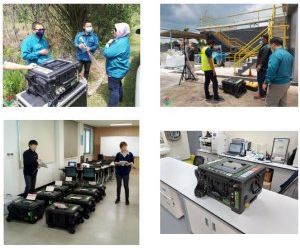
General Parameters
- Part Number: Shepherd FTIR
- Analyzer Type: Multi-gas portable point analyzer
- Technology: Fourier Transform InfraRed (FTIR) Differential Optical Absorption Spectroscopy (DOAS)
- Performance: Available with standard HAP (385 compound & 62 Compound), Criteria, Hospital and custom gas detection libraries.
- Data Output Rate: T90, Typically < 60s, depending on the gas flow and measurement time
- Measurement Principle: Beer-Lambert Law
- Measurement Technique: Classical Least Squares (CLS) regression analysis; optional Partial Least Squares (PLS)
- Operating Temperature: Short term 0°C to 40°C, long term 5°C to 30°C, non-condensing
- Storage Temperature: -20°C to 60°C non-condensing
- Power Supply: 100-115 or 230V, 50-60Hz
- Power Consumption: Average 120W; 300W max
- Instrument Cooling: Air cooled (optional thermoelectric air conditioner)
- Dimensions: 24.5" x 18.5" x 12" (62cm x 47cm x 30.48cm)
- Weight: 80 lbs (36.3kg)
Measuring Parameters
- Concentration measurement accuracy: ± 2% Reading TYP
- Concentration measurement precision: ± 2% Reading TYP
- Interferent Mitigation: Real time spectral subtraction and residual subtraction, multi-peak analysis.
- Zero point calibration: Simultaneous dual mode natural zero and/or synthetic zero on gas by gas basis. Automated compound specific background selection.
Software
- Real Time Operating Software: Cerex Continuous Monitoring Software (CMS)
- Operating System: Windows 10 Pro
- Post Collection Analysis Software: Cerex Data Processor
- Operating System: Windows 7, 8, 10
Spectrometer
- Apodized Resolution: User selectable: 0.5 cm-1, 1 cm-1, 2 cm-1, 4 cm-1, 8 cm-1, 16 cm-1, 32 cm-1
- Scan frequency: 6 scans/s @ 32 cm-1
- Detector: Stirling Cooled MCT (standard)
- TE Cooled MCT (application dependent)
- Detector temperature: 77 K (Stirling cooled MCT)
- Source: SiC, 1550K
- Beamsplitter: ZnSe (standard)
- Window material: ZnSe (standard)
- Wavenumber range: 600-4200 cm-1
- Temperature stability: < 1% per C°
- Frequency repeatability: < 0.001 cm-1 @ 1918cm-1
- Frequency accuracy: < 0.06 cm-1 @ 1918cm-1
- Short term stability: < 0.09%
- Maximum signal to noise ratio: 50,000: 1 (RMS, 60s, 4 cm-1, at peak response)
- Signal sampling: 24-bit ADC
Internal Quality Assurance Cell
- Quality Assurance Hardware
- Type: Internal linear multi-pass cell permanently mounted in beam path. External window removable.
- Calibration gas inlet: Quick Connect QA Adapter: 1/4" Swagelok
- Calibration gas outlet: Screw-in Exhaust Adapter: 3/8" Swagelok
- Path Length: 19.2 m
- Volume: 3.4 L
- Maximum sample pressure: 1 PSI
- Pressure and temperature measurement: Integrated pressure and temperature sensor
Integration
- HMI: Touchscreen (standard model)
- Digital Interface: RJ45 Ethernet LAN Port for local or internet based remote data and access using MODBUS TCP, VNC, and remote desktop. Spectral data may be stored locally, on a NAS, or disabled. Industrial external wireless option available. Type A USB for data retrieval and peripheral accessories.
- Power Connection: Environmentally sealed circular Amphenol bayonet connector.
- Integrated Computer: Embedded industrial PC
Options
- Integrated Wind Mapping: Three dimesnional ultrasonic anemometer with temperature measurement. Data integrated into CMS data tables and available via MODBUS.
- Integrated Data Acqusition: External ports with data integration for particulate or ancillary co-located analyzers (TDLAS laser, electrochemical, etc.).
- Data Output: MODBUS over RS-232, RS-485. MODBUS over TCP-IP is standard.
- Analog Output: 8 channel configurable 0-24mA (4-20mA with extended range)