

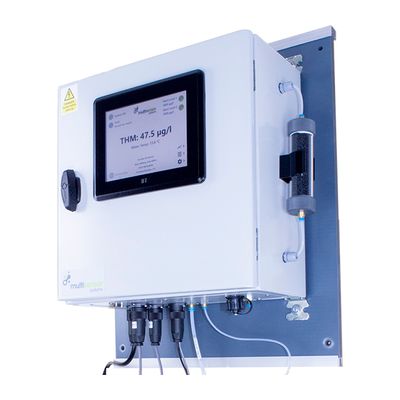
Multisensor - Model MS2000 -Online Trihalomethane (THM) Monitor and Analyzer
The MS2000 is a Trihalomethane on-line analyzer which provides measurements of THMs at low concentrations in water. Regulations limiting the levels of Disinfection By-Products (DBPs) such as Trihalomenthanes (THMs) in drinking water have made the ability to measure DBP levels throughout the distribution network essential. Multisensor’s THM analyzer provides that facility, efficiently and accurately.Measuring Total THMs with an accuracy of +/-10%*, the MS2000-SYS provides the confidence that is needed in a process control instrument which is vital in meeting regulatory and legal requirements. It is designed to:
- Analyze THMs post treatment
- Monitor THMs in the distribution network
- Monitor THMs post-chlorination for enhanced process control
- No sensor contact with water: low maintenance, no sensor cleaning
- NO REAGENTS: low running costs
- The most cost effective solution
- High sensitivity: ideal for potable water
- Alarms to SCADA and other communication interfaces
Trihalomethanes (THM) are a group of four chemicals that are formed along with other disinfection by products when chlorine or other disinfectants used to control microbial contaminants in drinking water react with naturally occurring organic and inorganic matter in water.
The THMs are Chloroform (CHCl3), Bromodichloromethane (CHCl2Br), Dibromochloromethane (CHClBr2), and Bromoform (CHBR3). National regulatory bodies set limits for the level of THMs in drinking water which, in most countries, are tested on a regular basis at the customer’s tap.
They are Cancer Group B carcinogens (shown to cause cancer in laboratory animals). Chloroform is by far the most common in most water systems. Dibromochloromethane is the most serious cancer risk, (0.6 µg/l to cause a 10-6 cancer risk increase) followed in order by Bromoform (4 µg/l), and Chloroform (6 µg/l).
THM levels tend to increase with pH, temperature, time, and the level of "precursors" present. Precursors are organic material which reacts with chlorine to form THM`s. One way to decrease THM`s is to eliminate or reduce chlorination before the filters and to reduce precursors. There are more precursors present before filtration, so it is best to reduce or eliminate the time chlorine is in contact with this water.
The US EPA, for example, has indicated that the best available technology for THM control at treatment plants is removal of precursors through "enhanced coagulation". Enhanced coagulation refers to the process of optimizing the filtration process to maximize removal of precursors. Removal is improved by decreasing pH (to levels as low as 4 or 5), increasing the feed rate of coagulants.
- Spec: Value
- Range: 0 – 200 ppb in water
- Accuracy: +/-10%
- Repeatability: +/-2%
- Sampling Frequency: 60 Minutes
- User Interface: 8" resistive touchscreen
- Data Storage: µSD Card and Internal Memory
- Data Interface: 4 – 20 mA and USB (Standard); Profibus, Modbus, Wireless (Optional)
- Alarms: x2 Via Relay Drivers, Levels User Definable
- Ambient Temperature : 0 °C– 50 °C
- Water Temperature Range: 1 °C – 40 °C
- Power Consumption: 25 W Continuous (90-240 VAC or 24 VDC)
- Reagents: None
- Carrier Gas: None
- Consumables: Air Filter Contents (Active Carbon), Dust Filters