


- Home
- Companies
- W&L Coating Systems GmbH
- Products
- W&L - Model NCS-12 / NCS-48 - Nano ...
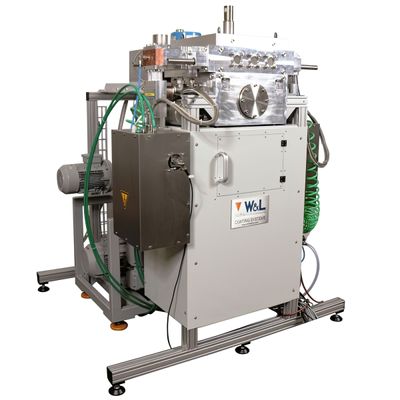
W&L - Model NCS-12 / NCS-48 -Nano Crystalline System
The NCS (Nano Crystalline System) platform is designed for advanced vacuum plasma chemistry processes with a focus on nano crystalline diamond deposition. Utilizing microwave plasma-enhanced chemical vapor deposition (PECVD), the system ensures high deposition rates across large areas by employing linear coaxial plasma lines. The NCS machines feature water-cooled aluminum frames, stainless steel cladding, and tailored process gas systems. The vacuum pump configurations typically involve a two-stage dry pump system, combining Scroll or Screw pumps with Roots blowers. System control leverages Siemens PLC communication via Profibus/Profinet, ensuring operational stability. Optical emission spectroscopy (OES) facilitates long-term process monitoring. The NCS 12-200 model, a versatile research tool, offers 12 kW of microwave power and can be pulsed up to 100 kHz, suited for developing microwave PECVD thin film processes. The NCS 48-620/1000 is tailored for mass production, featuring 48 kW of microwave power and 16 linear coaxial plasma lines for coating large rectangular substrates. The platform's modular design, integrated heating solutions, and precise microwave power management optimize production efficiency.The NCS (Nano crystalline system) platform for vacuum plasma chemistry processes in general and the depositon of nano crystalline diamond in particular
The key approach to obtain and secure high deposition rates by microwave plasma enhanced chemical vapour deposition over large areas much larger than the wavelengths of the microwaves always has been the linear coaxial plasma lines described in the PECVD section.
All NCS machines are based on this core technology. Usually, the number of parallel linear coaxial plasma lines arranged in planar arrays is chosen so that a certain substrate carrier area is well covered in plasma. It currently ranges from 4 lines for a round 8 inch substrate carrier to 16 for a 0.6 square meter rectangular substrate carrier.
All NCS machines are built from water cooled, deep-hole drilled aluminium frames with stainless steel cladding of all inside surfaces. They all are equipped with suitable process gas introduction and distribution systems. Vacuum pump systems usually consists of a two stage dry pump arrangement using a Scroll or Screw pump in combination with a roots blower.
All NCS machines enable the setting of a desired process pressure and the mass flow rates of process gases independent from each other. System control over extended periods of time is secured by Siemens plc communication with all system components by Profibus/Profinet and hardware interlocks according to international standards. Optical emission spectroscopy (OES) of the plasma appears to be the ideal tool for long term process control.
With emphasis on versatility rather than economy this system has been designed for the development of microwave PECVD thin film processes. A total of 12 kilowatts of microwave power supplied by two 6 kW, 2.45 GHz microwave generators, either magnetron or GaN semiconductor based, is rather excessive for a circular substrate carrier of 8 inch but avoids power starvation in any case.
Microwave power can be introduced as pure c/w but also pulsed up to 100 kHz. Pulsed power at reasonable pulse frequencies not only helps to reduce thermal losses of plasma processes but may also provide a different kind of plasma chemistry.
Since NCS type processes are best in a vacuum pressure range between 0.1 and 0.4 hPa the thermal impact of plasma discharges may not be sufficient to sustain substrate temperatures between 650 and 700°C as would be necessary for the formation of nano crystalline diamond layers. Additional heating from underneath the substrate carrier plate by coaxial type infrared heater wire in a helical arrangement is therefore available. If necessary, the IR heater can be replaced by a water cooled copper block to keep the substrate temperature down.
The substrate carrier plate itself, usually made from molybdenum, can rotate during the process to level out process imperfections. The entire heater stage can be vertically elevated or lowered to adjust the crucial distance to the coaxial plasma lines. The substrate carrier plate can be electrically grounded but can also float or be subjected to a DC of AC bias voltage up to 600 Volts.