


- Home
- Companies
- HYKO Technologies
- Products
- HYKO - Non Contact Type Radar Level ...
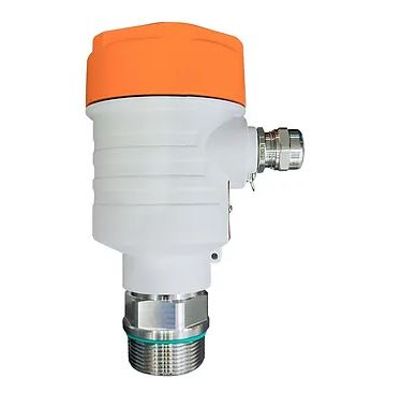
HYKO - Non Contact Type Radar Level Meters
Radar level transmitters, also known as radar level sensors, use radio waves to measure the level of liquids and solids. They consist of a radar antenna, a transmitter, and a receiver.
Design: A radar level transmitter typically consists of an antenna, which sends out a radar signal, and a transceiver, which receives the reflected signal. The antenna is mounted on the top of the tank or silo and is usually made of plastic or metal. The transceiver is typically located near the bottom of the tank or silo and contains the electronics needed to send and receive the radar signal.
Working Principle: The working principle of a radar level transmitter is based on the time of flight (ToF) principle. The radar antenna sends out a high-frequency radar signal, which travels through the air to the surface of the liquid or solid. The radar signal is then reflected back to the antenna, and the time it takes for the signal to travel to the surface and back is measured. This time is used to calculate the distance between the radar antenna and the surface of the liquid or solid. The distance is then converted into a level measurement.
Radar level transmitters are designed to operate in a variety of environments, including high-pressure and high-temperature applications. They are also suitable for use in environments with heavy dust or steam, as the radar signal is not affected by these conditions. Additionally, radar level transmitters are not affected by the dielectric constant of the material being measured, which allows them to measure level of various materials.
In summary, the design and working principle of a radar level transmitter consists of an antenna that sends out a radar signal, a transceiver that receives the reflected signal and the time of flight principle to calculate the distance between the radar antenna and the surface of the liquid or solid, thus providing level measurement. They are suitable for harsh industrial environments and can measure level of various materials.
- Application: All kinds of corrosive liquid, Solids
- Measuring Range:10 meters to 100 meters (Max)
- Process Connection: Thread, Flange
- Medium Temperature: -40? ~ 120?, High temp up to 106 Deg C is also available up on request
- Process Pressure: -0.1~0.3 MPa
- Accuracy: ± 5mm
- Protection Grade: IP67
- Frequency Range: 26GHz / 80GHz (FMCW)
- Signal Output:4... 20mA/HART (Two-wire / Four)
- RS485/ Modbus (Optional)
- Explosion-proof Grade: Exia ?C T6 Ga
Non-contact radar level transmitters have several benefits that make them a popular choice for industrial level measurement applications. Some of these benefits include:
- High accuracy: Non-contact radar level transmitters are highly accurate and provide precise measurements of the level of liquids and solids.
- Long-range measurement: They can measure level over long distances, making them suitable for use in large storage tanks and silos.
- High pressure and temperature capability: They can handle high pressures and temperatures, making them suitable for use in harsh industrial environments.
- Immunity to dielectric constant: They are not affected by the dielectric constant of the material being measured, allowing them to measure level of a variety of materials.
- Immunity to environmental factors: They are not affected by environmental factors such as foam, dust, or steam, which makes them suitable for use in harsh industrial environments.
- Low maintenance: They require minimal maintenance, making them cost-effective over time.
- Easy to install: They are easy to install and can be integrated into existing process control systems.
- Remote monitoring: They can be connected to remote monitoring systems, which allow for real-time monitoring and control of the process.
In summary, non-contact radar level transmitters are a suitable solution for industrial level measurement applications, providing high accuracy and long-range measurement in harsh environments, while also being low maintenance and easy to install.
Radar level measurement technology can be used in a wide range of industrial applications, including:
- Storage tanks and silos: Radar level measurement is suitable for use in large storage tanks and silos, as it can measure level over long distances. This makes it ideal for measuring the level of liquids and solids in tanks and silos used in the oil and gas, chemical, and food and beverage industries.
- Process vessels: Radar level measurement can be used to measure the level of liquids and solids in process vessels, including reactors, distillation columns, and crystallizers.
- Bulk solids: Radar level measurement can be used to measure the level of bulk solids in hoppers, bins, and chutes. This makes it suitable for use in industries such as mining, power generation, and cement production.
- Open channels: Radar level measurement can be used to measure the level of liquids in open channels, such as rivers, canals, and dams.
- High pressure and temperature applications: Radar level measurement can handle high pressures and temperatures, making it suitable for use in harsh industrial environments. This makes it ideal for use in applications such as high-pressure boilers, autoclaves, and pressure vessels.
- High-accuracy applications: Radar level measurement is highly accurate and provides precise measurements, making it suitable for use in applications that require high-accuracy level measurement, such as in laboratories and research facilities.
In summary, radar level measurement technology is versatile and can be used in a wide range of industrial applications. It is suitable for measuring the level of liquids and solids in storage tanks and silos, process vessels, bulk solids, open channels, high pressure and temperature applications and high-accuracy applications.