

OilGone - Model S-200 -Liquid Use in Domestic, Industrial and Nautical
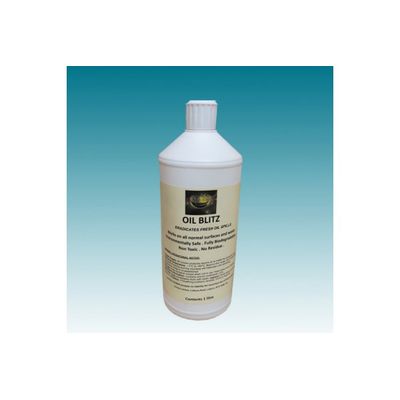
A proactive liquid that chases down and bonds with spilled oils and fuels, taking it inside its matrix where the pollutant is eradicated in situ with no toxic residue. For domestic, industrial and nautical use. Plant & animal friendly. Completely eliminates the need for expensive oil spill disposal and storage at long term toxic oil dumps. Whether it is domestic heating oil spills, diesel fuel spills on roads, airport runways, railroad tracks, oil spillage generated during production, transportation, or storage, coastal or inland waterway fuel spills or marine bilge maintenance, S-200 offers a cost-effective and safe natural solution.
- Exxon searched the globe for a biotechnological solution to the Valdez spill.
- French Petroleum company ELF AQUITAINE was developing a bio remediation product called INIPOL EAP-22.
- After extensive tests Exxon purchased INIPOL EAP-22 to remediate the contaminated coastline.
- Elf Petroleum was purchased by TOTAL Petroleum who rationalized their operations and folded the bioremediation chemical sales group of the AQUITAINE division.
- Head Chemist at ELF AQUITANE was Jim Lynn, founder of International Environmental Products ( IEP).
- Jim Lynn has in recent years developed the concept further to produce S-200 – OilGone.
S-200 Oilgone® is a bioremediation accelerator. It is used for the remediation of hydrocarbon spills or leaks. It is made from completely natural products – the base product being fish oil – is inert and non-toxic.
In April 2016, S-200 Oilgone® was listed on the product schedule of the US Environmental Protection Agency Approved List. It has also successfully passed all tests to be classified as a GREEN product according to OSPAR HOCNF standard for use in the marine environment (Convention for The Protection of The Marine Environment of the North-East Atlantic).
S-200 Oilgone® is a non-intrusive, cost-effective remedy for the clean up of hydrocarbons including petrol, diesel, oil, jet fuels, kerosene, lubricating oils, hydraulic oils and crude oils.
As a completely natural product, S-200 Oilgone® adds no ‘foreign bacteria’ to the ecosystem, the like of which are generally found in detergents and chemicals. Unlike other remediation products, S-200 Oilgone® requires no special solutions, no special mixing and no waiting period before application. Applying S-200 Oilgone® to the hydrocarbon spill or leak activates the product and starts growing the indigenous, hydrocarbon degrading microbes. It can be used in situ, resulting in reduced costs and eliminating hazards associated with transporting contaminated materials.
S-200 Oilgone® has proven to bioremediate almost 100% of hydrocarbon spills on solid ground is as little as 24 hours.
When there is a hydrocarbon spill Slick Solutions can provide a service to bioremediate the spill in situ, on land or on water. Slick Solutions will spray the hydrocarbon spill with S-200 Oilgone®, covering the spill with one litre of S-200 Oilgone®to one litre of the oil spill. Within a couple of minutes, the hydrocarbon and S-200 Oilgone® start to bond and the liquid on the ground starts to turn a milky white. What has happened is that the hydrocarbon has been absorbed by or encapsulated inside the S-200 Oilgone® – taken inside the matrix – and the process of breaking down the diesel has already started.
Trapped inside the matrix with the diesel are microbes – microorganisms that exist in oxygen in the air – that will eat the diesel. The inside of the matrix is like a greenhouse, which helps the microbes to multiple at many times the normal rate, and therefore the process of breaking down the diesel into its constituent parts – CO2 and H2O – will happen at many times the normal rate.
After 10 minutes or so, take a bucket of water or a hose and wash the milky white liquid away into the nearest drain. All of the diesel spills will have been absorbed by the S-200 Oilgone®, and the ground will be completely clean and free of any diesel residue. The milky white liquid is completely inert and environmentally safe to wash away.
The matrix with the hydrocarbon inside will continue to work until all of the diesel has been remediated – approximately 24 hours.
When a hydrocarbon is spilt on water, it is highly obvious – floating on the surface, a blue-green sheen clearly visible. This makes the testing of the water redundant – there is oil on the surface that needs to be treated.
When applied to an oil spill on water, S-200 Oilgone® will not mix with the water and become diluted. Within a minute it attaches to the hydrocarbon, bonding with it and creating a matrix – an agglomerated gel- that remains on the surface and cannot sink, no matter what the weather conditions. By bonding with the hydrocarbon, S-200 Oilgone® does not allow the hydrocarbon to disperse or sink. The motion on the surface of the water creates the optimum conditions for microbes, trapped in the matrix, to start the bio-remediation process. The microbes multiply very rapidly in the matrix – a greenhouse effect – rapidly eating the hydrocarbon until it is all gone. Depending on the type of oil this process can take from 12 to 36 hours.
The product has been tested thoroughly. Building on the success of the largest bioremediation project in history (Exxon Valdez, 70 miles of shoreline) and the Prestige Spill bio-remediation, the technical mechanism and its advantages were clearly seen as our products became the premiere products used in the spill clean up. What’s more, S-200 Oilgone® required only one application, not the multiple applications required by other technologies.
When soil or sand has been contaminated by hydrocarbons, there is a requirement to analyse the site to determine the extent of the spill – how wide and how deep is the contaminated area, where has the oil plume gone to, and how contaminated is the soil based on a Parts Per Million analysis (PPM)
A number of soil samples are taken from around the contaminated area and sent to a laboratory for analysis, to determine the concentration of the hydrocarbons in the soil. The results will indicate to what extent each area of the site needs to be treated, if at all.
S-200 Oilgone® allows contaminated soil to be treated in situ, with bioremediation results of over 99%. The process is as follows:
- The extent of the contamination is determined by taking some trial hole samples
- If the extent of the contamination is less than 20cm deep, the soil is rotavated and S-200 Oilgone® sprayed until the soil is moist.
- If the contamination is deeper than 20cm, the contaminated soil will be excavated and spread in 3m x 3m grids, to a depth of 10cm, and sprayed
- The S-200 Oilgone® immediately starts to bond with the hydrocarbon in the soil, encapsulating or absorbing it. The bioremediation process starts immediately.
- After one week, the area would be rotavated once again to allow oxygen to get at the soil under the surface.
- Further samples will be sent for testing and will illustrate a significant reduction in the PPM
- The entire process will take between one and four weeks depending on the extent of the contamination with results of 99% and better expected
- No contaminated soil needs to leave the site, meaning significant cost saving for the customer