


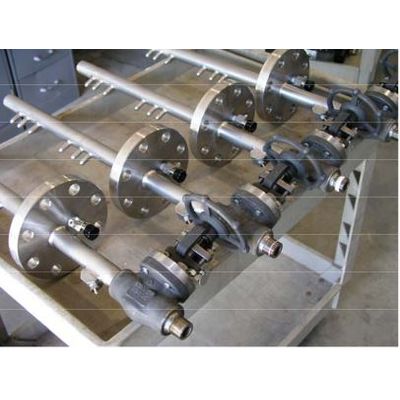
Thermochem - On-Line Steam Quality and Purity Instruments
Process and turbine inlet steam contains impurities, such as silica, sodium, chloride, iron and solid particulates, which can cause corrosion, scaling and erosion of power plant equipment, especially steam turbines. Impurities such as sodium, chloride and silica may be present as dissolved species in liquid water, or as particulate material, such as solid NaCL Volatile silica and chloride may exist in high-temperature or superheated steam, but dissolves rapidly in liquid water. In order to determine the amount of these impurities in steam, isokinetic sampling is required. The isokinetic steam sampling system incorporates a probe with isokinetic nozzles to obtain representative steam samples across the pipeline diameter. Isokinetic sampling minimizes errors due to non-representative collection of particles and droplets relative to the bulk vapor phase.
Thermochem`s Multi-Nozzle Isokinetic Probe & On-line Analyzers
Thermochem has designed a Multi-Nozzle Isokinetic Sampling Probe (MNP2000) for steam quality and purity applications- The probe can be interfaced to the Thermochem Vacuum-Jacketed Calorimeter (SQ2000) for online steam quality monitoring, and/or to our sample conditioning system (SSCC) for steam purity monitoring analysis.
Key design features and benefits of the Thermochem Multi-Nozzle Isokinetic Sampling Probe include:
- A profile composite of steam and entrained liquid by obtaining a true weighted average of 6 or more points across the pipeline.
- Multiple knife-edged nozzles are raised above the probe shaft and protrude into the steam flow where the sample can be extracted isokinetically with minimal flow disturbance.
- The probe shaft is off-set towards the steam flow to minimize flow disturbances bv the flanae assembly.
- The internal probe bore has a stepped diameter to maintain a constant, high sample velocity through the probe. This minimizes liquid hold-up and loss.
- Fully compliant with ASME PTC 19.11 for Steam Sampling and Analysis in the Power Cycle
- Superior to ASTM D1066-97 probe which suffers from stagnation boundary effects due to poor aerodynamic design, and a large internal bore causing sample hold-up and deposition of impurities.
- Superior to ASTM D1066-06 (EPRI/Jonas Single-Nozzle probe) which only collects from a single point near pipe wall and cannot obtain a representative profile of wet steam across the entire pipe diameter.
As Shown below from actual data collected at a power plant, multiple-point sampling (by a traversing probe) can produce data substantially different from the EPRI/Jonas Single-Nozzle probe which is plotted to the far right, compared to the profile average across pipeline. Multiple-point sampling produces equivalent results to the Thermochem Multi-Nozzle fixed sampling probe.