

- Home
- Companies
- Daliform Group Srl
- Products
- Daliform - Model Iglù® - Permanent ...
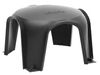
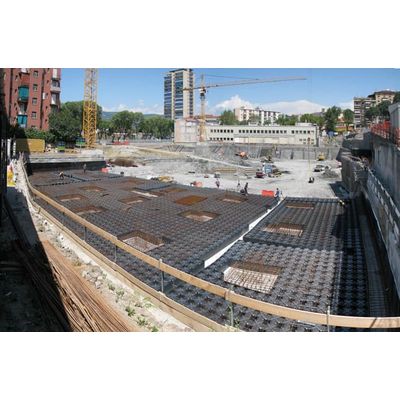
Daliform - Model Iglù® -Permanent Formwork for Ventilated crawl spaces
Iglù® is a market leading product that was created and patented for the realisation of sanitary spaces, ventilated cavities, under-floor cavities, ventilated floors and roofs during the construction and restructuring of civil and industrial buildings. This result of an ingenious idea dating back to 1993 considerably improved building methods. The innovative capacity of Iglù®; has received numerous successes and recognitions on a national and international level, quickly confirming it as a product of excellence in the building world.
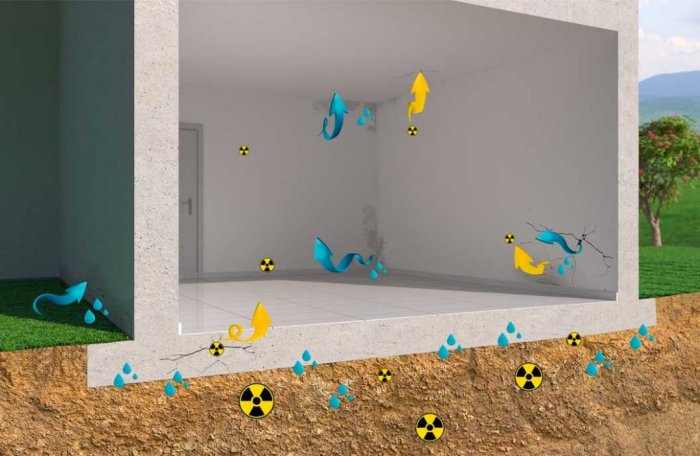
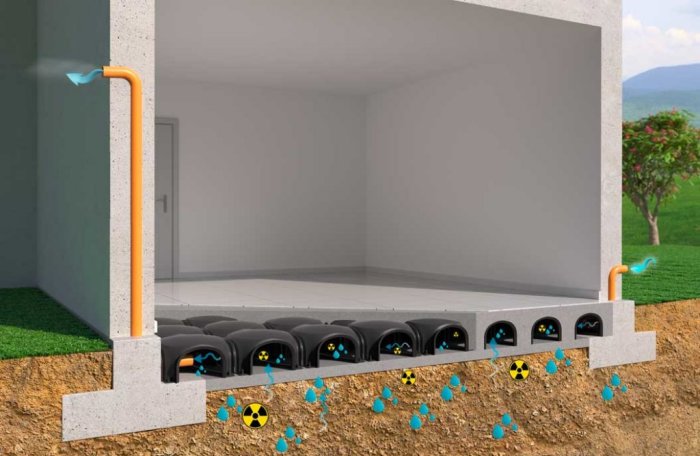
The modular Iglù® formwork made of recycled plastic, placed side by side in a pre-defined sequence, makes it possible to quickly create a self-supporting pedestrian platform, on which a layer of Iglù® is poured, in order to easily and economically create a ventilated slab resting on columns, with the cavity underneath available for the passage of systems, but above all ventilated to counteract rising damp and radioactive gases.
A ventilated under-floor cavity created with Iglu’® represents an effective, quick and economic solution that makes it possible to send humidity and dangerous Radon gas to the atmosphere, which is beneficial to our health. The air cavity formed by the Iglù® modules must be connected to the outside with simple pipes. This creates a natural air flow that crosses the cavity and eliminates moisture and Radon gas (if present).
- Reduction of manpower requirements by up to 80% in comparison to traditional systems.
- Drastic reduction in the use of concrete and aggregates as the arch form permits maximum resistance with a minimum thickness.
- Possibility to implement, in a single solution, foundation beams and the slab with the help of the L-Plast accessorie.
- Adaptable to non-standard spaces as the modules can be cut without underpinning.
- Ease of positioning due to lightness and simple linking of the modules.
- Simple adaptation to various perimeters.
Quick and immediate cutting and shaping of the modules. - Passage of the underground systems in every direction.
- Creation of a barrier against humidity.
- Tightness against rising humidity.
- Effective ventilation in all directions.
- Disposal of any RADON gas.
- No point of contact between the concrete and the ground.
- Perfect transpiration of the perimeter wall.
- BBA – Technical Approvals for Construction.
- Technical Construction Certificate issued by the Technical and Test Institute for Constructions Prague (Czech Republic).
- Technical Construction Certificate issued by the Agency for Quality Control andInnovation in Building (Hungary).
- Hygienic Certificate issued by the National Institute of Hygiene (Poland).
- Acoustic check for the verification of DIN standards.
- Avis Technique issued by the French institute CSTB (member of EOTA – European Organisation for Technical Approvals).
- Rupture load tests certified by the University of Padua.
- GHOST-R Certificate of conformity about quality and safety of products (Russia).
- Member of the Green Building Council Italia.
- Environmental Compatibility Certification (CCA).
- System certification pursuant to EN ISO 9001 – EN ISO 14001 – SA Standard 8000.
- ,Plastic Second Life Mix Eco
Dry assembly method
- Position the first element to the upper left with respect to the work surface, making sure that the arrow is pointing up.
- Unite the elements in sequence, by horizontal row, proceeding from the left towards the right and from the top downwards (following the direction normally used for writing), as shown graphically on the crown of each unit.
- To unite the units in sequence, be careful to perfectly link the “male-female” hooking elements at the base of the support feet (see photo sequence.
- Preparation of the natural ground.
- Preparation of the lean concrete foundation, to be sized according to the loads and capacity of the ground.
- Positioning the L-Plast panel around the foundation beams after positioning the necessary reinforcements.
- Positioning the linking male/female formworks, working from the left to the right, from the top down, making sure the arrow is facing upward.
- Laying the welded mesh Ø 6 20×20 above the formworks.
- Casting the concrete starting from the centre of the arc, letting it go inside the legs of the Iglu’®.