


- Home
- Companies
- Deep Green
- Products
- Physico-chemical Treatment Unit
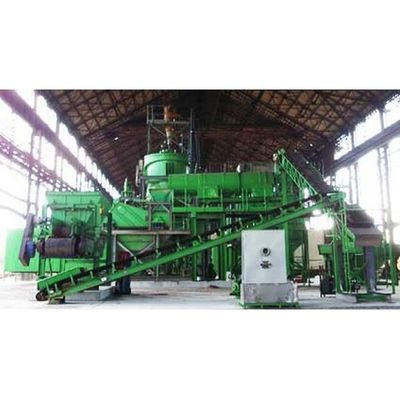
Physico-chemical Treatment Unit
The physico-chemical treatment is a separation treatment by particle size, gravimetric and magnetic sorting. The contaminants adsorbed on the fine particles, previously separated from the coarse particles, are transferred to the aqueous phase and the treatment consists of a concentration of the pollutants in a small volume of soil (the most polluted) thanks to the separations and attritions used in the particle size separation: pre-screening or Physico-chemicalcalibration, magnetic separation, disintegration unit or sludge trap, screening, hydrocycloning, density separation, gravity separation by sedimentation, filtration and dehydration of fine particles. The goal is to separate as much as possible the fine fractions containing the most of the pollution.
At the end of the physico-chemical treatment, the treated materials are separated into 5 classes of elements: gravel (> 4 mm), sands (from 63 µm to 4 mm), fine particles (
The operations carried out by the physico-chemical treatment unit are as follows:
- the removal of any remaining scrap which would not have been discarded during the preliminary screening operations;
- disintegration or settling: this step consists of adding water to the treated materials, which disintegrates and fluidifies them; the settling thus allows the separation of the fine particles agglomerated to the coarser particles;
- screening: this is carried out using vibrating screens and makes it possible to separate particles with a particle size greater than 4 mm;
- hydrocycloning: this is a separation technique based on the difference in mass of the particles; the spinning drives the heavy particles to the lower outlet while the light particles are directed to the upper outlet;
- backwashing: the water laden with particles is directed to a gravity separator through which a countercurrent passes making it possible to keep the fine particles in suspension with a view to their recovery and to allow the heaviest particles to settle;
- decantation: it allows the fine particles to be agglomerated by means of surfactants (a polymer) ensuring a first separation between sludge and treatment water;
- filtration and dehydration: the filters make it possible to recover the finest particles, which are then dehydrated using a press belt filter, ultimately producing filter cakes.