
- Home
- Companies
- PID Analyzers, LLC
- Products
- PID Analyzers - Model 103+ - ...
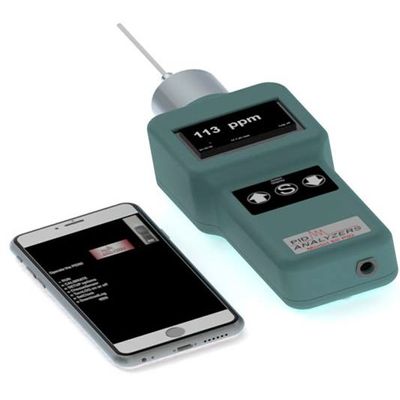
PID Analyzers - Model 103+ -Photoionization (PID) Analyzer for VOC’s (PPM & PPB)
Photoionization (9.5, 10.0, 10.6, 11,7 eV ppm, ppb), Infrared CO2 CH4, N2O, Electrochemical -H2S, CO , HCN, Cl2, PH3, AsH3, ETO, formaldehyde... PID ppm/ppb + 4 more sensors 6 sensor PID. From the developers of the first PID in 1974.
VOC’s ppm, benzene, 1,3 BD, ETO, TCE, PCE, VCM, THC, H2S, NH3, 1,3 BD, Hg, others: hundreds of VOC`s.
Hydroarbons, VOCs, LEL (IR), IR {CH4, CO2, N2O,} CO2, H2S, ETO, NH3, PH3, AsH3, benzene, TCE, PCE, 1,3 butadiene, TCA, Formaldehyde
Model 103 - PID -Analyzer for Total VOCs & Hydrides in Air & Water
HNU Systems, Inc. introduced the first commercial photoionization based instrumentation in 1974. In 2003, the company name and incorporation was changed as we became PID Analyzers, LLC. Nearly 50,000 of the portable and and laboratory PIDs have been sold throughout the world. Dr. Jack Driscoll, inventor of the PID, received the AIHA Edward Baier award in 2017 (https://bit.ly/2rRG6M8) for the development of the PID for industrial hygiene measurements. More than 50 United States Environmental Protection Agency and Occupational Safety & Health Administration (OSHA) methods have been published in the Federal Register. Many states have adopted these methods for VOC’s.
Principle of Operation
The process occurs when a molecule absorbs light of sufficient energy to ionize a molecule see below:
RH + hv = RH+ + e-
where
RH is a molecule of gas
hv is a photon with an energy greater than or equal to the ionization potential of the molecule RH.
The ultraviolet lamp generates photons that ionize the molecule RH (above) and generates positive ions. An accelerator electrode (positively biased) pushes the ions, to the collector electrode where the current (proportional to concentration) is generated, amplified and displayed on the digital meter.
PID -VOC’s ppm
- PID (9.5, 10.0, 10.6, or 11.7 eV) lamp easily interchangeable by customer
- Battery 3.7V LiPO UN 38.3 passed, w charger
- Display: bright 2.4” OLED
- Controls: Menu with Cal, QC,
- Range: 0-1,000.0 ppm, 1-25,000 ppb
- Resolution 0.1 ppm/1 ppb
- Size: 6 ½” L, 2.75" W, 1.75" H
- Weight: 1.0 #
- Communication: WiFi, Blue tooth, RS232
- Real time clock
- Data collection on server or PC: Data-Date, Time, Concentration
- Link to IPhone/Android
- Internal Memory:>100,000 points
Humidity correction for RH up to 90%
Applications:
- Non-specific- M60 PID- Responds to VOC’s & inorganic hydrides
- Safety, Industrial Hygiene surveys.
- Accelerants at Arson scenes, Hazardous waste spills and site evaluations, transportation, Total VOC’s in Air, Water and Soil
- Inorganic hydrides: H2S, NH3, PH3, AsH3
- Semiconductor plant leaks of PH3, AsH3
- Mercaptans in air and water
- Mercury in air or water
- Headspace- VOCs in soil or water
- Quality control- residual monomer in resins, residual solvents in paper or food, testing gas masks, residual gases in cylinders
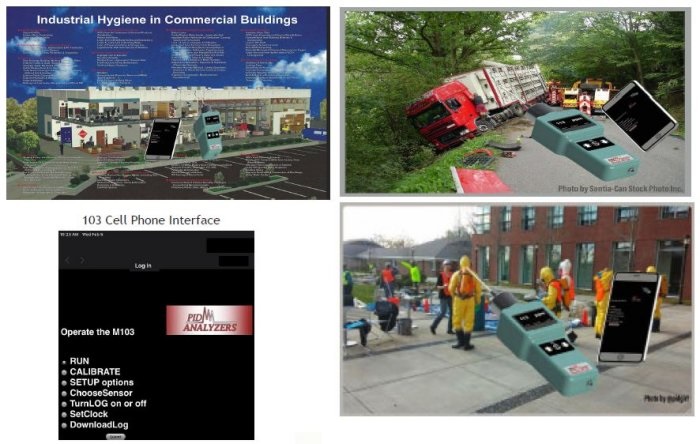
- Emergency response- spills from trucks & trains
- Fugitive emissions- leak detection
- Arson investigations- find trace accelerants
- Confined space entry- health & safety
- In addition, a library of compounds > 300 for the 9.5, 10.6 and 11.7 eV is available for selection by the customer.
Options
- IR sensor for CO2 ppm or %
- or IR sensor for CH4 ppm or %
- Electrochemical sensor - 2 or 3 selectable sensors
- Hard Carrying case
- Calibration kit (cal gas plus regulator)
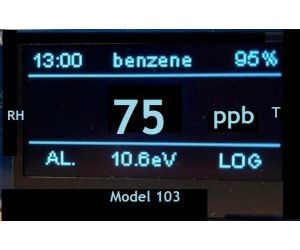
The 3 button display has a select button in the middle and up and down arrows to change the menu position.The menu selection is: The startup display has the lamp, compound set as, PPM VOC, Log on/ Off, Battery %, & alarm info The Run display has a larger ppm reading lamp info and respond as Calibrate- press select (S) to enter and calibrate with zero filter and span gas, The user is asked to connect the gases and when to press S The Library has selection for 9.5, 10.6 or 11.7 eV lamps and separate libraries for each lamp.
Isobutylene is used as the cal gas, then the Respond As will give the response the the gas of choice Background zero is used to set the background air to zero Setupfor lamp type,alarm, or additional IR or EC sensor The Model 103 has a 2.40" bright OLED display as shown below: