

- Home
- Companies
- ULTRAPAVE Corporation
- Products
- Polymeric Aggregate Treatment System
Polymeric Aggregate Treatment System
Performance, from an economic point of view, has been one driving force toward improving asphalt and paving technology. Finding an environmentally friendly solution has become a significant objective. These two factors have encouraged the development of polymeric treatment.
Research scientists and ULTRAPAVE®‘s formulators have been steadily advancing the use of polymers in hot mix asphalt pavements. They found that using polymers as an aggregate treatment enhanced water-proofing and adhesion.
ULTRACOTE® polymeric aggregate treatment is widely embraced as an important advance in enhancing pavement performance and resisting damage due to the ravages of weather and time.
The particles in ULTRACOTE® are extremely small (~0.5 microns). Their molecular structure allows them to cling together, and their diminutive size enables them to fill small cavities and weak spots in the aggregate.
The process is not unlike applying a primer coat before painting an object, such as a house or car. In a similar way, ULTRACOTE® improves bonding and protection for the aggregate that makes up a highway. The important characteristics of the polymer are that it is waterproof and has a high affinity for asphalt.
A CLOSER LOOK AT ULTRACOTE®
The following photomicrographs were prepared on an ElectroScan E-3 Environmental Scanning Electron Microscope (ESEM) at Western Research Institute (WRI) of Laramie, Wyoming. Since the early 1960’s WRI has worked with the Federal Highway Administration to clarify the chemistry of petroleum asphalt to enhance performance in roadways.
Here is a look inside ULTRACOTE® and its incredible properties:
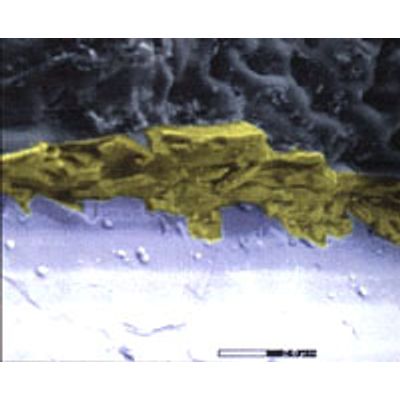
These pictures produced by the ESEM have been color highlighted to make it easier to identify the subjects. The aggregate (stone) is blue, ULTRACOTE® is gold, and the asphalt oil is black. The first ESEM photomicrograph shows the surface of aggregate coated with asphalt (upper left). The white scale bar represents 50 microns. For comparison, a 270 mesh sieve has an opening of 53 microns or .0021 inches.
The next ESEM photomicrograph is of the surface of aggregate coated with ULTRACOTE® (middle left). The white scale bar represents 50 microns. The largest stone is about 250 microns (60 mesh sieve size) and the other five large stones are about 100-125 microns (120-140 mesh sieve size).
This last photomicrograph (lower left) shows the outer edge of a cross-section of aggregate that was coated with 0.1% ULTRACOTE®, then coated with asphalt. During this exposure, an electron beam was focused on these three components to determine their reaction to the heat of the beam. The asphalt began to flow after a few minutes as depicted by the ropy looking texture. The ULTRACOTE® appears to be unaffected by the electron beam’s heat.