- Home
- Companies
- Porometer a Division of Aptco ...
- Products
- Poroliq - Model 1000 series - Liquid ...
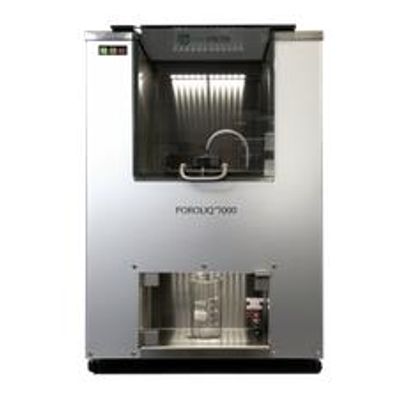
Poroliq - Model 1000 series -Liquid Liquid Porometer (LLP)
The POROLIQ 1000 is a Liquid Liquid Porometer (LLP). This rapid, precise method employed by the POROLIQ™ 1000 allows for testing of pore size down to 2nm and, compared to other techniques, uses lower pressures for characterisation of traditional micro-, nano-porous materials.
THE MOST ACCURATE LLP ON THE MARKET
- Based on the pressure step/stability method: a data point is only recorded when the user-defined stability algorithms are met for both pressure and flow.
- Detects the opening of a pore at a certain pressure and waits until all pores of the same diameter are completely opened before accepting a data point.
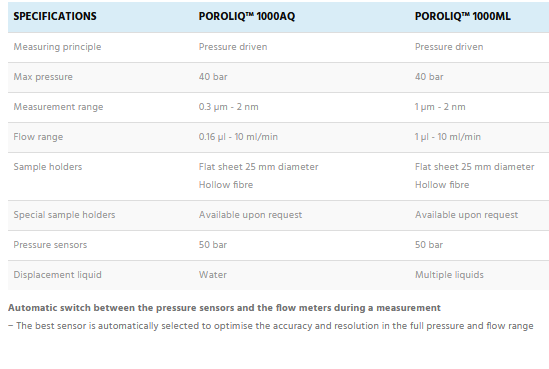
- The POROLIQ™ 1000AQ uses a combination of three ultrasensitive liquid flow sensors to measure exactly and accurately flow rates from 0.16 μl/min (to detect the displacement of wetting liquid out of the pores from the very beginning).
- Ideal for full characterization of hollow fibers at low pressures.
It is the first LLP equipment based on a pressure driven concept, which guarantees the maximum accuracy, especially when measuring pore sizes in the submicron range.
A measurement consists first of complete saturation of the porous membrane with a wetting liquid. The subsequent displacement of the wetting liquid from the pores is achieved by a second, immiscible liquid (displacement liquid). The pressure (P) required to expel the wetting liquid out of the pore depends on its diameter (D) as expressed by the Young-Laplace equation P=4*γ*cos θ/D , where γ is the interfacial tension betwen the wetting and displacement liquid. Typical interfacial tension values lie between 0.35 and 4 mN/m. This allows pores as small as 2 nm to be probed or, in comparison to traditional gas liquid porometry, for the use of more moderate pressures to test traditional submicron pore size ranges.
By measuring the flow rate of liquid thorugh the sample, a complete pore size distribution can be obtained.