


- Home
- Companies
- Brooks Automation
- Products
- Precise - Model PAVP6 - Collaborative ...
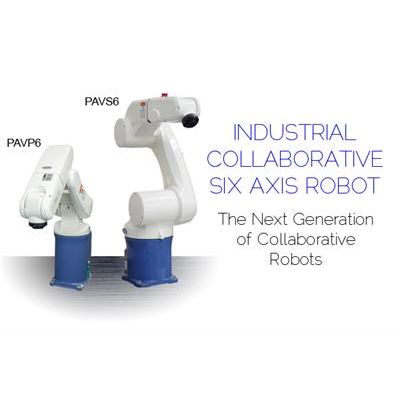
Precise - Model PAVP6 -Collaborative 6-Axis Tabletop Robot
The PAVP6 is a collaborative, tabletop six-axis articulated robot. The intrinsic collaborative capability of this robot permits it to be safely used next to people without requiring safety barriers, which are expensive, consume a great deal of bench/floor space, and obstruct access to equipment. Furthermore, all control electronics and power supplies are built into the robot`s base creating an extremely compact structure that eliminates extra controller cabinets, external harnessing and complicated installations and integrations. This space saving design combined with the robot`s collaborative aspects, low cost, reliable mechanism and excellent position repeatability make the PAVP6 an ideal choice for applications that require 6-axis capabilities and where size, safety and costs are critical.
Collaborative robots allow for the creation of a mixed manufacturing environment where people can enter and efficiently work around robots without the loss of throughput. However, whenever users are near, most "collaborative" robots must move slowly or use a reduced speed collaborative mode, thereby losing productivity. Precise`s six-axis robots are designed so they can be easily programmed to move at higher speeds in free space and to limit speeds when collisions against a rigid surface are possible. This allows for the robot to move at speeds similar to people, even when users are present in the workcell, while still limiting forces to the ISO collaborative robot standard. Thus, operators can move freely around the robot without concerns for their safety or reducing productivity.
To simplify setup for new users, many collaborative robots use a programming environment with limited features. Precise Automation`s collaborative robots offer the flexibility of both an easy-to-use web based interface as well as an optional advanced programming environment as capable as any industrial robot. The easy-to-use Guidance Motion interface is accessible from any web enabled device and allows technicians or operators to quickly and easily setup and teach the robot to perform real work. In addition, the powerful motion control enables the collaborative features without the use of expensive sensors providing industrial level performance at a cost less than other collaborative six axis robots.