


- Home
- Companies
- Optris GmbH
- Products
- Optris - Model PI 400i LT - Precise ...
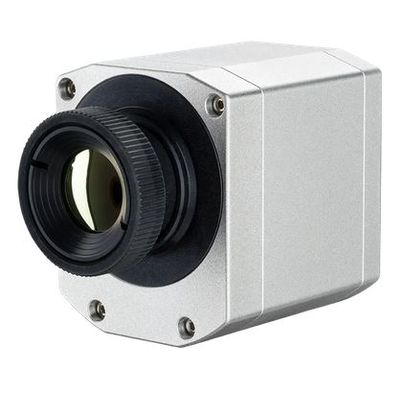
Optris - Model PI 400i LT -Precise Reliable Infrared Camera
The Optris PI 400i is a precise thermal camera designed for continuous industrial use. It measures from –20 °C to 900 °C. With a high-temperature option, the range extends to 1500 °C. The infrared camera operates in the 8–14 µm band for a very broad material coverage.
PI 400i thermal camera`s uncooled microbolometer offers 382 × 288 pixels. The frame rate is 80 Hz, so motion appears smooth. Moreover, the 17 µm pixel pitch supports precise spatial measurements at typical working distances. Interchangeable optics—from 18 × 14° to 80 × 54°—adapt the field of view to the task. Consequently, one thermal camera can serve both close-up and wide-area targets. Accuracy is ±2 °C or ±2 %, whichever is greater. Thermal sensitivity reaches 75 mK, depending on the lens. Therefore, the infrared camera resolves small gradients and transient events. In process monitoring, this helps detect early deviations. Integration is straightforward via USB 2.0. Alternatively, optional GigE with PoE simplifies single-cable installs. In addition, the process interface provides analog I/O and relay outputs. Thus, users can trigger alarms or close control loops directly from the thermal camera.
The thermal camera provides live visualization, statistics, and configurable alarms with the PIX Connect software. Furthermore, line-scan operation enables temperature profiling of moving products. Advanced users can employ SDKs for direct system integration or automation. Optional accessories extend the range of applications for harsh environmental conditions, for example, with the Cooling Jacket Advanced or the air-purge attachment.
The PI 400i’s capabilities are designed for continuous thermal monitoring in electronics assembly, plastics extrusion and calendering, materials and component testing, cable harnesses and electrical cabinets, and broader process engineering.
PI 400i Thermal Camera - Important Features:
- Temperature range: -20 °C to 900 °C - optional up to 1500 °C
- Spectral range: 8 to 14 µm
- Fast frame rate: 80 Hz
The Optris PI 400i is a high-resolution lass=”yoast-text-mark”>ref=”/products/category/thermal-cameras/”>infrared camera designed for continuous radiometric temperature monitoring in industrial settings. The thermal camera employs an uncooled focal plane array with 382 by 288 pixels, providing live thermal imaging at up to 80 Hz. The camera operates in the long-wave infrared spectrum from 8 to 14 µm, making it suitable for thermographic analysis of diverse materials and surfaces. Its combination of spatial resolution, temporal accuracy, and advanced software control allows process engineers and researchers to visualize temperature distributions, identify thermal anomalies, and implement automated alarms in closed-loop systems.
Performance is defined by a system accuracy of ±2 °C or ±2 %, and a typical thermal sensitivity of 75 mK with wide-angle optics. With the narrow 18 by 14° lens, sensitivity is about 0.1 K. This balance lets the thermal camera reveal subtle gradients and track fast transients without motion blur. Standard radiometric ranges cover -20 to 100 °C, 0 to 250 °C, and 150 to 900 °C. For higher temperatures, extended calibration increases coverage up to 1500 °C. One platform handles commissioning at ambient conditions and monitoring of hot zones in thermal manufacturing lines.
Interchangeable lenses allow users to match the field of view to their working distance and target size. Options include 18 by 14° with a 20 mm focal length, 29 by 22° with a 12.7 mm focal length, 53 by 38° with a 7.7 mm focal length, and 80 by 54° with a 5.7 mm focal length. A manual focus ring allows precise tuning for the chosen geometry, preserving measurement accuracy. Optris specifies both the instantaneous field of view for single-pixel sizing and the recommended minimum field of view, based on a three-by-three pixel spot, to support accurate measurement on small targets. PIX Connect software adds distortion correction for wide optics and calculators to help plan pixel size on target and stand-off distances.
Integration is straightforward. The PI 400i connects to a computer over USB 2.0 and ships with license-free PIX Connect software and a full software development kit. For long cable runs or networked installations, a USB-to-Gigabit-Ethernet server with Power over Ethernet is available. The PI NetBox miniature computer can convert the camera into a stand-alone node for Ethernet integration. Process inputs and outputs are handled by the standard Process Interface, which provides one analog output from 0 to 10 volts, one analog input from 0 to 10 VDC, and a digital input up to 24 VDC. These can be mapped to functions such as emissivity control, triggered snapshots and recording, line-scan mode, alarm signaling, or frame synchronization. The optional Industrial Process Interface adds galvanic isolation and expands the IO suite with dual analog inputs, three configurable analog outputs (0 or 4 to 20 mA for alarms), three relay outputs, and a dedicated fail-safe relay. This configuration lets the camera drive programmable logic controllers with clear, deterministic behavior during normal operation and fault conditions.
PIX Connect supports real-time visualization, statistical tools such as histograms and min or max tracking, line profiles, and time versus temperature charts. Users can configure triggers for data capture, alarm thresholds with hysteresis, emissivity tables, and region-based analysis. Radiometric video can be recorded in the Optris format for later playback and pixel-accurate analysis. Single frames can be saved as radiometric images or exported to CSV for external processing. Remote control is possible through the included COM and DLL interfaces, and developers can choose between the Connect SDK that automates PIX Connect or the Direct SDK that accesses the camera without the application. Both Windows and Linux are supported.
The thermal camera body is small and rugged. Typical dimensions are 46 x 56 x 68 to 77 mm, depending on lens and focus position, and the weight ranges from 237 to 251 g. An anodized aluminum housing with an IP67 rating protects against dust and water. The design is qualified to industry vibration and shock profiles according to IEC 60068. The allowable ambient temperature during operation is 0 to 50 °C. For harsher environments, the CoolingJacket Advanced raises the allowable ambient temperature to 315 °C and can accommodate the Industrial Process Interface within the enclosure. An outdoor housing supports weather-exposed deployments. High-temperature USB cables rated to 180 °C or 250 °C and stainless steel mounting bases simplify installation in areas with heat and mechanical loads.
Mobile commissioning is possible with the IRmobile application for Android. A smartphone or tablet with USB On The Go can display the live radiometric stream from the PI series, apply palettes and scaling, detect hot or cold spots automatically, and capture snapshots. This enables field alignment and quick diagnostics without a laptop and shortens setup time on the factory floor.
The performance profile of the PI 400i suits continuous thermal monitoring tasks in electronics assembly, plastics extrusion and calendering, materials and component testing, cable harnesses and electrical cabinets, and general process engineering. Hot-spot detection and envelope alarms enable early intervention, while fail-safe outputs support interlocks and safety logic. Radiometric recording adds traceability for audits and root-cause analysis. The camera can also perform line-scan style measurements for moving targets when a conveyor or rotating part requires high temporal resolution along a fixed line.
A typical delivery includes the camera with one lens, a 1m USB cable, a table tripod, the Process Interface cable with terminal block, PIX Connect software, a test certificate, and an aluminum transport case. Extended USB cables up to twenty meters can be ordered for long runs. The result is a compact imaging pyrometer that combines a 382 x 288 pixel resolution, 80 Hz acquisition rate, interchangeable optics, robust process interfaces, and a comprehensive software and SDK toolchain in a package optimized for industrial integration.