


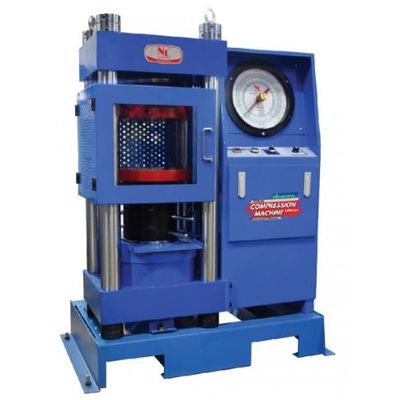
NL Scientific - Model NL 5025 X / 005A -Proctor CBR Soil Compactor Automatic Eco Smartz (ASTM/AASHTO)
The Proctor CBR Soil Compactor Automatic Eco Smartz is designed for carrying out proctor compaction tests on soil samples. This equipment is essential for determining maximum dry density and optimal moisture content, crucial factors in geotechnical engineering. It utilizes standardized procedures to evaluate soil`s mechanical strength for applications such as pavement design, where understanding load-bearing capacity is vital. The system benefits from an upgrade incorporating the ECO-SMARTZ technology, enhancing energy efficiency and operational consistency. Featuring a solid structure, it ensures uniform and accurate compaction of Proctor and CBR samples. The machine operates with a blow rate of 25 blows per minute, adjustable rammer weights, and predefined drop heights, providing reliable results in the controlled compaction environment required by international standards such as ASTM and AASHTO.
Proctor CBR (California Bearing Ratio) Soil Compactor is used for proctor compaction tests on soil samples, allowing for determining maximum dry density and optimum moisture content in geotechnical engineering according to standardized procedures. This process involves compacting soil samples in a standard mold under controlled conditions. This helps evaluate the mechanical strength of natural ground, subgrades, and base courses for pavement design, measuring the load-bearing capacity of soil when compacted to specific density and moisture content.
Newly upgraded model by using ECO-SMARTZ system for energy saving and consistency operation. Solid and compact design allows uniform and correct compaction of Proctor and CBR samples.
- Controlled compaction of soil samples in a standard mold under controlled conditions, ensuring consistent results.
- Perform Proctor compaction tests on soil samples to determine the maximum dry density and optimum moisture content.
- Single version mechanism for most international standard
- Pre-set blow system ensures even compaction
- Solid state controls reliability & ease of maintenance
- Separated control box unit protects against vibration damage
- Blow Rate : 25 blows/min
- Adjustable Rammer Weight : 2.5 kg / 4.5 kg
- Adjustable Drop Height : 12" or 18"
- Product Dimension (mm) : 490 (L) x 360 (W) x 1370 (H)
- Packing Dimension (mm) : 590 (L) x 460 (W) x 1570 (H)
- Approx. Product Weight : 150 kg
- Approx. Packing W : 180 kg
- Power : 220~240V, 1Ph, 8A, 250W, 50/60Hz
-
ASTM D558: This standard covers the determination of the moisture content of soil and rock by drying the material in an oven. It provides procedures for accurately measuring the moisture content, which is essential for understanding the behavior of soil and for compaction testing.
-
ASTM D698: This standard outlines the test method for determining the moisture-density relations of soils using a standardized compaction apparatus. It helps determine the maximum dry density and optimum moisture content of soils, crucial parameters for engineering applications such as road construction and foundation design.
-
AASHTO T99: This standard specifies the method for determining the moisture-density relations of soils using a standardized compaction apparatus. Similar to ASTM D698, it aims to determine the maximum dry density and optimum moisture content of soils for engineering purposes.
-
AASHTO T134: This standard covers the test method for the moisture content of soils by using calcium carbide gas pressure moisture testers. It provides procedures for rapid and accurate determination of the moisture content, which is vital for assessing soil properties and compaction characteristics.
-
AASHTO T180: This standard outlines the test method for determining the moisture-density relations of soils using a standardized compaction apparatus. Like ASTM D698 and AASHTO T99, it focuses on determining the maximum dry density and optimum moisture content of soils to ensure proper compaction and stability in construction projects.
-
Sample Preparation:
- Collect representative soil samples from the site.
- Air-dry the samples and break up any aggregates.
- Sieve the soil to remove any large particles or debris.
-
Determination of Moisture Content:
- Take a portion of the prepared soil sample and determine its initial moisture content using an appropriate method, such as ASTM D558 or AASHTO T134.
-
Compaction Test:
- Set up the Proctor/CBR Soil Compactor according to the manufacturer's instructions and calibrate it if necessary.
- Place a specified amount of soil into a standard compaction mold (usually a cylindrical mold with known dimensions).
- Determine the compaction effort required based on the type of Proctor test being conducted (Standard Proctor or Modified Proctor).
- Compact the soil in layers by applying a specified number of blows from the compaction hammer. The blows are evenly distributed over the surface of each layer.
- Measure and record the height of each compacted layer.
- Repeat the compaction process for additional soil samples at varying moisture contents.
-
Determination of Dry Density:
- After compacting all the samples, carefully extract them from the molds.
- Determine the dry weight of each compacted sample by oven-drying them to remove all moisture (ASTM D558 or AASHTO T134).
- Calculate the dry density (bulk density) of each sample using the known volume of the mold and the dry weight of the soil.
-
Plotting the Compaction Curve:
- Plot a graph of dry density versus moisture content for the tested soil samples.
- Identify the maximum dry density and the corresponding optimum moisture content from the curve.
-
Interpretation:
- Evaluate the results to determine the suitability of the soil for engineering applications, such as road construction or foundation design.
- The maximum dry density and optimum moisture content provide crucial information for achieving the desired level of compaction in the field.