- Home
- Companies
- Bellin S.p.a
- Products
- Bellin - Model Type N - Progressive ...
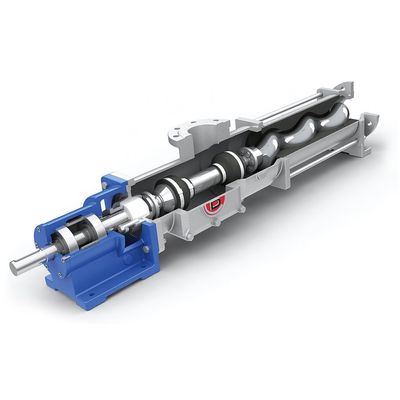
Bellin - Model Type N -Progressive Cavity Pump
Execution with bearings housing for coupling with any kind of drive through a flexible coupling. Strong construction suitable for heavy duty jobs. Capacity up to 260 m3/h – Pressure up to 30 bar. (Special executions up to 50 bar).
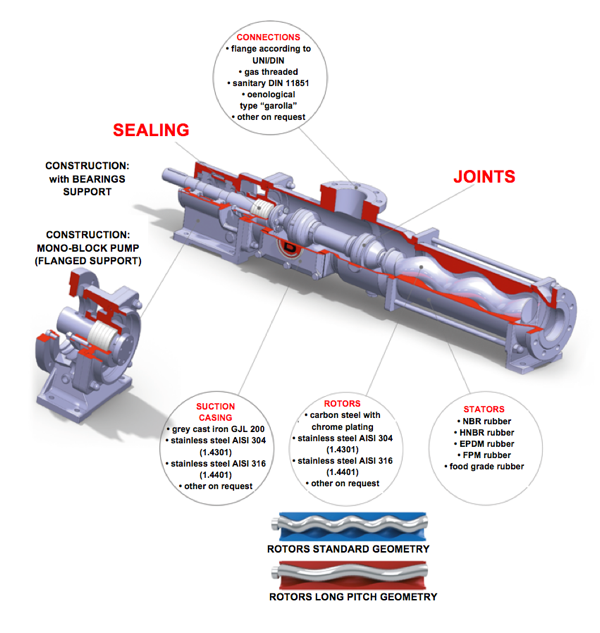
Bellin progressive cavity pumps have many advantages over other types of pumps which allow use extremely diverse:
- self priming up to 7-8 mt
- low speed and so longer pump life (200-500 r.p.m. in comparison to 1400-2800 r.p.m of the centrifugal pumps)
- suitable to transfer abrasive and higly viscous products
- steady flow with minimum pulsation and low shear effects
- high abrasion resistance
- minimum maintenance
- low noisy
- capacity up to 260 mc/h
- pressure up to 30 bar
- direct relation between conveying capacity and speed makes the Bellin pumps suitable also for dosing purposes.
Pump “PRESSURE” depends on the number of rotor/stator stages:
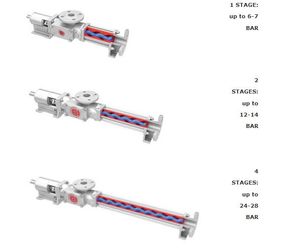
The “progressive cavity pumps” are “positive displacement” pumps. The 2 principal parts are the “rotor” (round thread screw) which turns eccentrically inside a fixed rubber part, the “stator” (vulcanized rubber into a steel cylinder) – moving the fluid in a series of cavities along the axis of the pump.
Theoretical capacity”is in relation to the pump speed and to rotor dimension. Theoretical capacity is as below:
Qth = 4*e*D*Ps*n*60
This means
- Qth Theoretical capacity [m3/h]
- e = Eccentricity of rotor [m];
- D = Diameter of rotor [m];
- Ps = Stator Pitch (this is double of the rotor pitch = Pr) [m];
- n = Rotational speed [rpm]
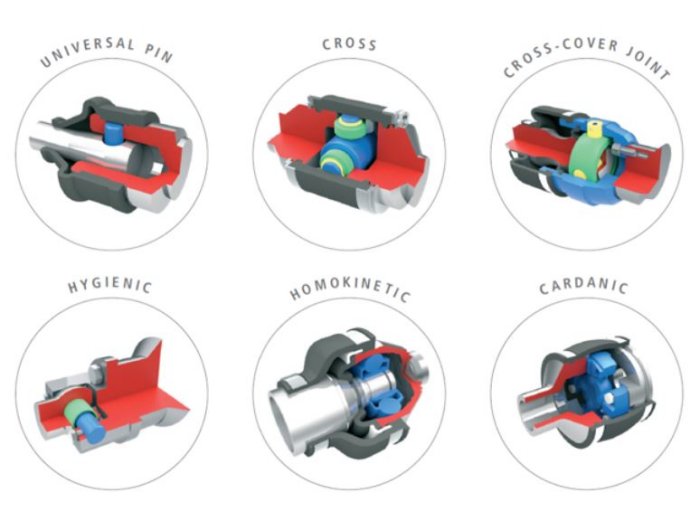
The correct joint has a influence on the operational reliability and life cycle cost of a progressive cavity pump. The correct selection of the joint in relation to the size of pump is therefore of particular importance.