- Home
- Companies
- Bellin S.p.a
- Products
- Bellin - Model Type L - Progressive ...
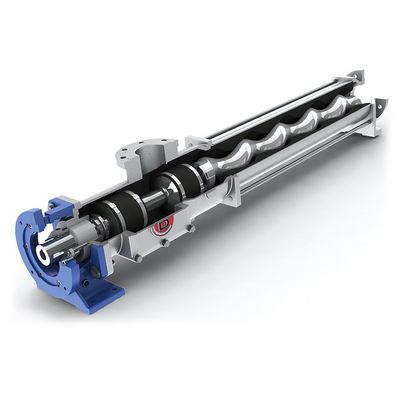
Bellin - Model Type L -Progressive Cavity Pump
Mono-block execution direct-coupled to the motor. Unit. Compact and economical version to meet the needs of limited space. Capacity up to 110 m3/h – Pressure up to 14 bar.
Bellin progressive cavity pumps have been designed for easy, low maintenance: wear parts can easily be replaced on the site. Eccentric screw pumps are heavy duty pumps and they can be used to pump abrasives sludges, viscous products, oils, emulsions etc. Due to the steady non turbulent flow they can also handle shear sensitive products and medium with solids content without breaking up the solids.
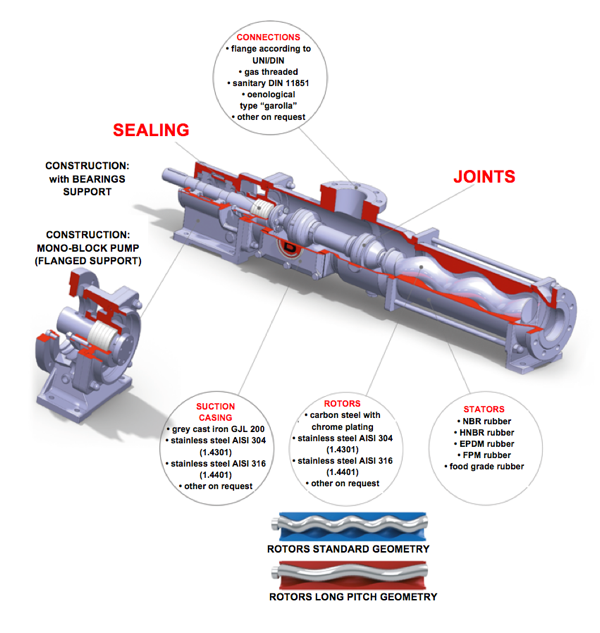
Bellin progressive cavity pumps have many advantages over other types of pumps which allow use extremely diverse:
- self priming up to 7-8 mt
- low speed and so longer pump life (200-500 r.p.m. in comparison to 1400-2800 r.p.m of the centrifugal pumps)
- suitable to transfer abrasive and higly viscous products
- steady flow with minimum pulsation and low shear effects
- high abrasion resistance
- minimum maintenance
- low noisy
- capacity up to 260 mc/h
- pressure up to 30 bar
- direct relation between conveying capacity and speed makes the Bellin pumps suitable also for dosing purposes.
Execution:
- pump housing with replaceable internal plates in stainless steel 304 ;
- tri-lobes entired rubber covered ;
- self-lubrificated mechanical seals.
Main advantages:
- low speed;
- dry running possibility;
- easy maintenance and cleaning in place with removal of the front inspection cover
Fields of application:
- to transfer grapes crushed grapes; to handle fermented grapes coming from the fermentations tanks. Available in execution with trolley and infeed hopper (size 4000) or without hopper (type 7000) to connect directly to conveyors.
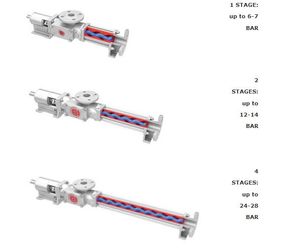
Pump “PRESSURE” depends on the number of rotor/stator stages:
The “progressive cavity pumps” are “positive displacement” pumps. The 2 principal parts are the “rotor” (round thread screw) which turns eccentrically inside a fixed rubber part, the “stator” (vulcanized rubber into a steel cylinder) – moving the fluid in a series of cavities along the axis of the pump.
Theoretical capacity”is in relation to the pump speed and to rotor dimension. Theoretical capacity is as below:
Qth = 4*e*D*Ps*n*60
This means
- Qth Theoretical capacity [m3/h]
- e = Eccentricity of rotor [m];
- D = Diameter of rotor [m];
- Ps = Stator Pitch (this is double of the rotor pitch = Pr) [m];
- n = Rotational speed [rpm]
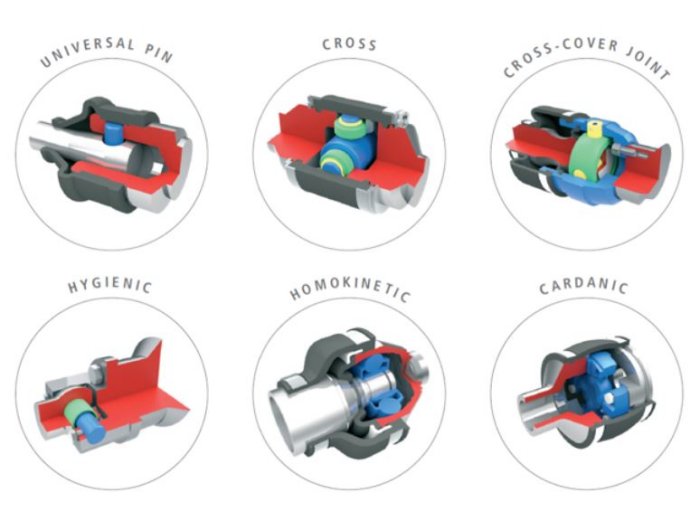
The correct joint has a influence on the operational reliability and life cycle cost of a progressive cavity pump. The correct selection of the joint in relation to the size of pump is therefore of particular importance.