


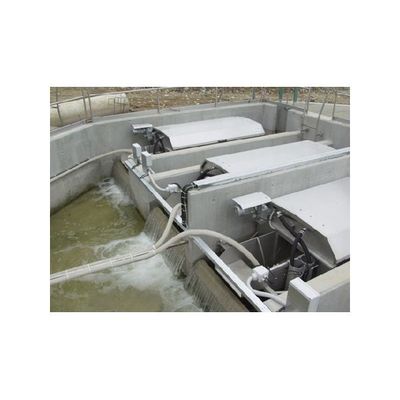
Purestream ES - Model In-Eko -Microscreen Drum Filter
A part of the mission statement of Purestream ES, LLC is to bring new and innovative advanced wastewater treatment products to the marketplace at a reasonable cost. The In-Eko Microscreen Drum Filter is by far our most convincing proof that we are succeeding. The affordable and user-friendly Microscreen Drum Filter is a compact unit designed to produce high quality tertiary treatment consistently. Available in a stand alone unit or in a configuration to be installed in a concrete channel, the flexibility and low horsepower requirements make this a perfect addition to your new project, or an option to bring existing plants into compliance.
The In-Eko Microscreen Drum Filter is manufactured using the highest quality 304 stainless steel as well as durable and non-corrosive plastics. The filter media itself is a stong polyamide nylon that is available in a number of sizes of openings. For more rugged applications, such as mining operations, we can also offer a stainless steel media that is more resistant to sharp objects.
No part of the drum filter ever needs lubrication and maintenance is limited to the periodic replacement of the filter media.
- With lower effluent limitations becoming more and more prevalent, the In-Eko Microscreen Drum Filter is the perfect piece of equipment to upgrade an existing facility.
- Our filter is completely self-contained. There is no need for additional controls, tankage, pumps, or an outside water supply as the backwash cycle is performed using the filtered water.
- The In-Eko Microscreen Drum Filter offers lower capital and operational costs than any other filter.
- 304 Series stainless steel means less maintenance and no corrosion.
Purestream ES, LLC has a trailer-mounted unit available for field testing so that you can see the advantages of this screen firsthand. Give us a call to set up an appointment.
BMF Microscreen Drum Filters are designed for the tertiary stage filtration process and especially for the removal of non-soluble particles in community and industrial wastewater treatment plants. The BMF Filters are open, gravitational filter sets based on the drum filter principle. The filters are constructed so that they can be built into an underground concrete channel or attached to a stainless steel tank for aboveground installation.
Microscreen Drum Filters are manufactured using stainless steel for the larger parts and shafts, and the highest quality plastic for the smaller parts. The simple, rugged construction eliminates deposits left below the water surface and guarantees safe, low-maintenance service. The automatic two-way rinse filter also ensures simple, trouble- free operation.
No part of the Microscreen Filter needs lubrication, and maintenance is limited to periodic replacement of the used filter cloth. The life span of the filter cloth depends on the condition of the water being filtered and the content of the solid materials it contains. Aplastic switchboard cabinet (NEMA4 X rated) is included in every filter. The switchboard is completely equipped for the automatic operation of the filter.
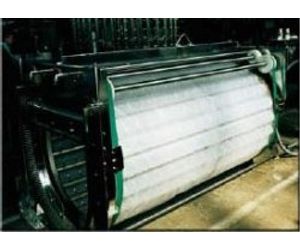
Water containing solid particles flow through the inlet pipe into the interior part of the filter drum. Impurities are caught on the inner side of the filter cloth and the filtered water flows out through the cloth. The entire filter remains off during this initial process. As the filter cloth slowly becomes clogged by the increasing amount of filtered waste, its resistance to the flow increases. The water level inside the filter drum increases accordingly. When the preset level is reached, the level probe located at the forefront of the filter automatically activates the rotating drum and simultaneously the rinsing pump which pumps the filtered water into the jet rinse system. The residue accumulated on the inner side of the filter cloth is removed by the directed stream of water from the jets and then washed into the waste trough located in the inner drum. The residue is then washed into the silt sump where it is washed out by the silt pump which is automatically controlled by the level probe located on the wall of the silt sump. This pump may not be needed when the gravitational flow alone is sufficient to rinse out the silt.
The rinsed cloth is relocated at the bottom of the filter by the revolving of the drum rotation. The surface level difference is diminished and the probe automatically switches off the drum rotation, as well as the p u m p . T h e rotating drum and the pump remain off until reactivated, at which point the entire cycle is repeated. The average activated operation and rest cycles of the filter are dependent on the amount of impurities flowing into the filter, the properties they contain and the condition of the filter cloth.
Since the flow of the untreated water remains uninterrupted throughout the entire filtration process, and the flow of the rinse water is taken directly from the filter set, no additional rinse water trays or tankage is needed. This significantly reduces initial investment costs.
The automatic activation and deactivation of the filter reduces the amount of electricity needed for filter operation. It also increases the average quality of the water filtered, increases the density of the outflowing sludge and prolongs the life span of the entire system.
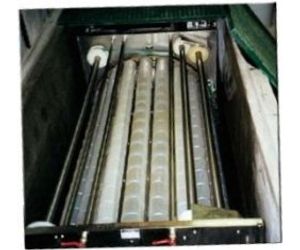
The filter capacity is determined by the basic parameter of the effective working surface of the filter cloth. The second and third parameters are the size of the openings in the filter cloth and the area of their freely functioning surface. These parameters are chosen to produce the required quality of the filtered water. The composition of the solid particles also has a significant effect on the capacity of the filter. This depends on 1.) their shape; (flat particles block the openings more easily than round), 2.) their density; (solid particles are filtered better than nonsolid mucus), and 3.) the average amount of large and small particles in the entire volume of inflowing wastewater.
When a certain amount of dense particles larger than the filter cloth openings is reached, a thin silt layer is formed on the filter cloth. This silt layer acts as a secondary filter and is able to catch particles which are much smaller than the actual openings in the filter cloth. Therefore, it is advantageous to select a filter with a larger filter surface so the "rest" period between cycles is as long as possible. This secondary filter layer is then washed into the waste trough when the filter cloth is rinsed.
When using the Microscreen Drum Filter as the tertiary treatment process in domestic and industrial plants, a filter cloth with an opening diameter of 0.04mm is usually suitable. For more contaminated water or to meet specific requirements, optimal opening diameters and other parameters can be determined by prior experience in similar conditions or by administering filter tests.
In locating the Miscroscreen Drum Filter it is necessary to consider that the flow of water into the filter should whirl as little as possible so that solid particles are not broken up. For this reason a gravity flow is recommended rather than a filter feed pump. Aflow control box should be used to create a gravity flow into the filter in lieu of direct pumping.
The Microscreen Filter should be set in a horizontal position with a maximum divergence of 3mm.
The filtered water outlet from the filter must be kept obstacle-free at all times. The water level behind the filter must not be allowed to rise to a level which would cause back-flow into the filter. The unchecked flow of water back into the filter will cause the water level inside the filter to rise and the filter will cease to function.
If either the filter capacity is exceeded or the filter stops functioning, water will pass through unfiltered. Building a bypass line is not necessary although it may be advantageous to be able to cut off the water flow in order to change the filter cloth. Filter models installed in concrete shafts may be lifted out and then returned to the sewer without interrupting the sewer water flow.
- Inexpensive WWTP upgrade to meet more stringent effluent requirements
- Completely self contained - no need for additional controls, tankage, pumps, or outside water supply
- Lower capital and operational costs than any other filter
- 300 series stainless steel construction means less maintenance and no corrosion