- Home
- Companies
- Process Wastewater Technologies LLC
- Products
- PWTech - Model Cyclone - Patented ...
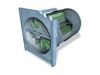
PWTech - Model Cyclone -Patented Self-Powered Drum Screen
This patented self-powered drum screen is ideal for applications such as storm water tank discharges, pumping station overflows, sewage treatment plant by-passes, and small combined sewer overflows. The Cyclone achieves 100 percent removal of ¼-in. (6-mm) particles for two dimensions. Designed to be virtually maintenance free, the Cyclone has a projected 20-year life. Download the product flyer for more information on how the Cyclone operates.
Manufactured from 316L or 304L stainless steel, then electropolished, the Cyclone bolts directly to a chamber wall over the outlet, or spans across the CSO chamber from weir wall to chamber wall.
The shaft bearings are also stainless steel and are sealed for life. Drum sizes are up to 25 inches in diameter and 42 inches long. Cyclone applications include storm water tank discharges, pumping station overflows, sewage treatment plant by-passes, and combined sewer overflows.
- The Cyclone begins operating when the water level reaches the shaft level.
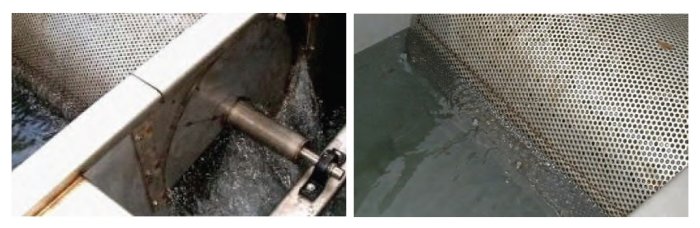
- Water flows over an overflow weir created by an the open quadrant in the inner (fixed) drum. Screened effluent flows onto internal vanes that are attached to the perforated (outer) drum, causing the drum to rotate.
- As the flow increases, the water level over the weir rises, creating a greater inflow screen area and increasing the screen throughput.
- The patented screen uses the available energy of overflow through its internal water wheel to effect self-cleansing. The drum rotates faster, increasing the shear action and improving the cleansing action.
- The high shear action between the drum face and surrounding water causes screenings attached to the outside of the drum to be stripped from the screen face.
- The unit is self-regulating across the full range of flows.
- The drum continues to operate at maximum inflow even if the unit becomes completely submerged.
- Virtually maintenance free
- Requires no mechanical cleansing of the screen surface and no external power source
- The 6 mm aperture screen is self-cleansing
- Whether installed individually or in multiples, the Cyclone can be designed with quick release fittings and frames for easy removal and access to the CSO chamber
- Ideal for treating small combined sewer overflows
- Simple, rapid installation
- The cyclone is located at the spill point from the sewer system with the fixed internal weir at the minimum system discharge level.
- When fluid exceeds the level of the fixed internal weir, it flows through the screen, onto the internal vanes, and out of the discharge end.
- The flow of water onto the vanes, which are attached to the outside screen, causes rotation of the vanes and screen.
- The rotation of the screen creates a sheer force that continuously cleanses the screen surface. As flow increases, the additional fluid flowing over the weir and onto the vanes increases the rotation velocity, increasing the sheer and cleansing action.
Manufactured from 316L or 304L stainless steel, then electro-polished, the Cyclone bolts directly to a chamber wall over a circular outlet, or spans across the CSO chamber from weir wall to chamber wall. The shaft bearings are also stainless steel and are sealed for life. The standard drum unit is 28 in. (710 mm) long with a 20-in. (500-mm) diameter. Whether installed individually or in multiples, the Cyclone can be designed with quick-release fittings and frames for easy removal and access to the CSO chamber.
Three standard sizes with design flows of 1.77 cfs (1.14 mgd), 3.53 cfs (2.28 mgd), and 5.30 cfs (3.43 mgd).
The Cyclone achieves:
- 100% removal of 6 mm particles for two dimensions
- Design now in three sizes: 1.77 cfs (50/ls), 1.1 mgd; 3.53 cfs (100 l/s), 2.3 mgd; and 5.30 cfs (150 l/s), 3.4 mgd
- Head over the internal weir of 10 to 12 1/2 inches maximum
Designed to be virtually maintenance free, the Cyclone has a projected 20-year life. PWTech suggests an annual inspection to ensure that the drum is clean and rotating freely.