
- Home
- Companies
- Raymetrics S.A.
- Products
- Raymetrics - Customized Vertical Lidar
Raymetrics - Customized Vertical Lidar
Raymetrics provides a range of highly customizable backscatter, depolarization and Raman LIDARs, designed to cover almost all of a very huge set or range of scientist`s requirements. Customers can select themselves components and build the entire system. (see below). ISO 9001:2015 certified.
Upgrades, such as the addition of extra wavelengths, can be accounted for in the initial design. Requests for LIDARs from outside the standard range can also be accommodated (such as multiple telescopes and emitters, Differential Absorption LIDARs, etc - see here).
Upgrades, such as the addition of extra wavelengths, can be accounted for in the initial design. Requests for LIDARs from outside the standard range can also be accommodated (such as multiple telescopes and emitters, Differential Absorption LIDARs, etc - see here).Upgrades, such as the addition of extra wavelengths, can be accounted for in the initial design. Requests for LIDARs from outside the standard range can also be accommodated (such as multiple telescopes and emitters, Differential Absorption LIDARs, etc - see here). Upgrades, such as the addition of extra wavelengths, can be accounted for in the initial design. Requests for LIDARs from outside the standard range can also be accommodated (such as multiple telescopes and emitters, Differential Absorption LIDARs, etc - see here).
- High energy lasers (30, 60 or 90 mJ at 355nm - up to 330mJ at 1064nm)
- Large telescopes (200, 300 or 400 mm as standard)
- High energy per pulse and large receivers for better data quality and increased range
- Choice of up to 8 wavelengths with upgrades available
- Telescopes designed by Raymetrics specifically for lidars, increasing signal efficiency by as much as 40% compared to off-the-shelf telescopes
- Optical quality glass for emitter and receiver windows to prevent chromatic aberration
- Simultaneous analogue and photon counting modes
- Complete software package provided
- Flexible networking options - fully operable from remote networked workstations via built-in Ethernet port or LAN connection (controllable even over WiFi, such as from a laptop, tablet, or mobile phone)
- Real-time data display
- Weatherproof enclosure with climate control options for almost all environmental - conditions
- Robust, industrial design
- 12 month warranty
- 3 day installation and training course on site as standard
- Company certified to ISO 9001:2008 standard
- Designed to be compliant with all EARLINET (European LIDAR network) recommendations for LIDAR design
Raymetrics was founded in 2002 with the aim of manufacturing the highest quality scientific instrumentation. The company designs, manufactures and delivers a range of advanced LIDAR systems for atmospheric measurement. Standard products include backscatter, depolarization and Raman LIDARs and LIDAR-related components such as specialist telescopes.
Through a global network of distributors, Raymetrics has LIDAR installations around the world including in the U.S.A., China, India, Europe, Southeast Asia, Africa and South America. Our client list includes such prestigious organizations as the Met Office (UK), Meteo France, the European Space Agency, CASER (run by Korean Met Agency) and the German Aerospace Centre (DLR).
Researchers remain a major part of the company’s client base, but in recent years the market for atmospheric LIDARs has begun to expand. More than decade of development and use of our products in all kinds of environments has led to robust designs which are suitable for operational organizations such as meteorological agencies, aviation authorities, airports and more.
A background in LIDAR science has led to products which are compliant with all EARLINET (European LIDAR Network - key authority on LIDAR) requirements. The company is certified to standard ISO 9001:2008.
Raymetrics has several products with fixed specifications, including an LR111-ESS-D200 model scanning LIDAR for applications including fog detection, visibility monitoring and plume monitoring; and an LR111-D300 model vertical LIDAR for meteorological applications including volcanic ash detection and Planetary Boundary Layer (PBL) studies. However we also offer our clients multiple options to modify their LIDARs according to requirements and budgets. Raymetrics produces LIDARs from within a standard range of components. Specifications which can be varied include:
- Laser energy
- Telescope diameter
- Backscatter wavelengths (UV, Visible, IR)
- Cross-polarization wavelength options
- Nitrogen Raman options
- Water vapour Raman option (requires large telescope and high energy laser)
- Vertical or 3D scanning deployments
- Accessories
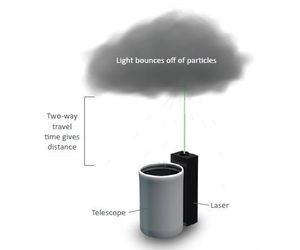
A LIDAR works by emitting a laser beam into the atmosphere. The laser light is scattered by particles, with some “backscattered” to a telescope placed alongside the laser. Because the speed of light is known, the distance to the particle layers can be determined from the time taken for the light to return.
More advanced LIDARs can also take advantage of the properties of the returned light. From these, certain characteristics about the atmosphere can be determined, such as optical depth and particle identification (volcanic ash, smoke, marine aerosols, dust).
LIDARs plot every laser pulse individually. This means that energy per pulse is of the highest importance, since the more energy a laser pulse has, the further it will reach into the atmosphere before being scattered away. Stacking or integrating data can improve data quality but cannot do much for the range. This is why Raymetrics LIDARs use some of the most powerful industrial lasers on the market.
- Volcanic Ash Detection
- Water Vapour (Humidity)
- Fog Detection
- Remote Visibility/Slant Visual Range
- PBL Depth
- Smoke Detection
- 3D Cloud Base
- Aerosol Discrimination
- Aerosol/Dust Layering
- Detection of Pollution Sources
- Water/Ice Cloud Determination
- Plume Tracking
- Backscatter Coefficient
- Colour Ratio
- Depolarization Ratio
- Extinction Coefficient
- Optical Depth
- Extinction-to-Backscatter Ratio
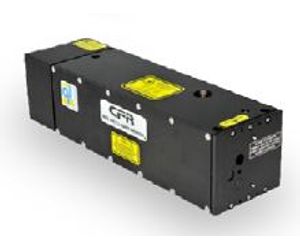
- Emission at 355 nm: 30, 60 or 90 mJ per pulse
- Emission at 532 nm: 55, 130 or 200 mJ per pulse
- Emission at 1064nm: 100, 200 or 330 mJ per pulse
Others available on request
Laser specs:
- Q-switch flashlamp-pumped Nd:YAG laser
- Repetition rate 20 Hz
- Energy stability <3%
- Pulse duration 5.5 - 9ns
- Divergence
- Flashlamp life >50 million shots
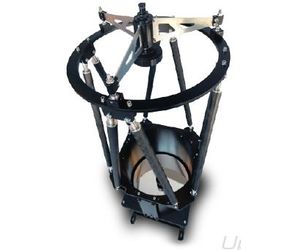
- 200 mm
- 300 mm
- 400 mm
Custom sizes available on request
Telescope specs:
- Designed by Raymetrics specifically for LIDARs
- Carbonfibre tube/struts for stability
- Focal point inside telescope for reduced telescope size and greatly reduced obscuration from secondary mirror
- Optical quality glass with exceptional flatness (note: glass not used as lens, which introduces chromatic aberration)
- Enhanced aluminium (SiO2/TiO2) overcoat with up to 96% reflectivity
- Coatings tailored for wavelengths beyond visible range (UV and IR)
“Vertical”
Raymetrics builds “vertical” LIDARs (note: levelling feet can be included which allow tilting up to around 50).
Enclosure sizes vary from less than 1 m2 up to 1.8 m x 1.6 m x 1.0 m (H x W x D). Enclosure size is dictated by telescope size, number of wavelengths detected and accessories required, as well as whether the system is for indoor or outdoor use.
Raymetrics can build LIDARs ready for future upgrades, such as by including a larger enclosure, a laser emitting at wavelengths which are not yet detected, etc.
Custom deployments are also available, such as vehiclemounted systems.
Deployment Options
3D Scanning
3D scanning options are also available. Scanning LIDARs can be supplied as single self-contained units or as two-unit models for easier transportation and added wavelength options (see images below).
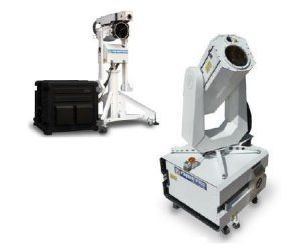
3D Scanning Features
- 200mm telescope
- Q-switch Nd:YAG flashlamp-pumped laser
- Emission 30 mJ per pulse at 355 nm
- 10 X beam expansion
- Eye-safe emission (according to EU standard on laser safety EN60825-1: 2007)
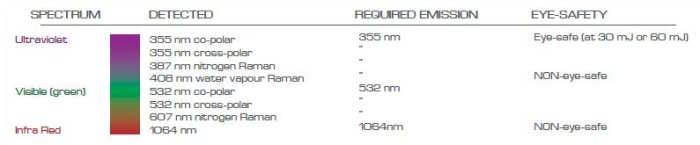
- Detectable wavelength options:
- 355 nm co-polar (required)
- 355 nm cross-polar
- 387 nm nitrogen Raman
- Full 3D rotation 3600 (azimuth, 900 zenith)
- 200m overlap
- Range up to 10 - 15 km
- Environmental tolerance +50 to +350C (climate control option available for extended range)
Raymetrics offers a range of accessories, including:
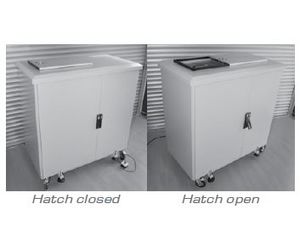
- Rain sensor with automatically closing hatch to protect windows from rain
- UPS with safe shutdown on power loss and automatic re-start upon power resumption
- Internal and external blowers for window condensation
- Double-walled enclosure with rain cover
- Camera for checking system functionality
- Temperature and humidity sensors
- Laser cooled with ethylene glycol (anti-freeze) for cold environments
- Full climate control (heater and cooler)
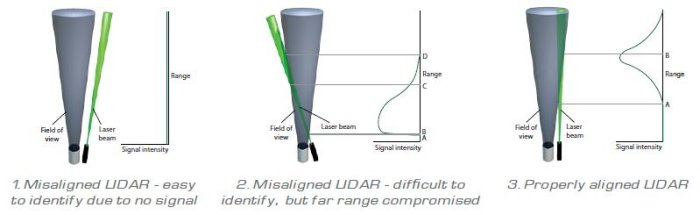
All LIDARs become misaligned over time. Misalignments can be difficult to identify, as shown in image 2 above. Some manufacturers use a large Field of View to combat this, but this introduces noise and reduces range. Raymetrics therefore gives the user the option to align the laser and telescope (or to increase FOV if required). Alignment can be achieved remotely through pico-motors which rotate reflecting mirrors to align the LIDAR. The motors can be controlled through Raymetrics software installed on a remote PC. Raymetrics LIDARs also come with equipment which allows the user to manually conduct the Telecover Test to check LIDAR fine alignment. All required software for alignment is supplied.
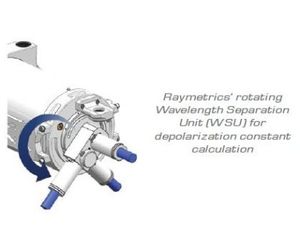
Raymetrics builds Wavelength Separation Units (WSUs) specifically designed to enable calculation of the depolarization constant. Calculation of this constant on site and at regular intervals, especially after the equipment has been moved, is extremely important . Even small errors in the constant can result in errors in the data greater than 100%!
Raymetrics LIDARS come with a WSU specially designed to perform EARLINET’s +/-450 Test to calculate the depolarization constant. Because of the way the WSU is designed, Raymetrics can achieve close to 0.1% uncertainty in the depolarization ratio.
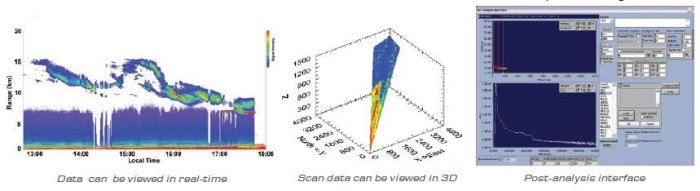
Raymetrics LIDARs come fully ready for use, with a full suite of software for instrument operation, diagnostics, data acquisition, data storage (database facility) and advanced data analysis and visualization. Software offers the capability to view data in realtime and to schedule measurements so that an operator is not required. Software comes pre-installed on the LIDAR’s internal industrial grade PC and can be installed on additional external PCs. The internal PC allows for simple networking and remote operation.
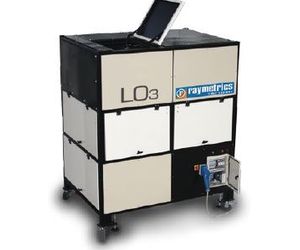
Key features of a Raymetrics LIDAR include...
- Powerful yet robust industrial grade laser with high energy per pulse for better data quality and range
- Large custom-designed telescope specifically for LIDARs, increasing signal efficiency by up to 40% compared to off-the-shelf telescopes
- Up to 8 wavelengths detected including nitrogen Raman, water vapour Raman and Depolarization channels
- Advanced Wavelength Separation Unit with optional remote +/- 45 degree calibration at 355nm and 532nm
- Automated filter wheel option to allow for remote signal optimization
- Custom designed dichroic mirrors and optics which allow for minimum attenuation and negligible phase shift at depolarization wavelengths
- Opto-mechanical design guaranteeing <2 degree angle of incidence for each optical surface over the full effective measurement range
- Fully contained within a robust aluminium enclosure designed for housing electronics
- Optional accessories for outdoor use and storage - climate control, UPS, double-walled enclosure, humidity & temperature sensors, etc
- Complete software package provided as standard – including automated measurements, real-time views and advanced analysis
- Flexible networking options due to control by internal PC (even controllable over wifi, such as from a laptop, tablet, or mobile phone)
- Com pliant with all EARLINET recommendations for LIDAR specifications
Raymetrics builds most of its LIDARs from within a standard range of components. However the company also offers fully customized LIDAR designs from outside the standard component range.
This includes complete LIDAR stations with multiple emission sources (lasers) and multiple telescopes (e.g. for near and far field). It also includes customized vehicle-mounted systems.
As well as options from within the standard range of backscatter, depolarization and Raman type aerosol LIDARs, Raymetrics also builds custom Differential Absorption LIDARs (DIAL Systems). Currently these are only available for detecting ozone, however other gases may be available on request.
Raymetrics has a long history of designing customized systems. Other types of atmospheric LIDARs may also be available, including DIAL systems for other gases or LIDAR Induced Fluorescence (LIF) for detecting various gases and particles. Please contact us to discuss your LIDAR requirements.
- EXPERIENCE: Raymetrics is probably the most experienced atmospheric LIDAR company in the world (in operation since 2002).
- GLOBAL BRAND: Clients come from all over the world, including Europe, North & South America, Africa, Asia & South East Asia.
- REASSURANCE: Our client list includes such prestigious organizations as Meteo France, the German Weather Service (DWD), European Space Agency, Dirección Meteorológica de Chile ,German Aerospace Centre (DLR), National Environment Agency (Singapore), and the Met Office (UK), including networks of operational LIDARs and sales to many important research institutes.
- REPUTATION: Raymetrics has an excellent reputation among the LIDAR community.
- QUALITY: We use only high quality components provided by reputable suppliers. We provide specifications for all sub-components including manufacturer names. Blueprints and software source code are available to research clients on request.
- POWER: Raymetrics uses lasers with higher energies per pulse than most other manufacturers. This means the laser beam penetrates further into the atmosphere before being scattered away, resulting in better range and data quality.
- SIZE: Raymetrics designs optical systems including telescopes, which are larger than most other manufacturers’, capturing more signal.
- MODULAR DESIGN: Raymetrics LIDARs are designed to be modular, allowing clients to customize and upgrade according to their needs.
- STANDARDS: Raymetrics LIDARs comply with all EARLINET (European LIDAR Network - global authority on LIDAR) requirements. This includes a depolarization unit capable of conducting the +/-450 test (for depolarization calibration constant calculation), tools for conducting the Telecover test for alignment checking, correction tools for daytime measurement and electronics & PMT performance tools.
EMITTER
- Laser energy:
- Emission at 355 nm: 30.60 or SO mJ per pulse
- Emission at 532 nm 55. t30 or 2CO mJ per pulse
- Emission at 1064nm: 1CO. 2CO or 330 mJ per pulse
- Repetition race: 20 Hz
- Beam Expansion: X5 to X10
- Eye-safe: Some models (EU standard EN 60825-12007)
- Laser Class: IV
RECEIVER
- Size [primary mirror): 200. 300 or 400 mm
- Field of view (FOV): 0.25 - 3 mrad [user adjustable)
- Overlap:
- < 200 m [200 mm telescope)
- < 250 m (3CO mm telescope)
- < 5CO m (4CO mm telescope)
DETECTION UNTT
- Detected Wavelength Options:
- Emission at 355 nm
- 355 nm co-polar. 355 nm cross-polar. 387 nm nitrogen Raman. 40S nm water vapour Raman
- Emission at 532 nm:
- 532 nm co-polar 532 nm cross-polar; 607 nm nitrogen Raman
- Emission at 1064 nm:
- 1064nm
- Spatial resolution: 7.5 m (3.75 m available on request)
- FWHM bandwidth: Approx. 0.5 nm per wavelength
- Detection modes: Analogue and photon counting for near and far field
GENERAL
- Internal PC: Industrial grade PC running Wndows
- Software: Full suite of software supplied
- Automation: Remotely operable with measurement schedulng for automation Rashlamp changes requred every 3-4 months on average with measurement scheduling program.
- Enclosure:
- Single-walled "indoor" models (weatherproof)
- Double-walled aluminium alloy for better heat regulation for outdoor environments
- Warranty: 1 year as standard
- Training: 3 day installation and training course on site as standard
- Accessories:
- Climate control
- Internal and external window blowers
- Rain sensor + automatically closing hatch
- UPS + automatic re-start after power loss
- Antifreeze laser coolant for cold weather
- Temp. S. humidfty sensors + external camera
ADDITIONAL
- Effective Range: Variable depending on specs, environmental conditions, integration times and wavelengths, in general up to 10-15 km with 200 mm telescope at 355 nm with 30 mJ laser and up to 20 km with 400 mm telescope at 355 nm and 90 mJ laser
- Environmental tolerance
- Indoor - +5 to + 35 °C
- Outdoor -20 to + 45 °C
- Dimensions: Variable depending on specs <18 m x 15 m x 1.0 m (HxWxD)
- Weight: 100 to 300 kg
- Power: 110 - 240 V 50 - 60 Hz (standard domestic power supply)
- Peak current 25 Amps.
Description
- Raymetrics’ software team is developing firmware and software adding functionality to existing products in order to provide innovative solutions to its customers
- The new LiDAR firmware support efficient and remote control of LiDAR systems allowing it to be operated even in remote environments acting as early-warning systems for natural hazards like volcanic eruptions, wildfires and dust storms
- Α new, subscription based platform allows easy visualization and processing of data gathered by LiDAR systems, targeting both existing and new customers
- New processing capabilities will be available to subscribed customers Raymetrics is developing a unique cloud-based platform that integrates LiDAR data with other sensors and information sources to address specific clients needs
- An example of this platform is the new desert dust monitoring and forecasting solution, integrating state-of-the-art lidar processing algorithms and dust forecasting to a single web- based platform.
Software
- The new firmware optimizes system performance, eases maintenance of existing systems while speeding up the development cycle of new products
- The firmware is optimized for low connectivity installations, allowing the installation of system in remote areas such as early warning systems
- The new instruments are able to integrate with other internet-enabled devices, forming smart sensor networks and solving complicated client needs
- A subscription-based platform will allow customers to monitor the systems’ operational status, easing day-to-day operation and reducing unexpected failures
- At the same time, it will allow Raymetrics to promote pro-active maintenance contracts and suggest
- system upgrades based on the actual needs of each system ensuring a constant stream of recurring revenues
Firmware
- Raymetrics is developing new web-based platform that can handle data from both single lidar systems and large network.
- A subscription-based web-based platform for lidar data visualization and processing allow efficient management of lidar data, and easy integration to customer workflows.
- Innovative processing algorithms will allow to achieve user requirements with much lower hardware costs, significantly increasing the competitiveness of all Raymetrics products.
Software
Raymetrics provides a full suite of custom-designed LIDAR software in a common GUI with every system. No additional software is needed to run the system or perform advanced analysis. Modules are included for:
- System Alignment
- Measurement Scheduling
- Data Acquisition
- Data Storage (Database)
- Data Analysis
- Data Visualization (in 3D if system is 3D scanning)
- System Diagnostics
Automation
- Raymetrics LIDARs can be fully automated through measurement scheduling software, including 3D scanning systems which can be programmed with multiple scan patterns.
- Data can be displayed in real-time, with "quick-look plots" exported as jpegs either manually or automatically.
- Raymetrics` software now features auto-picking of atmospheric layers, including the Planetary Boundary Layer (PBL), clouds and aerosol layers.
- Software can also achieve automatic particle classification in real-time, allowing the user to discriminate between volcanic ash, dust, smoke and marine particles.
Networking
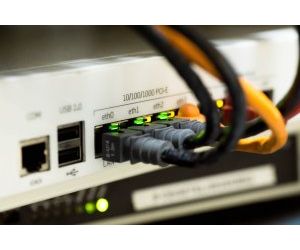
Raymetrics LIDARs are controlled by internal industrial grade PCs running Windows Operating Systems. As such, our LIDARs can be easily networked in all the myriad ways a PC can be networked. This can include connection via Ethernet to a network, with data sent to a remote server for distribution to web pages, or any other method. Raymetrics LIDARs can even be operated remotely from mobile phones or tablets.
Visualization
3D Scanning data can be displayed and viewed in 3D in Raymetrics` native software, or can be easily exported for use in other software (e.g. we can provide a simple 3-click solution for displaying data in Google Earth).
Data format
Data format is binary for fast processing, with the option to automatically convert to ASCII format for compatibility with other software.
Raymetrics does not currently limit the number of licences for users. Clients can even request access to the source code to develop additonal software modules, or can request Raymetrics to develop new modules.