


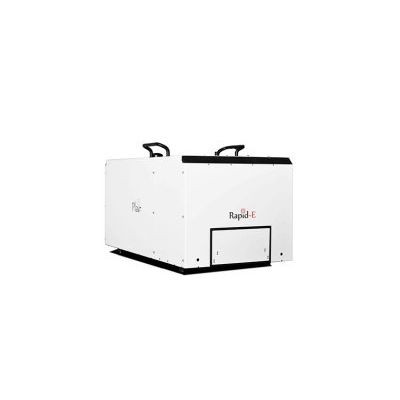
Rapid - Model E -Real-Time Airborne Particle Identifiers
Rapid-E is the world’s first instrument to accurately and comprehensively analyze single aerosol particles in real time. Fully automated, it characterizes any airborne particle in the range of 0.5-100 micrometers, matching and opening up numerous applications in environmental monitoring, and beyond. Rapid-E has a robust design that ensures its continuous use both outside and indoors.
- Particle size range: 0.5-100 μm
- Continuous and automatic monitoring
- Highly sensitive detection
- Revolutionary single particle analysis
- Remote operation
- Individual or connected
The instrument continuously monitors ambient air, instantly counting and characterizing different pollen species, spores, and even air pollutants, such as PM2.5, PM10 and certain polycyclic aromatic hydrocarbons. The proprietary technology enables rapid species recognition, providing a good understanding of atmospheric aerosol concentrations and their influence on public health and the environment.
The high sensitivity of Plair’s Rapid-E enables precise information about when the particle emission event took place, giving its users time to act and take preventive measures. In addition, Rapid-E operates autonomously and remotely, enabling data access anywhere and anytime.
Continuous and Automatic Monitoring
Rapid-E provides continuous online measurements 24 hours per day, all-year round. It requires no human intervention and low maintenance, ensuring reliable and uninterrupted environmental monitoring.
Highly sensitive detection
The instrument is able to detect down to 1 particle per cubic meter.
Revolutionary single particle analysis
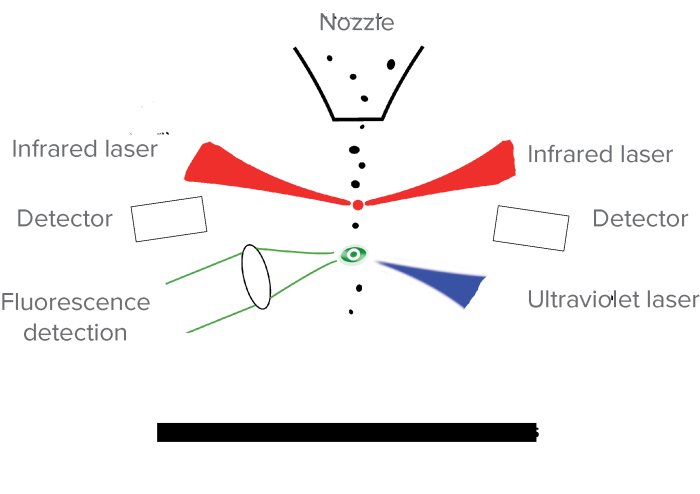
Each individual particle drawn into the detector is examined by an advanced fluorescence laser spectroscopy and morphology analysis. For each particle, several hundred parameters of scattered light pattern and laser-induced fluorescence are recorded, representing a unique optical fingerprint. This analysis allows highly precise species identification, with a record low rate of false positives.
Remote operation
Rapid-E operates remotely. The data are accessible in real time from any internet-connected device. The instrument is equipped with a GPS tracker that provides global time and location for all measurements. User-specified alerts can be configured to provide email and/or SMS text notifications as soon as threshold values are reached.
Individual or connected
Rapid-E is easily integrated into a network of other devices, or forms its own network.
Continuous Monitoring
Rapid-E provides continuous online measurements 24 hours per day, all-year round. It requires no human intervention and low maintenance.
Automatic and Real-Time
Rapid-E is an all-in-one detector designed to provide continuous and real-time detection, identification, and counting of airborne particles
Individual or Connected
Rapid-E is easily integrated into a network of other devices, or forms its own network.
Autonomous Solution
Rapid-E operates autonomously and can report the presence of pollen or other species automatically and within minutes.
Rapid-E`s technology is based on morphological analysis through light scattering, and chemical analysis through high-resolution, laser-induced fluorescence and fluorescence lifetime.
For each particle, several hundred parameters of scattered light pattern and laser-induced fluorescence are recorded, representing a unique optical fingerprint. This analysis allows highly precise real-time species identification, with a record low rate of false positives.
With Plair Rapid-E (Real-Time Airborne Particle Identifier) there is now an easy way to count pollen – automatically, more rapidly and precisely than ever before. The proprietary laser-sensing technology enables identify multiple pollen species simultaneously and in real time.
Plair offers the world’s most advanced comprehensive solution for pollen monitoring. The solution comprises the instrument’s installation and maintenance, cloud-based data processing and reporting, alongside with assistance on field calibration.
Real-Time Pollen Count
Pollen concentration per species is delivered each hour through the online dashboard and a .CVS/Excel file.
Fungal Spore and Total Particle Count
Hourly concentration of fungal spores and total particle count can be also reported together with pollen information.
Maintenance
Installation of Rapid-E with its outdoor enclosure, maintenance such as cleaning and data processing are offered with the solution.
- Rapid-E Instrument
Rapid-E provides best-in-class analysis of single aerosol particle. It continuously monitors air and instantly detects allergens such as pollen, fungi, and air pollution.
- Outdoor Enclosure
The outdoor enclosure maintains the device operation at all weather conditions within a temperature range of -20 – +50. It is supplied with a sigma-2 inlet for a more efficient sampling.
- Online Dashboard
Real-time statistics on pollen species is delivered through the online dashboard and a .CVS/Excel file.
With Plair Rapid-E (Real-Time Airborne Particle Identifier) there is now an easy way to analyze bioaerosols – automatically, more rapidly and precisely than ever before.
Rapid-E can differentiate between a wide number of disparate entities, including pollen species, organic particles such as fungal spores, inorganic particles such as soot and dust or sand, and pollutants such as polycyclic aromatic hydrocarbons. The detector`s high specificity allows it to identify multiple species simultaneously, enabling a full understanding of atmospheric aerosol concentration.
Single particle measurements
Rapid-E provides best-in-class, real-time analysis of single aerosol particles. The proprietary technology enables a leap in highly specific aerosol detection and characterization.
Full range of particle size
Rapid-E characterizes any airborne particle in the range of 0.5-100 micrometers, matching and opening up numerous applications in environmental monitoring, and beyond.
Full access to the raw data
Access to the raw data of measured particles` scattered light patterns and spectrally-resolved fluorescence enables develop specific libraries for species of interest.