


- Home
- Companies
- Universal Aquacare Technology
- Products
- Recycle & Reject Management
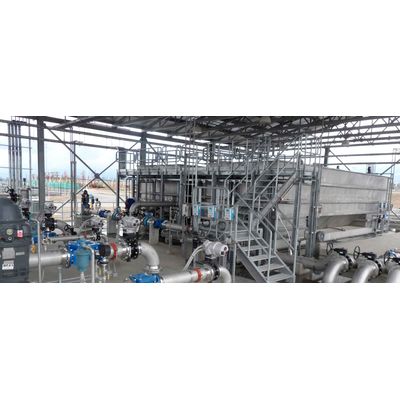
Recycle & Reject Management
In industrial settings, RO is often used to remove total dissolved salts (TDS) from industrial wastewater or treated industrial wastewater and yield permeate with relatively low TDS concentrations. While RO is an effective method for handling wastewater, what to do with the concentrate or reject water (typically as much as 20-50% of the RO feed water volume) can be an issue. Specifically, the high salinity in RO reject / RO concentrate can make it prohibitive for discharge to a local sewer facility. Hauling the wastewater to a treatment facility can also be prohibitively expensive
Typical RO reject / RO concentrate TDS concentrations are often in the range of 30,000 – 50,000 mg/liter. The salts in solution can range from highly soluble sodium and potassium salts to less soluble or reverse soluble calcium and barium salts. Note: The term reverse soluble implies lower solubility as solution temperature increases. ENCON MVC Evaporators operate at typical temperatures of 225-230°F for high TDS applications like RO reject / RO concentrate. Similar or slightly higher (250°F maximum) operating temperatures can be expected with high TDS applications.
Evaporator concentration endpoints tend to correspond closely with saturation concentrations of the various salts at the referenced temperatures. Many sodium and potassium salts such as sodium sulfate, sodium chloride, potassium chloride, and potassium nitrate, have saturation points in the range of 400,000 – 600,000 mg/liter at the referenced elevated temperatures. Based on simple arithmetic, concentrating the RO reject / RO concentrate wastewater from 30,000 mg/liter to 400,000 mg/liter corresponds to a volume reduction percentage of approximately 92.5%. Concentrating from 50,000 mg/liter to 600,000 mg/liter would yield a volume reduction percentage of approximately 91.6%.
Less soluble salts such as barium sulfate and magnesium carbonate present more of an issue due to the tendency to precipitate out and scale heat transfer surfaces. To minimize this issue, a type of anti-scale chemistry referred to as Threshold Scaling Inhibitors (TSI) are being used. TSI chemistry is added upstream of the evaporator and modifies the insoluble salt crystals creating a soft slurry that has less of a tendency to adhere to surfaces and cause scale. The resulting soft slurry also has a consistency that minimized the likelihood of erosion on heat exchanger or plumbing surfaces.