


REM Isotropic
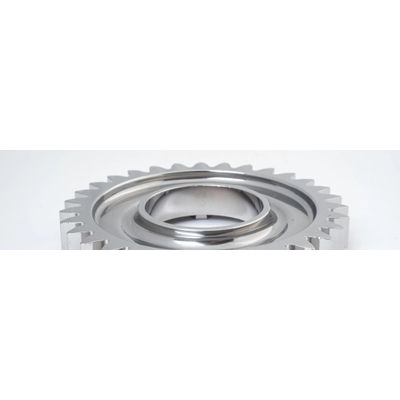
REM® Isotropic Finishing cost-effectively mitigates surface roughness to reduce friction and improve wear. Finishing has become more important as companies look for solutions to improve the performance of components in applications where they will experience friction and wear. REM Isotropic Finishing mitigates a component`s surface roughness to reduce forces and improve the sliding friction between two contacts. Manufacturing processes such as machining, forming, and grinding are directional, and leave machining or grinding lines on the surface of the part, as shown in Figure 1. This limits how much they can reduce surface roughness. The directional lines produced by these processes may exhibit low friction when components contacting the surface are sliding in one direction, but exhibit greater friction if sliding perpendicular to the machine lines.
REM® Isotropic Finishing is a non-directional or unidirectional superfinishing process that produces a uniform surface roughness with no directional lines. It is easily scalable and less expensive than other finishing options such as buffing, honing and lapping. While progressive steps of polishing, lapping or honing will reduce the surface roughness, they are expensive and directional and still leave fine lines on the surface of a part, just like machining or grinding.
The REM process combines the use of a chemical additive with a non-directional mechanical finishing process that accelerates the finishing process and produces low surface roughness. The process allows for small lot processing, while larger lots can be processed in bulk with no damage to surfaces. The versatility of the process allows for energy levels to be adjusted and media to be matched to the geometry of the components being processed to achieve uniform finishing even on complex geometries. The uniform reduction in surface roughness produces a low friction sliding contact.
The addition of a DLC or PVD coating or Salt Bath Nitriding will further reduce sliding friction and improve wear.
The REM Isotropic Finishing process produces a uniform surface roughness reducing sliding friction. Utilizing a vibratory finishing process, the parts can be matched with proper media to finish complex geometries and surfaces that can be difficult to access.
The process is designed to remove the peaks on the surface and allow the valleys (or low areas) to remain. The valleys will still retain oil at the wear surface interface, but will not have the high peaks that increase friction.
The initial step of the process is referred to as the refinement or cut process: the chemistry reacts with the surface of the parts, forming an oxide. The chemical conversion of the surface to an oxidized state allows the soft oxide on the peaks to be mechanically polished away by the media, allowing the bare, exposed surface to be oxidized again—a process that can repeat several times.
As the mechanical finishing by the media continues, it wipes the soft oxide layer away at the peaks but does not affect the valleys on the surface. When the refinement process is complete, it will transition into a burnishing step, which neutralizes and removes the refinement chemical and produces a mirror-like, polished finish on the product. (See schematic illustration below.)
- Stainless Alloys
- Low Alloy Steels
- Carbon Steels
- Super Alloys: Inconel & Waspalloy
- Aluminum
- Titanium
- MIM