- Home
- Companies
- Thermo-Kinetics Company Limited
- Products
- Thermo-Kinetics - Resistance ...
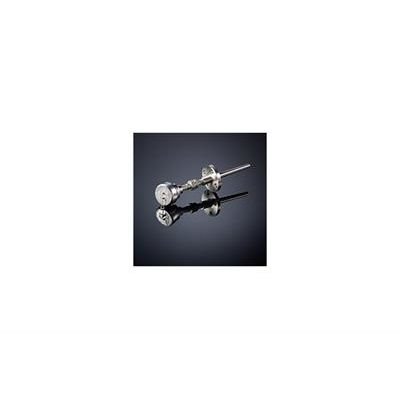
Thermo-Kinetics - Resistance Temperature Detectors (RTDs) Probes
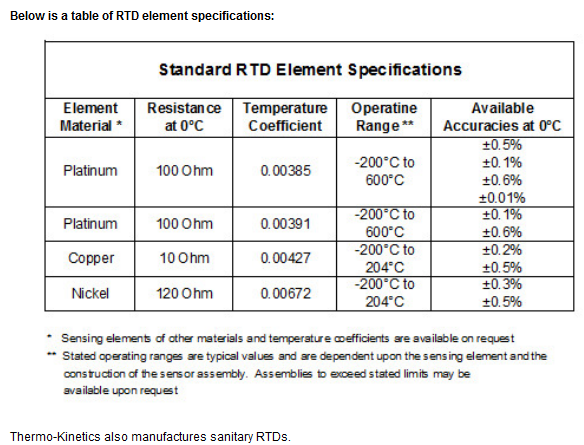
RTDs are sensors used to measure temperature by associating the resistance of the RTD element with temperature. The RTD element is made from pure material, most commonly platinum, but also nickel and copper. Platinum is a noble metal and has the most stable resistance-temperature relationship over a large temperature range.RTDs are slowly replacing thermocouples in many industrial applications below 600°C, due to their higher accuracy and repeatability. Thin film elements are most commonly used today, although ceramic wire wound elements still have their place. Ceramic wire wound RTDs are used when the temperature being measured is higher or if there is vibration in the application.
Resistance Temperature Detectors (RTDs) are used for industrial temperature measurements where high accuracy and long-term stability are required. The 100 ohm platinum element is the most common for industrial applications. The 3-wire lead configuration is used for industrial temperature measurements and provides adequate compensation for leadwire resistance. The 4-wire arrangement fully eliminates all leadwire effects and is used in applications where high accuracy is required.
Product Features:
- Rugged Construction
- Accurate and Stable Probes
- General Purpose, Tip Sensitive, High Temperature and High Vibration Probes and Assemblies
- 2, 3 and 4 Wire Configurations
- General Purpose or Spring Loaded Mounting, with or without Thermowells
- Nipple, Nipple-Union-Nipple or Bushing Extension Hardware
- CSA Approved Assemblies for Hazardous Locations in certain configurations
- Averaging RTDs
- Custom Configurations
- Head Mounted Transmitter Options
- In-house calibration available
RTDs are slowly replacing thermocouples in many industrial applications below 600°C, due to their higher accuracy and repeatability.
Thin film elements are most commonly used today, although ceramic wire wound elements still have their place. Ceramic wire wound RTDs are used when the temperature being measured is higher or if there is vibration in the application.
Advantages of RTDs include:
- High accuracy
- Low drift
- Wide operating range
- Suitability for precision applications
Disadvantages of RTDs include:
- More expensive
- A current source is required
- Less rugged than thermocouples
- Vibration requires special construction
Classifications of RTDs:
- Industrial Platinum Resistance Thermometers: These are designed to withstand industrial environments. Sheath material is typically 316 stainless steel, with or without a thermowell; higher temperature applications may require Inconel.
- Standard Platinum Resistance Thermometers: These are generally used in laboratories and are very expensive because they use larger diameter reference grade platinum wire. They are usually supplied with a quartz or Inconel tube depending on the temperature range.
- Secondary Standard Platinum Resistance Thermometers: These are constructed like the SPRT but the materials are more cost effective.