


- Home
- Companies
- SA Fire Protection
- Products
- SA-Fire - Model HFC 227 ea - Halocarbon ...
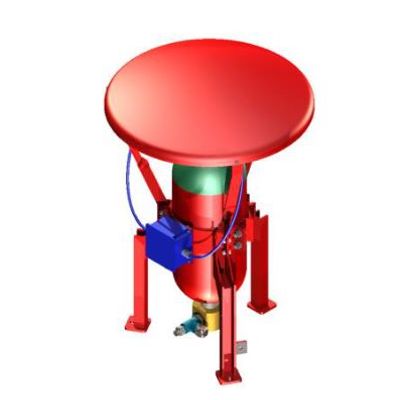
SA-Fire - Model HFC 227 ea -Halocarbon Rim Seal System
The SA type HALOCARBON HFC 227 ea is an Automatic gas based Rim Seal Fire Suppression System integrated with a pneumatic fire detection tube. The system is used on top of Floating Roof Tanks to protect the seal zone and is designed for early fire detection and fast suppression acting directly on the rim seal zone by means of bulb type nozzles.
The system is available in two different configurations: Wet Type and Pre-action. In the wet type configuration the system uses the same distribution circuit for fire detection and discharge of the extinguishing gas. In such case when a fire break out in the nm seal zone: the thermic bulb of the nozzle breaks releasing the extinguishing agent. In the pre-action configuration the system employ an external fire detection module that coupled with the closed head nozzles forms a system that requires a double consent for releasing the gas. The distribution piping is normally kept empty at atmospheric pressure whereas the extinguishing gas is kept pressurised in the cylinder. The activation of the system is achieved using a pneumatic fire detection module with a pre-action control trim to which a linear pneumatic heat detector (PLHD) is connected. The PLHD runs all over the rim seal zone where the discharge nozzle are located. If fire condition the system will discharge only when both detectors (PLHD and Nozzle bulbs) are activated The system is calculated to discharge in a very short time variable from 30 to 40 seconds in order to extinguish the fire and avoid fire spread. The coverage of each unit shall be evaluated depending on each floating roof tank: its foam dam geometry and the NFPA 30 classification of its contents. However, in most cases the unit is valid for roughly 40 meters of seal circumference protection. On board of every unit, there are one pressure switches and one level switch Ex-ia used to control system pressurization and activation respectively. Every installation may be configured in a point to point or common zone depending on the interconnection and cable routing that is preferred.