


- Home
- Companies
- Sahut-Conreur
- Products
- Sahut-Conreur - Grinding Process System
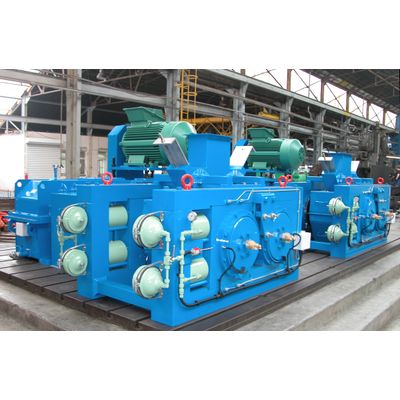
Sahut-Conreur - Grinding Process System
From a long experience of design and construction of double roll presses, SAHUTâ€CONREUR has developed a range of roller press specifically adapted for grinding application. These machines can crush materials of variable size range. The material fed between the rollers is ground and comes out as friable flakes. Depending on the flowing of the product and its bulk density, in some cases a gravity feed system is sufficient to feed the rolls.
For materials with low density and critical flowing, the feeding of the rolls must be ensured by a pre‐densification screw (force‐feeder). In most cases, a single pass through the roller press is sufficient to obtain the desired particle size reduction. If the final product requires an extremely fine particle size or if the particle size range is very accurate, a screen or an air classifier must be installed after the roller press. Oversized particles are returned to the roller press for a new grinding pass.
Compared with traditional techniques, the use of this process means:
- Energy savings up to 50% for some materials.
- Throughput increases of crushed end‐product from 30 to 100% when the process is fitted into an existing grinding circuit.
- A cost decrease of production and low wear maintenance of these equipment.
- A low noise operation.
- A low space required.
- High availability.
- No contamination of the product.
The grinding with roller press can be installed either in a new plant or an existing one by replacing old technologies.
The raw material used during the manufacture of titanium dioxide pigments, often issued of ores as Rutile (R) or Anatase (A), undergo calcination treatments before to be finely grinded. This grinding process is very important due to its influence on the next steps of process but also because of energetic and maintenance costs. Since several years, the roller press has been introduced in this grinding process to replace pendulum mills or hammer‐mills.
A secondary grinding realised by a ball mill or a high‐speed disperser allowing the flake breaking shaped during the first step and the obtaining of a very fine product with a size range of about 0,2 to 3 µm. Beforehand this secondary grinding, the TiO2 flakes are mashed in the ball mill or the high‐speed disperser.
Roller press has increasingly highlighted its very important crushing effect in modern titanium dioxide production especially in the production of plastic grade TiO2 and Ink grade TiO2 such as TR52 products so on. More and more Titanium dioxide factories around the world especially sulfate titanium dioxide factories choose roller press as their important crushing equipment to improve the quality and stability of their products.
The below table shows the advantages generated by the introduction of grinding by Roller Press associate to high speed disperser instead of Raymond/Hammer‐mill.
SAHUT‐CONREUR has developed roller presses, specially designed for the grinding of clinker for cement production. In the past, the grinding of clinker, commonly carried out by ball mills, required heavy investments and generated a high energy consumption associated with important maintenance costs.
- In combination with a ball mill, the roller press performs a pre‐grinding of the clinker before it is fed into the ball mill.
- Integral grinding carried out by the combination of a roller press, a separator with desagglomerator stage and an elevator.