


- Home
- Companies
- Sauereisen Inc.
- Products
- Sauereisen - Model 65 - Corrosion ...
Sauereisen - Model 65 -Corrosion Resisting Mortar
Sauereisen Corrosion-Resisting Mortar 65 is a completely inorganic, potassium silicate base mortar for bonding acidproof brick or tile used in the construction of industrial chimneys, stacks, tanks, kilns and floors. 65 is a two-component material, consisting of a Powder and a Liquid, which are mixed together as used on the job. Mortar65 is applied by troweling in the same manner as ordinary bricklaying.
Physical properties were determined on specimens prepared under laboratory conditions using applicable ASTM procedures. Actual field conditions may vary and yield different results; therefore, data are subject to reasonable deviation.
65 is particularly recommended for installations handling all concentrations of sulfuric acid and strong oxidizing acids such as nitric and chromic. The mortar is highly resistant to sulfation, which may develop in other types of silicate base cements when brickwork is subjected to alternate wetting and drying, fluctuating dewpoints or acid mist conditions.
65 is preferred as a mortar for bonding brick linings in large industrial chimneys handling combustion gases from sulfur bearing fuel. With the trend towards lower operating temperatures in these chimneys, there is considerably stronger acid condensation and increasingly higher moisture present in the gases. As a consequence, moisture can be as great a problem as acids, and it is extremely important that the materials used to line the chimneys are both acid and water resistant.
When fully cured, 65 is resistant to water and acids (except hydrofluoric) throughout the complete width of the joint. In flue gas systems, 65 may be safely exposed to weak alkaline salts alternating with acid exposures. The improved chemical resistance of 65 permits use in higher pHs – depending on the alkali, its concentration and temperature. Consult Sauereisen for a specific recommendation.
- Resists most solvents, oil and acids (except hydrofluoric) over a pH range of 0.0 to 7.0. Not recommended for alkalies.
- Rapid setting – permits continuous construction without brickwork slipping out of line.
- Noncorrosive – may be used in direct contact with steel, iron, lead and most other materials.
- Highly resistant to sulfation, blooming and efflorescence.
- Develops lineal shrinkage of less than 1.0% as compared with lineal shrinkage of 3.0% or more developed by other potassium silicate cements.
- Safe to use – does not emit noxious or hazardous fumes or odors during mixing, application or setting.
- Bond strength (ASTM C-321): 170 psi (11.9 kg/cm2)
- Color: Off white
- Compressive strength (ASTM C-579): >3,000 psi (>211kg/cm2)
- Coefficient of thermal expansion: 7.4 x 10⁻⁶ in/in/ºF (13.3 x 10⁻⁶ cm/cm/ºC)
- Density (ASTM C-20): 123 pcf (1.97 gm/cm3)
- Maximum service temperature (ASTM D-648): 1250ºF (677ºC)
- Mix ratio (Powder: Liquid by weight): 7:3
- Modulus of elasticity (ASTM C-580): 5.6 x 10⁴ psi (3.9 x 10³ kg/cm2)
- Recommended pH range for use: 0.0-7.0
- Shrinkage (ASTM C-531): 1.0%
- Tensile strength (ASTM C-307): 400 psi (28 kg/cm2)
- Thermal conductivity (C-1117): 4.8-5.80 BTU·in/ft2·hr·ºF (1.65 x 10⁻³ - 1.99 x 10.-3 Cal·cm/cm2·sec·ºC).
Physical properties were determined on specimens prepared under laboratory conditions using applicable ASTM procedures. Actual field conditions may vary and yield different results; therefore, data are subject to reasonable deviation.
Temperature of Working Area
Maintain a temperature of 50o - 80oF on air, substrate, No. 65 Powder, No. 65 Liquid, and masonry units during mixing, application, and cure.
At temperatures below 50oF, the viscosity increases, application becomes more difficult and curing is retarded. No. 65 Liquid should not be subjected to freezing temperatures. Consult Sauereisen for specific recommendations.
Above 80oF, working time of the material decreases. This can be overcome by mixing in a cooler area, cooling the mortar mixing equipment with ice water and/or cooling the No. 65 Liquid prior to mixing.
Surface Preparation
All surfaces in contact with No. 65 should be clean, dry, and free of dust, dirt, grease, oil, and other contaminants. Surface prep should be in accordance with membrane requirements.
Mixing
Mixing should be done mechanically with a slow-speed mortar mixer. The mixing equipment must be clean and free of Portland cement or other contaminants. The size of the batch will be governed by the area to be covered, the number of workers applying the material, and the speed with which it can be placed.
Weigh a convenient amount of No. 65 Powder into a container and the appropriate amount of No. 65 Liquid into a second container. Mark the levels of each container so that succeeding measurements can be made by volume, thus eliminating the necessity of weighing each batch.
Pour the entire amount of No. 65 Liquid into the mortar mixing equipment. Add the No. 65 Powder slowly to the No. 65 Liquid mixing continuously to reduce the entrapment of air. Mix thoroughly for at least 5 minutes until cement is a uniform, smooth consistency.
Material which has begun to set cannot be retempered and must be discarded. Never add Liquid or other materials to mixed material or any component part.
Installation
Trowel on an average 1/8-inch thick bed joint of 65 directly on top of membrane or preceding course of brickwork. Apply the mortar by buttering one side and one head joint of each masonry unit. Set the masonry units in place and position by tapping to form an average 1/8-inch wide vertical joint.
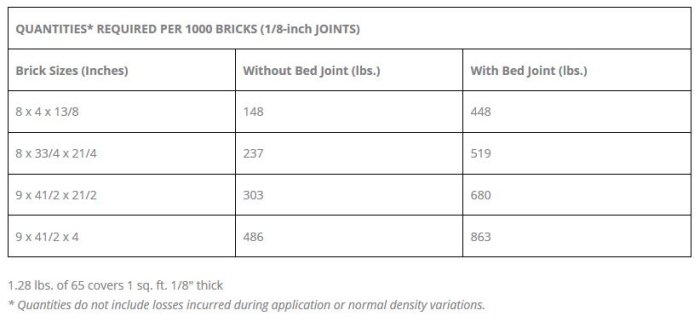
Strike extruded mortar off the face of the masonry unit with a trowel.
All equipment should be cleaned by scrubbing with a stiff brush and water at the end of each working period, or when buildup becomes pronounced. If removal is required after cure, consult Sauereisen for recommendations.
65 is self-hardening due to a chemical reaction which occurs when the Powder and Liquid are mixed together. An initial set occurs in 30 to 45 minutes; the final set is achieved in 24 to 48 hours depending on temperature. No acid wash is required except in the event of mortar being exposed to water before final cure. Brickwork should not be subjected to water, steam or chemical environment before mortar is completely cured.
- 65 Liquid
- 50 lbs. in 5-gal pail.
- 600 lb.: drum.
- 65 Powder: 50 lb. moisture resistant bags on plasticwrapped pallets.
Sauereisen 65 Powder has a shelf life of six (6) months; 65 Liquid has a shelf life of one (1) year when stored in unopened, tightly sealed containers in a dry location at 70°F. Avoid freezing. If there is a doubt as to the quality of the materials, consult a Sauereisen representative.
Consult Safety Data Sheets and container label Caution Statements for hazards in handling these materials.
We warrant that our goods will conform to the description contained in the order, and that we have good title to all goods sold. WE GIVE NO WARRANTY, WHETHER OF MERCHANTABILITY, FITNESS FOR PURPOSE OR OTHERWISE, EXPRESS OR IMPLIED, OTHER THAN AS EXPRESSLY SET FORTH HEREIN. We are glad to offer suggestions or to refer you to customers using Sauereisen cements and compounds for a similar application. Users shall determine the suitability of the product for intended application before using, and users assume all risk and liability whatsoever in connection therewith regardless of any suggestions as to application or construction. In no event shall we be liable hereunder or otherwise for incidental or consequential damages. Our liability and your exclusive remedy hereunder or otherwise, in law or in equity, shall be expressly limited to our replacement of nonconforming goods at our factory or, at our sole option, to repayment of the purchase price of nonconforming goods.
- Distributors and agents in major cities throughout the world. Consult manufacturer for locations.
- Information concerning government safety regulations available upon request.
- Sauereisen also produces inorganic compounds for assembling, sealing, electrically insulating and grouting