

- Home
- Companies
- SciAps, Inc.
- Products
- SciAps - Model Z-903 - Handheld LIBS ...
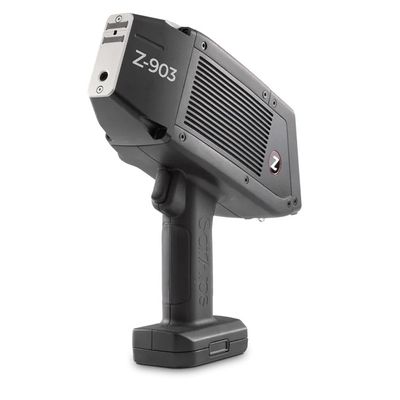
SciAps - Model Z-903 -Handheld LIBS Analyzer
The Z-903 measures every element in the periodic table of the elements – from H to U. It uses the same powerful laser as SciAps other Z-900 models, but with an extended spectrometer range from 190 nm out to 950 nm. The extended range allows emission lines from elements H, F, N, O, Br, Cl, Rb, Cs and S to be measured. These lines cannot be measured with the other Z-900 series analyzers. There are other benefits to the extended range. For example, it measures a more sensitive line for lithium near 675 nm to achieve limits of detection in the 2-5 ppm range. It also measures a more sensitive, and interference-free line for potassium (K). The more traditional potassium lines have heavy iron interference, whereas the line used by the Z-903 is free of such interference. In use globally for mineral exploration including lithium in hard rock and brines. It is also used in forensics, authentication, archeology, and oil/gas exploration due to the wide elemental range.
The Z is the world’s only handheld offering elemental micro-analysis in the field. Users may set up the raster to a grid pattern, using the 100 um laser spot size for elemental heat mapping point-by-point. For bulk samples, the Z can be set to average results from every raster location for a bulk sample result, just like handheld XRF analysis.
Australian Synchrotron’s X-ray fluorescence microprobe (XFM) data courtesy of Shaun Barker (University of Waikato) and Jeremy Vaughan (Barrick).
The Z-903 accomplishes what no other portable analyzer has done. It’s a handheld analyzer that measures every element in the periodic table of the elements – from H to U.
It uses the same powerful laser as SciAps other Z-900 models, but with an extended spectrometer range from 190 nm out to 950 nm.
- The extended range allows emission lines from elements H, F, N, O, Br, Cl, Rb, Cs and S to be measured. These lines cannot be measured with the other Z-900 series analyzers.
- There are other benefits to the extended range. For example, it measures a more sensitive line for lithium near 675 nm to achieve limits of detection in the 2-5 ppm range.
- It also measures a more sensitive, and interference-free line for potassium (K). The more traditional potassium lines have heavy iron interference, whereas the line used by the Z-903 is free of such interference.
The Z-903 is most widely used for mineral exploration including lithium in both hard rock and brines. It is also used in forensics, authentication, archeology and oil/gas exploration due to the wide elemental range.
The laser strike pattern, cleaning shots, spectrometer settings are all under user control. The analyzer includes advanced software for modifying all settings, comparing spectral data, and for generating quantitative calibration curves. The Z-903 features the same Android OS and intuitive App-driven software as all other SciAps models.
Extend the Range
The key to rock solid, in-field carbon analysis for alloys.
-
Identification of stainless steels and low alloy steels, including carbon analysis down to 70 ppm and instant CE (carbon equivalents) calculations.
-
Powerful laser, on-board argon purge and high resolution spectrometer are built for carbon.
-
Narrow profile for accessing the tightest spaces, aerospace-grade aluminum body for improved performance in high ambient temperatures, and re-designed user-interface. The most usable platform on the market, at only 4.35 lbs. (1.97 kg).
Spectrometer range 190 nm – 625 nm. Includes a third, dedicated spectrometer for superior resolution.
PMI and NDT
Confirm alloy type and grade 300 series stainless steels into L, H, and S series. Carbon equivalent for welding. Material verification pre- and post-fabrication. Validating mill test reports. Material verification in chemical plants and refineries. Re-rating vessels.
Pipeline integrity management
Grading. Determining carbon equivalents. Validating MTRs.
Steel production
Screen incoming scrap material. In-process quality control. Resolving material mix-ups. Rapid screening of material at EAF for heat compliance.
Weight
4.35 lbs. (1.97 kg) with battery
Processing Electronics
ARM Quad Cortex -A53 1.2GHz memory: 2 GB LPDDR3, 16 GB eMMC
Dimensions
10.75 x 2.875 x 8.625 inches
Data Storage
Results Storage: 32 GB SD
Spectral Range
190 nm – 625 nm
Display
3.5-inch high-brightness color touchscreen, readable in all conditions. Rear-facing display for easy results viewing.
Drift Correction
On-board automated drift correction software with factory or user-provided reference materials.
Sample Viewing
Integrated camera and laser target indicator before and during analysis provide proper sample alignment. Includes 2nd “macro camera” for scanning QR or bar codes and for photo-documentation and report generation.
Power
On board rechargeable Li-ion battery, rechargeable inside device or with external charger, AC power.
Regulatory
CE, RoHS, USFDA registered. Class 3b laser. Sample sensor on board, allows for operation under Class 1 conditions subject to local LSO approval.
Laser Raster
On-board Y stage for rastering laser to discrete locations for targeted analysis or averaging.
Connectivity
Built on Google’s Android platform for real-time data exporting, including built-in WiFi (IEEE 802.11b/g/n), Bluetooth (BR/EDR+BLE), GPS and USB-C to connect to virtually any information management system.
Security
Password protected. Multi-user support with configurable access.
Atmosphere
SciAps proprietary Opti-Purge inert argon environment improves spectral signal-to-noise ratio; improves performance in UV range.
Calibration Check
Internal 316 stainless check standard for calibration verification and wavelength scale validation.
Grade Library
500+ grades, multi-library support, libraries may be added or edited.
Analytical Range
One or more lines from all elements in the periodic table.