


- Home
- Companies
- Sepragen Corporation
- Products
- Sepragen Express - Bio Reactor
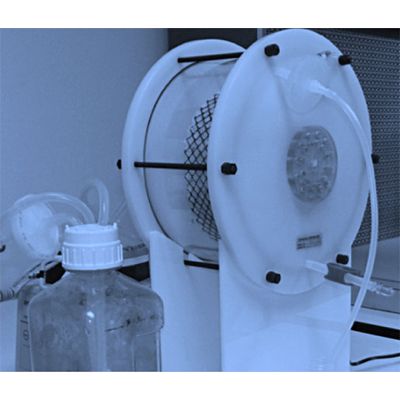
Sepragen Express - Bio Reactor
The patented Express® Bioreactor represents a Paradigm shift in culturing cells. Cells are grown on a bee- hive like spongy matrix which is suspended in a sterile chamber in an atmosphere of air/ CO2. This provides a high surface area and high oxygen availability for growing both suspension and anchorage-dependent cells. The cells can be grown in a batch, fed-batch or perfusion mode. The Express® Bioreactor is disposable, comes pre-sterilized and can be easily set up in a standard air/ CO2 incubator.
Unlike conventional bioreactors, the Express® Bioreactor requires no rocking or agitation whatsoever. By eliminating shear and the limitation of oxygen availability, 5- 30 fold higher cell densities and higher product yields are easily achieved.
Express Bioreactor Highlights
- 5-30 X Higher Productivity
- High Cell Density
- Attachment or Suspension Cells
- Hybridomas, CHO, HEK 293, Fungal, Insect Cells
- Grow in Serum, Harvest Serum Free
- Low media usage
- High Oxygen Availability
- Zero shear
- Perfusion or Batch
- Easy, single-use, disposable
- Cost-effective
- Small Footprint
The Problem with Traditional Culture Cell
All traditional bioreactors have one thing in common. Cells grow in the liquid nutrient medium which is also the means by which dissolved oxygen is transported to the cell surface. Air/ CO2 is dissolved in the medium by bubbling the gas into it followed by stirring or rocking of the medium to aid in its diffusion to the cells. The oxygen which is known to have a poor solubility in the medium is rapidly depleted as the cell density rises, resulting in apoptosis, an eventual “crash” or death of the culture. To prevent this, the bubbling, stirring or rocking rates are all increased over time to increase oxygen delivery. Unfortunately, these actions cause an increase in shear rates that fragile mammalian cells cannot handle. In perfusion systems like hollow fibers rate of media exchange is increased to enhance oxygen transport. This leads to direct increase in media consumption, and increased cost of goods.
The Breakthrough Solution
In the Express® Bioreactor, the feeding and the oxygen transport are decoupled. The very porous honey- combed matrix is constantly exposed to air/ CO2 and provides a large surface area for a large population of cells to grow on mimicking a “lung” with superior gas exchange abilities. Fresh media is constantly dripped on to the matrix and allowed to wick through the matrix to the cell surface. Product and waste metabolites are constantly removed while the cells are growing only a thin layer of medium away from O2. This unique design can thus support high cell density, high oxygen availability and nutrient exchange while continuously removing product and deleterious waste metabolites from the cells with zero shear. Surface treatment of this biocompatible matrix assures growth of conventional suspension cells as well as difficult to grow attachment cells. Hybridomas, HEK 293, CHO fungal, yeast and insect cells have all been grown in the Express® Bioreactor.
How it Works
Culture media is continually dripped very slowly onto the top of the “lung”-like matrix and allowed to wick by capillary action, as a very thin film over the entire growth surface. Circulating air flows freely throughout the large pores integral to the matrix. Cells are never submerged, but continually bathed by the thin film of culture media, thus allowing every growing cell equal access to highly efficient gas-exchange.
Innoculation, feeding and harvesting are all completed in a simple media exchange procedure. To date a variety of cell lines including hybridomas, CHO, human embryonic kidney (HEK), fungal and insect cells have all been successfully grown to high densities.
Comparison of the Express® Bioreactor vs. Standard Stirred Tank (data courtesy 3M Corp.)
This experiment was designed to compare the productivity of a standard 1 liter stirred tank bioreactor with a similar sized Express® Bioreactor. Hybridoma cells were grown in both bioreactors and the cumulative output of antibody produced was measured. The data shows a 15-fold higher antibody production in the Sepragen Express® Bioreactor.