


- Home
- Companies
- S.K. Euromarket Ltd
- Products
- S.K Euromarket - Membrane Filtration - ...
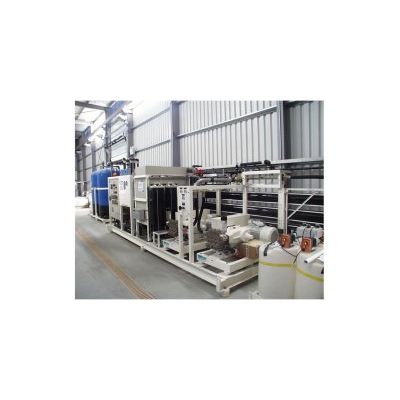
S.K Euromarket - Membrane Filtration - Reverse Osmosis System
For applications where a very high quality effluent is required, membrane filtration is the most appropriate technology utilized. Euromarket`s membrane filtration systems range from microfiltration to reverse osmosis (RO) and are custom-made to serve big industrial or commercial applications for: Purification of brackish water, Desalination of sea water, Removal of impurities, bacteria, sugars and small particles.
Design Criteria
- The salinity or the concentration of particles / impurities to be removed
- The flow characteristics of the incoming stream: average flow, peak flow, duration of fluctuations
- The desired quality of the outgoing effluent stream
- The available space for installation
Basic System Components
The basic components of our membrane filtration systems include the follwing:
- Booster high pressure pump(s)
- Pressure vessel
- Membrane modules
- Product and reject flow meters
- Pressure gauges and low pressure switches
- Water quality instrumentation (TDS meter)
- Coarse pre-filtration (optional)
- Control panel
All components and pieces of equipment such as booster pumps and membrane modules are sourced by reputable international manufacturers with whom we have long term partnerships.
Vessels and tanks are in-house designed and manufactured to the highest specification standards and with materials and processes fit for each particular application.
Membrane filtration is a general term used to describe various liquid-solid separation processes. There is an increasing use of membranes as a result of the great amount of effort that is put into the development of more reliable and more efficient membranes. Nowadays, membrane filtration is a competitive with conventional techniques.
Membrane separation technology is based on the use of semi permeable membranes. The operating principle is quite simple: the membrane acts as a very specific filter that will let water flow through, while it retains suspended solids and other substances including living microorganisms. To enhance the effectiveness of the process, water is typically forced to penetrate the membranes under high pressure.
- It provides high quality of purified effluent
- It is a physical process thus it doesn’t need any chemicals
- It is a process with low energy consumption. Most of the energy that is required is used to pump liquids through the membrane
- The operation of filtration systems is a straight forward operation
- It can perform equally well at low temperatures. This is mainly important because it enables the treatment of heat-sensitive media.
- Its capacity can be easily expanded
The concept behind membrane filtration is simple enough and the stages involved in the process are few. In fact, besides the membranes, only a pumping unit is required to boost the pressure of water to a certain level in order to pass from the membranes. After the membranes, filtered water is usually ready to be disposed to the end user.