

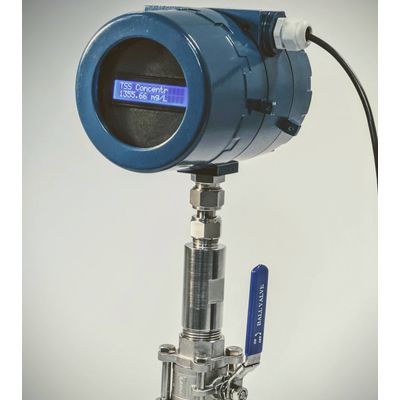
OLPAS - Model OTU-SDXA -Sludge Concentration sensor (TSS)
The Olpas Sludge Concentration sensors, use the innovative ultrasound OLPAS technology, thus providing a reliable and economical measurement. The technology used, provides a fouling-resistant measurement of the sludge concentration, independent of sludge type or morphology. There are several version available with a small transducer for easy inline installation, for installation with the Olpas hot-tap retractable, and versions that are optimised for installation in a bassin. With the unprecedented fouling-resistance, which results in maintenance interval that are 4 times longer compared to optical sensors, the sensor provides an economic measurement that is several times cheaper compared to alternative technologies. Several hardware versions are available, all using the same innovative OLPAS Technology.
A key-measurement to monitor aeration tanks...
Biological wastewater treatment, both aerobic or anaaerobic, relies on the acurate knowledge and controle of process parameters such as Total Suspended Solids (TSS) or MLSS (Mixed Liquor Suspended Solids). Specifically MLSS in aeration tanks is a key parameter to operate a wastewater treatment plant (WWTP) reliably.
and an essential measurement in the dewatering process
Measuring the sludge concentration at the inlet of the dewatering unit allows pro-active adaptation of the dewatering process. Knowing the variations in the ingoing sludge, is vital to determine the most optimal process: the parameters of the dewatering unit, and the amount of polymers to add.
An accurate measurement that swiftly follows the real concentration trend allows the control system logic to adapt the added polymer content or sludge flow-rate.
Where optical turbidity sensors fail
Current state-of-the-art optical sensors fail to measure the concentration accurately in changing conditions, due to their dependence on the optical parameters of the sludge. Furthermore, fouling is present after a few days of operation that cannot be fully reversed by the fault-prone mechanical wipers.