


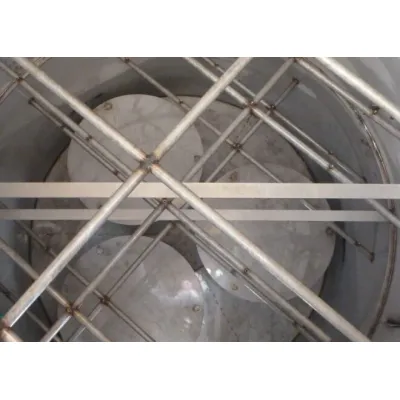
Socrematic WATSPRAY - Low-Energy Particulate Control Scrubber
The WATSPRAY scrubber is a high-performance, low-energy wet scrubber designed for efficient particulate control, combining de-dusting and demisting functionalities within a single system. It operates as a cross-flow spray scrubber, utilizing a large quantity of recirculated liquid sprayed perpendicular to the gas flow to effectively clean gases. As the gas ascends through a vertical column, the system sprays the liquid in flat circular layers over multiple stages. This design optimizes the scrubbing process, making it ideal for applications like dust removal from pulp dryers in the sugar industry and alfalfa dryers. The WATSPRAY® scrubber represents a cutting-edge solution with a minimal water and energy footprint, ensuring compliance with emission regulations while maintaining operational efficacy.
The WATSPRAY® tower scrubber is a low energy scrubber and is the simplest wet scrubber used for particulate control.
The WATSPRAY® system is composed of two different parts:
- The absorption and de-dusting section
- The eliminator chamber with swirl vane demister or WATVANE® or WATMESH® demister depending on particle size to be catched (can be combined).
The WATSPRAY technology is a cross-flow spray scrubber. The recirculated liquid, used to dedust the gas, is sprayed in large quantities and perpendicular to the direction of movement of the gas to be cleaned. As the gas passes through the column from the bottom to the top, the liquid is sprayed horizontally in the form of flat circular layers over several stages.
A typical application of the WATSPRAY chimney is the dust removal of pulp dryers in the sugar industry as well as alfalfa dryers
The ultimate low water and energy footprint dedusting solution
Capacity
- Gas flow: up to 500 000 m³/h
- Particle size distribution: > 6 µm
Advantages
- Low water consumption due to maximum water recycling in the process
- Low energy consumption due to low pressure drop generated by the system
- Space saving
- Simultaneous absorption of gaseous pollutants possible