

SoilMoisture / Stevens - Soil Sampling Augers
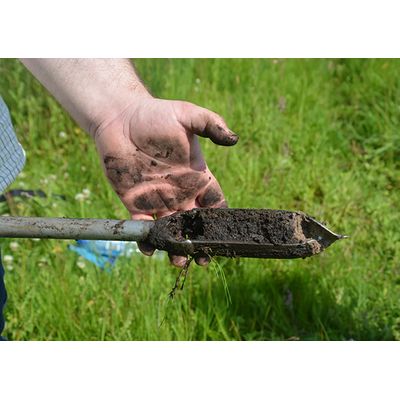
Soil sampling augers are tools used to collect soil samples from the ground for analysis. They are commonly used in agriculture, environmental science, geology, and construction to assess soil composition, structure, contamination, or nutrient levels. A soil sampling auger is basically a cylindrical tool with a handle and a helical or bucket-shaped blade at the end. It is twisted into the soil by hand or with a powered driver, allowing the user to extract a core or column of soil.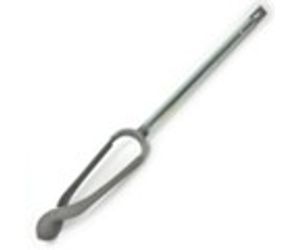
HELICA augers and EDELMAN augers are specialized tools used in soil sampling and investigation, particularly in hydrology, agriculture, environmental studies, and geotechnical work. Each is suited to specific soil conditions and sampling needs:
Edelman Auger (provided by SoilMoisture): General-purpose soil sampling in most soil types, especially loamy and cohesive soils. Ideal for describing soil profiles and collecting soil samples for analysis. Used in agronomic and environmental studies to assess soil horizons, moisture, or contamination.
Features:Semi-circular, spoon-shaped blades that cut and hold soil. Good for hand-boring to moderate depths (typically up to 5 meters). Minimally disturbs the soil structure, making it useful for horizon identification.
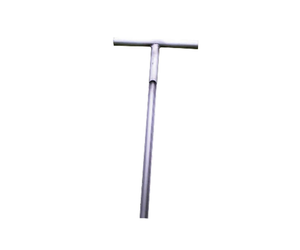
Gouge augers are specialized soil sampling tools used primarily for collecting undisturbed, cylindrical soil cores in soft, cohesive, or waterlogged soils, such as peat, clay, or muddy sediments. They are commonly used in environmental, geological, and agricultural studies. Use applications:
- Wetlands and Peatlands: Ideal for sampling soft organic soils like peat or muck.
- Hydrological and Ecological Studies: Used to examine soil structure, organic content, and stratification in marshes, floodplains, and lowland areas.
- Undisturbed Soil Sampling: For soil profile description and analysis of horizons, structure, and layering, especially where minimal disturbance is crucial.
- Shallow Coring: Typically used for sampling to depths of around 1 to 2 meters, though extensions can allow deeper sampling.
Design Feature: Half-cylinder (open-faced) used for softer, wet soils, often in environmental or peat soil sampling. Minimizes the distortion of a sample, which makes them suitable for profile research and sampling.Allows for clear visibility of the soil profile and easy extraction of the core.
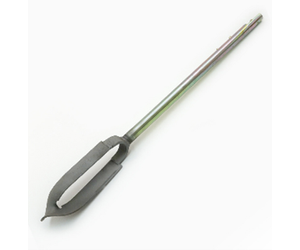
Loam Soils Augers, also known as Dutch augers, are used primarily for sampling loamy, mixed, and moderately cohesive soils. They are a type of Edelman auger, specially shaped for versatile use across a range of soil textures — particularly where sand, silt, and clay are present in balanced proportions (i.e., loam soils).
Loam Soil / Dutch Augers Are Used:
- General soil investigations in agriculture, hydrology, and environmental studies.
- For describing soil profiles and collecting samples in non-stony, moderately firm soils — like loam, sandy loam, and silty clay loam.
- When versatility is needed across multiple soil types, particularly in areas with transitional horizons.
- For manual sampling in fieldwork, typically to depths of 1 to 5 meters, depending on extensions and soil resistance.
Design Features: Wing-shaped blades with a rounded bottom — designed to cut through and retain loamy soil effectively. Offers a good balance between penetration and sample retention in medium-textured soils.
Not ideal for Very hard, compact, or gravelly soils (better suited for Helica/Spiral augers), or for ery soft or saturated soils like peat or muck (Gouge augers are better here).
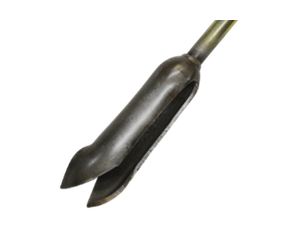
A stony soil auger is specifically designed for sampling or boring into soils that contain a significant amount of gravel, stones, or coarse fragments. It's commonly used in the following contexts and locations:
1. Agricultural and Soil Surveys
- Purpose: To assess soil composition, fertility, and suitability for farming
- Where: Rocky or gravelly fields, orchards, and pastures—often in upland or mountainous agricultural zones.
2. Environmental and Geological Studies
- Purpose: To collect subsurface samples for environmental monitoring, remediation assessments, or geological research.
- Where: Stony hillsides, glacial tills, or coarse alluvial deposit3. Construction and Civil Engineering
3. Construction and Civil Engineering
- Purpose: To evaluate subsurface conditions for foundations or infrastructure projects.
- Where: In gravelly or rocky terrain, such as road cuts, utility trenches, or undeveloped land with shallow bedrock.
4. Forestry and Land Management
- Purpose: To understand soil conditions for tree planting, forest health assessments, or fire risk evaluation.
- Where: Forested regions with naturally stony soils, especially in temperate and boreal zones.
5. Archaeology Fieldwork
- Purpose: To examine stratigraphy or locate artifacts in areas where manual digging is difficult.
- Where: Rocky or uneven sites with a mix of natural and cultural layers.
Features of a Stony Soil Auger:
- Reinforced cutting edge or open-blade design to handle rocks and gravel.
- Shorter and thicker blades than standard augers to reduce breakage.
- Often used with hammering or percussion attachments to penetrate tough layers.
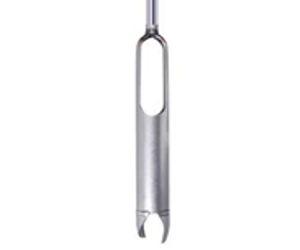
A Riverside auger is used when sampling or investigating coarse, rocky, or gravelly soils, especially those found in riverbeds, floodplains, or stony terrains. Its design allows it to handle challenging conditions that would clog or damage standard soil augers.
Why Choose a Riverside Auger?
- Handles coarse fragments (gravel, small stones).
- Less prone to jamming than standard augers in rough soils.
- Ideal for shallow to moderate-depth sampling.
- Often used manually or with portable rigs in remote or uneven terrain.
Typical Uses of a Riverside Auger
1. Soil Sampling in Stony or Gravel-Rich Soils
- Why: Its open, rugged design resists clogging and allows rocks and coarse fragments to pass.
- Where: Alluvial soils, glacial tills, or construction sites with coarse fill.
2. Environmental Site Assessments
- Why: It can penetrate disturbed or naturally rocky soils often found in river valleys and floodplains.
- Where: Brownfield sites, riverbanks, or riparian zones needing contamination checks.
3. Geotechnical Investigations
- Why: Useful for preliminary subsurface characterization before drilling or construction in rocky areas.
- Where: Roadway corridors, bridge abutments, or hillside developments.
4. Hydrological and Riparian Studies
- Why: Helps collect soil from areas influenced by seasonal flooding or fluvial processes.
- Where: Along streambanks, wetlands, or near river terraces.
5. Archaeological Fieldwork (Selective Use) - Why: For initial probing in coarse, disturbed, or naturally rocky soils where hand excavation is impractical.
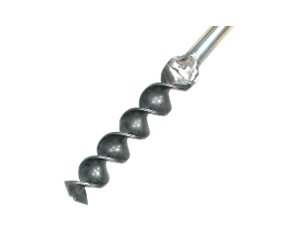
Helica Auger (aka Spiral Auger or Flight Auger) - Best for hard, dry, or sandy soils, including coarse gravel or dense layers that resist penetration. Often used when deeper or more forceful boring is needed than an Edelman auger allows.Suitable for initial boring before switching to another auger type because Helica Auger efficiently removes loose material and provides relatively fas penetration.
Features:Spiral or corkscrew-shaped blade that drills into soil. Efficient at breaking through compact layers or penetrating resistant soil. Often used in conjunction with other augers for composite sampling.