


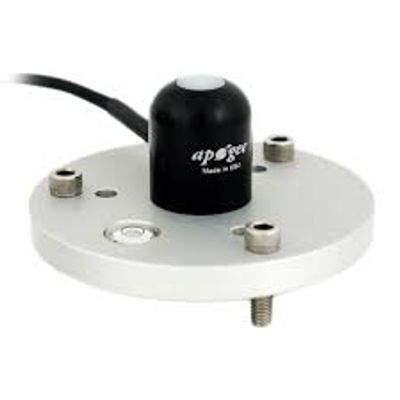
Apogee - Model Series -Solar Radiation Sensor
A solar radiation sensor (also called a pyranometer) is a device that measures the total solar energy received on a surface over time, typically expressed in watts per square meter (W/m²). A solar radiation sensor measures global solar radiation, which includes Direct solar radiation – sunlight that travels straight from the sun; Diffuse solar radiation – sunlight scattered by clouds, dust, or atmospheric particles; Reflected radiation – sunlight bounced off nearby surfaces (depends on sensor placement).Most popular related searches
solar radiation sensor
radiation sensor
green building design
atmospheric particle
photon flux
weather sensor
green building
meteorology sensor
radiation monitoring
hydrology
- Meteorology & climate .......................... Track solar input for weather, climate, and energy models
- Solar energy ......................................... Optimize placement and performance of solar panels
- Agriculture ............................................ Understand energy availability for crops and evapotranspiration rates
- Hydrology ............................................. Used with evapotranspiration models (e.g., Penman-Monteith equation)
- Green building design ........................... Assess site exposure for energy-efficient architecture
A solar radiation sensor contains a photosensitive diode or filter that converts light in the 400–700 nm range into an electrical signal. The signal is calibrated to give a readout in µmol/m²/s, representing the photon flux density available for photosynthesis.