


- Home
- Companies
- Droplet Measurement Technologies (DMT)
- Products
- DMT - Model SPIN - Spectrometer Ice ...
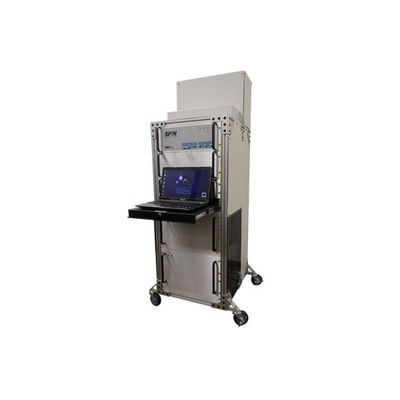
DMT - Model SPIN -Spectrometer Ice Nuclei
The SPIN is the first commercially available ice nuclei counter, with a particle detection range from 0.3 μm to 10 μm. Particle detection allows for individual particle sizing and discrimination of ice and water particles using polarization change in the scattered light.
Real-time particle phase change
Detect particle phase change via an advanced optical particle counter and four optical detectors to report side scatter (sizing) and back-scatter (depolarization).
Reproducible, exchangeable testing conditions
Create custom automated SPIN ramp profiles to provide a convenient and reproducible method of testing conditions exchangeable with other SPIN users.
Portable, single rack design
Deploy in challenging environments not accessible with other ice nuclei technologies.
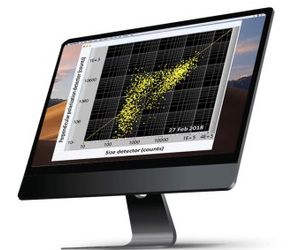
The SPIN is controlled by fully integrated software. This software offers the following features:
- Real-time display of measured and calculated data
- Real-time information about instrument status
- Easy configuration of the SPIN’s operating parameters
- Intuitive user interface
- Cloud Physics Research
- Weather Modification Research
Super saturation generation and particle light-scattering
Chamber:
- SPIN exposes particles to controlled temperature and RH conditions. The chamber walls are two parallel plates coated with a 1 mm layer of ice.
- A laminar airstream flows between the plates. A temperature difference is maintained between the plates so that water vapor and heat diffuse from the warmer to the colder wall.
- Linear profiles of water vapor partial pressure and temperature between the two walls leads to supersaturated conditions with respect to ice and water.
- In these conditions, droplets and ice can nucleate and grow. Droplets evaporate and shrink in the evaporator section. Those that breakthrough can be detected. The ice particles are counted as ice nuclei.
Particle detector
- OPC collects light scattered into a number of different angles, including back-scattering in two polarization planes. P-polarized light maintains the polarization of the incident light. S-polarized light is scattered at right angles to the incident light.
- Water droplets should produce very little S-polarized scattering; ice crystals will produce a mixture of S and P-polarized light.
- Comparing the S and P components of scattered light allows separation of water droplets from ice crystals.
- Measured Parameters : Single-particle light scattering (both normal and polarized light)
- Derived Parameters :
- Particle diameter
- Particle phase
- Size Range of activated particles : 0.5 – 15 µm
- Particle Residence Time in Chamber : 10 -12 seconds
- Chamber Design : Parallel-plate geometry
- Refrigeration :
- Self-contained compact system
- Cold plate temperature to -65°C, warm plate temperature to -40°C
- Particle Residence Time in Chamber : 10 -12 seconds
- Computer Capabilities :
- Full computer control of all systems
- Programmable ramp/soak temperature profiles
- Dimensions : Self-contained in a single rack, 59 cm wide x 73 cm deep x 167 cm high
- Power Requirements : 220 VAC, 50/60 Hz, 3000 W or 28 VDC, 3000 W