


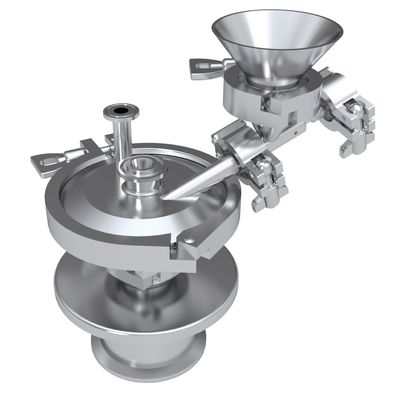
DP Pulverizer - Spiral Jet Mill - Ultra-Fine Precision Milling
DP Pulverizer Jet Mills use high-velocity gas to grind powders to submicron sizes with no moving parts—ensuring precision, purity, and consistent results. Our Jet Mills lead the industry in engineering, innovation, performance, & quality, all while keeping a realistic price point that everyone can afford.
Jet mills are essential in industries requiring ultra-fine, contamination-free powders
Pharmaceuticals
Micronizing active ingredients (APIs) for enhanced absorption and performance.
Cosmetics
Grinding pigments and powders for smooth texture and flawless finish.
Food & Nutraceuticals
Processing spices, extracts, proteins, and starches for clean nutrition.
Chemicals
Fine grinding of polymers, pigments, and specialty chemical compounds.
Aerospace & Ceramics
Milling technical ceramics and composites for high-heat applications.
Battery Materials & Electronics
Creating ultra-fine powders for cathodes, anodes, and conductors.
A jet mill is a type of industrial size-reduction equipment used to grind materials into very fine and ultra-fine particles, often in the micron and sub-micron range, without the use of mechanical grinding media.
Instead of relying on rotating blades, hammers, or balls, a jet mill uses high-velocity compressed gas—typically air, nitrogen, or steam—to accelerate particles to extreme speeds. The particles collide with one another inside a specially designed grinding chamber, fracturing along natural material weaknesses. This process is known as particle-to-particle impact milling.
Because there are no moving mechanical grinding parts in the milling zone, jet mills are exceptionally well-suited for materials that are:
- Heat-sensitive
- Abrasive
- Contamination-sensitive
- Chemically reactive
- Required to meet tight particle size distributions
Jet mills are widely used in industries where precision particle size control, purity, and repeatability are critical, including pharmaceutical manufacturing, nutraceutical processing, specialty chemicals, food ingredients, pigments, advanced materials, and battery powders.
Traditional milling technologies—such as hammer mills, pin mills, or ball mills—use mechanical force generated by rotating components to break particles down. While effective for many applications, mechanical mills introduce friction, heat, wear surfaces, and potential contamination.
Jet milling works differently.
In a jet mill:
- Grinding energy comes from compressed gas, not mechanical contact
- Material breaks through high-speed collisions, not cutting or crushing
- Heat generation is minimal due to gas expansion and short residence time
- There is no grinding media to wear, shed particles, or require replacement
This makes jet mills particularly effective for applications where mechanical stress, temperature rise, or metal contamination would compromise product quality.
Jet mills are commonly selected when final particle size requirements fall between:
- ~1 micron to 20 microns for ultra-fine applications
- Up to ~50 microns for controlled fine grinding
When integrated with an internal air classifier, a jet mill can deliver a narrow particle size distribution, ensuring consistent product performance batch after batch.
Manufacturers turn to jet milling when they need:
- Ultra-fine particle sizes without excessive fines
- Excellent temperature control for heat-sensitive materials
- High purity with minimal risk of cross-contamination
- Repeatable, scalable results from R&D through production
- Inert gas operation for oxygen-sensitive or explosive materials
Because jet mills rely on physics rather than mechanical force, they are often the preferred solution for high-value powders where product integrity matters more than raw throughput alone.
Jet mills are used to process a wide range of materials, including:
- Active pharmaceutical ingredients (APIs)
- Nutraceutical and botanical powders
- Sugar, starches, and specialty food ingredients
- Pigments, dyes, and colorants
- Fine chemicals and catalysts
- Ceramic and mineral powders
- Battery and advanced energy materials
The versatility of jet milling makes it a foundational technology in modern powder processing.
In industrial applications, a jet mill is rarely a standalone machine. It is typically integrated into a complete milling system, which may include:
- Precision feeding systems
- High-efficiency air handling
- Internal or external classification
- Dust collection and containment
- Explosion protection or inert gas operation
- PLC-based control systems
When engineered as a complete system, jet mills deliver exceptional control, safety, and consistency across demanding production environments.
Jet mills are essential in industries requiring ultra-fine, contamination-free powders
Pharmaceuticals
Micronizing active ingredients (APIs) for enhanced absorption and performance.
Cosmetics
Grinding pigments and powders for smooth texture and flawless finish.
Food & Nutraceuticals
Processing spices, extracts, proteins, and starches for clean nutrition.
Chemicals
Fine grinding of polymers, pigments, and specialty chemical compounds.
Aerospace & Ceramics
Milling technical ceramics and composites for high-heat applications.
Battery Materials & Electronics
Creating ultra-fine powders for cathodes, anodes, and conductors.