


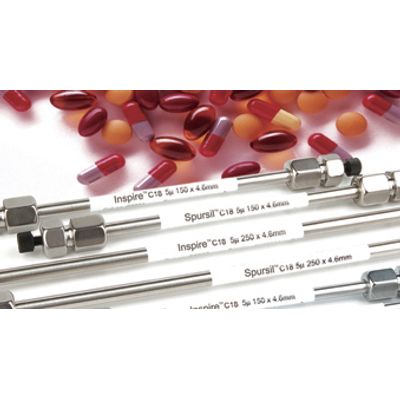
Spursil - Polar-Modified Columns
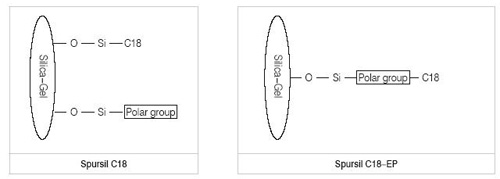
Spursil polar-modified phases are based on ultra high-purity silica and novel polar modification technology. The unique bonded phases maximize polar retention and selectivity, while virtually eliminating silanol activity. The resulting polar-modified packing material contains a surface which is easily `wetted` with polar eluents and can run in highly aqueous conditions. The polar group also seems to play a role in base deactivation. We have seen some evidence that hydrogen bonding occurs between certain polar linkers and the silica surface, thereby decreasing the interaction of such silanols with basic components in the sample. Additionally, polar-modified phases often provide selectivity quite different from standard C18 phases.
- Combine high purity silica with unique polar modification technology
- Unique selectivity and enhanced resolution
- Silanol shielding for excellent peak shape
- Improved water wettability and stable retention in highly aqueous mobile phase conditions
- Excellent retention for polar compounds
- Extended range pH stability
- Choose from a variety of selectivities and hardware formats
Standard reverse phase columns, particularly C18 columns, often suffer from "phase collapse" and the retention of the compounds is severely diminished when used in combination with highly aqueous phases. This phenomenon is substantially reduced with Spursil because the polar modifications make the phase less hydrophobic and more wettable. Polar-modified phases remain fully extended in aqueous phases, allowing increased interaction between samples and the bonded phase. Spursil columns show good retention of polar compounds which tend to elute in the void volume on standard ODS phases.
Spursil columns are available in 3, 5, and 10 micron particle sizes, column lengths are ranging from 30 mm to 250 mm, and column dimensions are ranging from 2 mm to 21.2 mm. Ten micron preparative materials are available in bulk form.

A chromatographic efficiency test is run on all columns. Plates per column and USP tailing factor are measured for each column to confirm packing efficiency. The USP tailing factor, a measure of peak symmetry at 5% of peak height, is a stringent indicator of peak shape. The test analytes are neutral hydrophobic compounds chromatographed in a acetonitrile: water mobile phase. The retention, selectivity, efficiency and peak symmetry of these molecules are measured to provide specifications for column performance.
Superior Peak Shape and Resolution for Basic Analytes
The most sensitive measurement of silanol interactions is achieved using highly basic probes with a pH 7 mobile phase. At this pH, many of the residual silanols are in their ionized form, and the basic probes are completely protonated. The protonated bases interact with the ionized silanols by an ion-exchange mechanism, and the degree of tailing is a direct measure of silanol activity. Basic compounds tend to tail on alkyl phases because of the interaction with the silanols on the silica surface. This can often cause increased retention but loss in performance (peak shape). Polar-modified phases shield the silica surface and provide improved peak shape. The separation of a complex mixture of tricyclic antidepressants, having both hydrophobic and polar characteristics, demonstrates the unique selectivity of Spursil™ columns, and the power of stationary phase manipulation in HPLC method development. The polar groups in Spursil™ phases impart a unique selectivity with good separation not observed in traditional alkyl phases. The peak symmetries and efficiency values obtained for these drugs, which are considered to be difficult HPLC candidates, furnish a good measure of performance of these columns for similar problem drugs compared to traditional alkyl columns.
TCAs at Neutral pH*
- Column: Listed on chromatograms
- Dimension: 150 x 4.6 mm
- Mobile Phase: MeCN:20 mM phosphate buffer (pH 7) = 2:1
- Flow Rate: 1.0 mL/min
- Temperature: Ambient
- Detection: UV 254 nm
- Sample:
- Desipramine
- Nortriptyline
- Imipramine
- Amitriptyline
- Trimipramine