


- Home
- Companies
- Kore Technology Limited
- Products
- Kore SurfaceSeer - Model I TOF-SIMS - ...
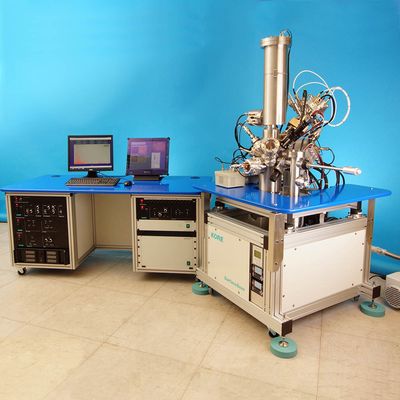
Kore SurfaceSeer - Model I TOF-SIMS -Surface Analysis With Imaging and Chemical Mapping System
The SurfaceSeer I is a high sensitivity TOF-SIMS for imaging and chemical mapping of insulating and conducting surfaces. The SurfaceSeer I is ideal for investigating the chemistry of surfaces and is equally at home in R&D as well as industrial quality control applications. The SurfaceSeer I uses the same TOF-MS technology as the SurfaceSeer S, but is fitted with a high brightness high spatial resolution 25 kV liquid metal ion gun (LMIG) as the primary ion source. Additional computer control allows the gun to be scanned during the mass spectral acquisition so that chemical images, or maps, may be collected. A secondary electron detector is also provided for tuning of the primary beam.
PRIMARY ION GUN
A high performance liquid metal ion beam system (LMIG) designed to provide a range of ion beams for SIMS applications. It offers a wide current range with fine probe capability and d.c. or pulsed operation. Digital control allows easy set-up of the gun and a provision for remote control is included.
The gun column consists of a liquid metal ion source and a high precision two-lens optics assembly, including:
- Stigmation and alignment units
- Aperture selection, to allow a wide choice of output current (normally manual, but there is a motorised option)
- Optional Mass filter, used with alloy sources
- Deflection plates for blanking the beam
- Optional Pulse bunching
- Raster plates for imaging
SECONDARY ELECTRON DETECTION
For an imaging TOF-SIMS system it is essential to have a secondary electron imaging system. This has three main functions:
- To focus the primary ion beam
- To permit the beam to be set for ‘motionless blanking’ – this is a tuning that permits the ion beam to be blanked at high speed with minimal distortion of the beam (necessary for TOF-SIMS imaging)
- To obtain ion-induced secondary electron images. This latter function can only be achieved with a continuous primary ion beam, and is normally reserved for when all analytical work is complete on a sample
The SED system comprises a channeltron detector inside the analytical chamber, with the SED preamplifier mounted on the external flange. A power supply unit with SED controls is made available on a separate ‘sample viewing’ electronics unit.
OPTICAL VIEWING
In surface analysis, it is extremely helpful to view the sample optically to assist in navigation and to determine the correct location for subsequent analysis. Kore has developed a viewing system with the following capabilities:
- Zoom from ~3mm to ~400µm field of view.
- High lateral optical resolution at high magnification (<5µm).
- A long working distance of 175 mm ideally suited to ultra high vacuum chambers where it is not possible to locate a camera near to the sample.
- Mounting onto a 70mm OD CF window.
- A colour camera mounted on the microscope.
- Dedicated colour monitor display.
- Cold, dichroic halogen illuminator mounted on a 70mm OD CF window.
- Power supplies for the illuminator and camera
SAMPLE HANDLING
X, Y, Z High Stability Stage. The stage has motions of ~ ±10mm in X and Y and 2mm in Z. There is a concept of an optimum z height at which all the beams are confocal. The sample surface is brought to this position. If the sample is relatively thick >1mm, then there are two possibilities:
- The sample can be ‘back-mounted’, meaning that the sample is located behind a mask that is at the correct height. The maximum thickness of sample that can be mounted in this way is ~5mm (5 high x 8 wide x 20mm)
- The sample is ‘top-mounted’ onto a sample holder with a cutaway of 1mm (deeper on request). For top-mounted thicker samples, it is possible to use the z height adjustment of the stage to lower the sample holder so that the sample surface is positioned at the correct height.
Samples are pumped down within 2-10 minutes in a small volume load lock and are then entered into the analytical chamber (via a manual gate valve) with a simple forward motion and 90° twist action of a magnetically coupled sample introduction rod. Porous or ‘wet’ samples can take longer to pump down.
DELAYED EXTRACTION
The instrument also employs a technique known as ‘delayed extraction’ for the secondary ions produced. In this technique the primary ions bombard the surface and produce the analytically important secondary ions. A short time after the primary beam pulse has finished bombarding the sample, the ion extraction field is pulsed on. This results not only in secondary ion extraction, but also secondary ion compression as the ions travel through the analyser to the detector. In some TOF-SIMS instruments the primary beam is compressed or ‘bunched’, but in this instrument it is the secondary ions that are bunched. This delayed extraction is set so that the secondary ions of the same m/z are temporally focused to produce better mass resolution than would otherwise be obtained with the long primary pulse (60ns) on its own.
CHARGE NEUTRALISATION
One of the advantages of using a pulsing ion beam/delayed extraction combination is that there are relatively long periods in each TOF cycle when there is no ion extraction field applied. In that period a pulse of low energy electrons (30eV) is directed at the analytical area. By doing this it is possible to neutralise the effect of positive charge that would otherwise build up on the surface as the primary ion beam bombards an insulating sample.
TOF ANALYSER
The instrument has a 150mm diameter reflectron analyser, with a total effective flight-length (including the flight tube) of 2 metres. It is a dual-slope reflectron with in-vacuo high precision resistors, and has an adjustable ‘retard’ potential within the reflectron that has been set for optimum spectral performance.
VACUUM PUMPING
Vacuum pump controllers are integrated into the main instrument frame. Two ion pumps maintain vacuum in the analytical chamber and LMIG source. A turbomolecular pump is used for the sample load lock, backed by a 2-stage rotary pump. Load lock venting and pumping is achieved with a single manual button. A high vacuum gauge (inverted magnetron) monitors the pressure in the analytical chamber at all times, and is used to provide vacuum interlock protection, shutting down high voltages if the pressure rises beyond a set point.
STATIC SIMS LIBRARY
The instrument will be provided with the Surface Spectra Static SIMS Library. This software has a mass spectral library of more than 1900 spectra covering data more than 1000 different material.
The software also has peak searching tools to allow the analyst to input mass peaks and search the library to identify unknown compounds and materials.
- High surface sensitivity: 1x10⁹ atoms/cm2 (ppm)
- Conducting and insulating surfaces:
- Positive and Negative SIMS:
- Mass resolution: >3000 m/δm (FWHM) using time-of-flight Reflectron mass analyser
- Mass range: >1000m/z
- Mass accuracy: ± 5 milli amu
- Analytical spatial resolution: ≤0.5µm
- Elemental and molecular information
- Separates common organics from elements
- Isotopic analysis
- Sputter cleaning capability
- 5 minute sample pump down from atmosphere
- 1 minute analysis
- Affordable
- Expandable
- Data libraries available
APPLICATION AREAS
Applications for the imaging version of the Surface Seer are similar to the ‘S’ model, but now the imaging facility extends the analysis to samples with heterogeneity on the micrometer scale:
- Surface chemistry
- Microstructural surfaces
- Patterned devices (semiconductors etc)
- Failure analysis at micrometer scale
- Powders
- Fibres
- Multilayer films
- Adhesion
- Delamination
- Printability
- Surface modification
- Plasma treatment
- Surface contamination
- Trace analysis (ppm in surfaces)
- Catalysis
- Isotopic analysis