


Telonics, Inc.
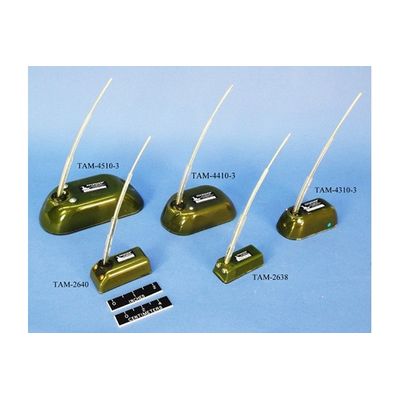
Telonics - Model TAM Series -Argos Marine Transmitters
FromTelonics, Inc.
Five fully configured models designed specifically for marine applications are shown. Tubing provides strain relief and mechanical protection for the antenna assembly.
Most popular related searches
sensor data
underwater temperature
wildlife monitoring
deep ocean
transmission data
depth profiler
water conductivity
pressure switch
water software
- These TAM models operate through the Argos System. This satellite-based system provides global coverage and particularly good performance in the polar regions. Animal locations are calculated using the Doppler-shift in frequency of the transmitter`s uplink transmission. (These units do not use GPS for location determination.).
- The TAM-26xx models provide small, light-weight packages for smaller species or juveniles. These units use Telonics ST-26 electronics, have 250 mW standard output power, and can collect and transmit data such as last dive time, dive count, maximum and average dive time, percentage of time spent under water, and temperature.
- The TAM-4xxx models provide 500 mW standard output power using the µGPSI-23 electronics, and can include not only dive time-related and temperature data, but also pressure-related data such as depth of dive, profile of a single dive, and percentage of time in user-defined depth layers (TAM-4x25-3 units include a transducer and can provide pressure data). Other features included in the TAM-4xxx, but not the TAM-26xx units are:
- All data is stored in non-volatile memory, such that it can be downloaded if the unit can be recovered.
- Support highly compressed data transmission called page data.
- A VHF transmitter is also included and can be enabled. It shares the transmitting antenna with the Argos transmitter.
- Expanded operational temperature range of -40°C to +70°C.
- Salt-water-switch (SWS) synchronizes Argos transmissions with surfacings and suppresses them while underwater to save energy. The SWS allows collection of dive data including length of dives, dive count, and percentage of time spent under water. Units can also be programmed to shut down Argos transmissions after a defined "haul-out" period to save energy. Normal data collection and Argos transmissions are resumed when the SWS is again submerged. The SWS settings on the TAM-4310 and larger models can be selected to allow detection of either seawater, or most freshwater and seawater (submergence may not be able to be detected in water with very low conductivity).
- Argos transmissions can be duty-cycled (e.g. daily and seasonal cycles), and the number of Argos transmissions in a defined interval can also be limited (e.g. not more than 100 within 6 hours), to extend operational life. A real-time clock/calendar controls all timing functions.
- These models can be programmed using Telonics Product Programmer (TPP). TPP makes it possible for users to program their own systems and simulate performance of the system prior to deployment.
- On-board sensors can be activated or deactivated. Data collection regimes and schedules can be altered. Sensor data can be added or deleted from Argos transmissions.
- Argos ID codes, transmission frequencies, transmission power levels, and transmission schedules can all be modified.
- Telonics Data Converter (TDC) is used to download data from a unit in hand, or to process the highly compressed "page" data used when transmitting large amounts of data through Argos. TDC provides complete data decoding of Argos DS files, including location and sensor data, and provides a plot of locations in Google Earth. More simple data formats do not require processing of via TDC.
- These models are internally solidly cast to withstand high pressures experienced during deep ocean dives. In general, the battery system determines how much pressure the unit can withstand. Most fully cast configurations can withstand pressures exceeding 1500 psi if the exposure is short term.
- Powered by primary battery, and can be turned on or off using a magnetic switch. When turned off, TAM-26xx units consume less than 5.3 µA, and TAM-4xxx units consume less than 12 µA.
- Can be refurbished to their original condition at the factory.
- Timing Accuracy :
- 6 min/year at 25° C
- 30 min/year -20 to +40° C
- 47 min/year -40 to +70° C
- Available Sensors : Mortality, Activity, Temperature, Low Voltage. Salt water switch also available on select models.
- Argos Operating Frequency :
- ARGOS Frequencies:
- 401.6300MHz to 401.6800MHz in 1 kHz Steps
- Brazilian SCD-1: Channels C1 to C9
- 401.6180MHz to 401.6220MHz in 500Hz Steps
- Argos Frequency Stability
- ±0.5 ppm maximum from -30° to +70° C
- ±2.0 ppm maximum from -40° to -30° C
- Argos Initial Frequency Error : ±0.5 ppm maximum at +23°C, ±2° C
- Argos Frequency Aging : ±2.0 ppm maximum after 1 year
- Argos RF Power Out : 250mW (+24.0dBm ±2dB) standard, 150mW (+22.5dBm ±2dB) option, both nominal into 50 Ω
- (User selectable using TPP programming software)
- Argos Spurs and Harmonics :
- <-40dBc minimum, -60dBc typical (Coherent Spurious)
- <-50dBc minimum, -60dBc typical (Non-coherent spurious)
General Specifications
- Timing Accuracy : Timing is synchronized to GPS time when available. If GPS time is not available, then internal timing accuracy is:
- 6 min/year at 25° C
- 30 min/yr -20 to +40° C
- 47 min/yr -40 to +70° C
- Available Sensors : Mortality, Activity, Temperature, Low Voltage (as allowed by specific software)
- Salt-water-switch and Pressure are hardware and software options on some configurations.
- Memory Capacity : Capable of storing ~500K fixes in nonvolatile flash memory in association with other sensor data.
- Programming : Programmable using Telonics TPP software and TSC-9A cable. Programming options are hardware and software dependent, but include GPS, Argos, and VHF schedules; sensor activation and schedules; power output; Argos can also be scheduled to transmit only during satellite overpasses based on the GPS location and the orbital parameters installed prior to deployment.
Argos Transmitter Specifications
- Operating Frequency : ARGOS Frequencies
- 401.6300MHz to 401.6800MHz in 1 kHz Steps
- Brazilian SCD-1, Channels C1 to C9
- 401.6180MHz to 401.6220MHz in 500Hz Steps
- Frequency Stability : ± 0.5 ppm maximum from -30° to +70° C
- ± 2.0 ppm maximum from -40° to -30° C
- Initial Frequency Error : ± 0.5 ppm maximum at +23°C, ± 2° C
- Aging : ± 2.0 ppm maximum after 1 year
- RF Power Out : Standard Power version: 500mW (+27dBm), 400mW (+26dBm) option, into 50 Ω
- (User selectable using TPP programming software)
- High Power version (H): 800 mW (+29 dBm) ±1dB nominal into 50 Ω
- (available in some configurations)
- Spurs and Harmonics : <-40dBc minimum, -60dBc typical (Coherent Spurious)
- <-50dBc minimum, -60dBc typical (Non-coherent spurious)
VHF Transmitter Specifications
- Available Frequency Options :
- Option 702 134-139 MH
- Option 705 140-154 MH
- Option 707 146-160 MH
- Option 715 156-172 MH
- Option 720 160-177 MH
- Option 740 174-192 MH
- Option 750 191-210 MH
- Option 760 210-237 MH
- Note: Frequency can be programmed in 100Hz steps within a given frequency range.
- Frequency Stability : Better than ±3ppm at room temperature ±5 ppm total tolerance over full temperature range
- Operating Temperature : -40° to +70° C
- Pulse Width : Programmable (10 to 250 msec)
- Pulse Period : Programmable (265 to 5000 msec)
- Multiple pulse periods selectable per specific software and TPP
- Transmitter Timing : Programmable, including daily and seasonal duty cycles.
- Power Output : Selectable levels via hardware and software.
- Effective Isotropic Radiated Power (EIRP) varies, depending on packaging, antenna configuration, and immediate environmental conditions. *California Users: This transmitter meets the California requirement of EIRP < 0.0009W for all configurations.
- Emission Designator : 2k00P0N
- Harmonic Suppression : Better than 30dB (>40 dB typical)
- Spurious Emissions : <-35 dBc at 10 kHz offset from carrier
- Frequency :
- Aging: <2ppm/year
- Shock: <1ppm 3000g x 0.3ms x ½ sine x 3 dir
- VSWR : RF output stable to 10:1 VSWR, all phases
- Radiated harmonic levels are degraded with poor load VSWR.
- Spurious emission specification maintained for >10:1 VSWR