
- Home
- Companies
- Terragon Environmental Technologies ...
- Products
- Terragon - Model STEP™ - For Integrated ...
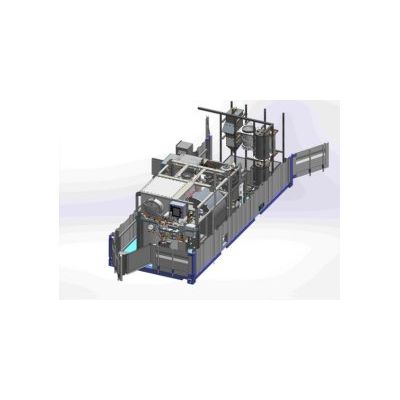
Terragon - Model STEP™ -For Integrated Solid and Liquid Waste Treatment
By combining MAGS and WETT, Terragon is creating STEP (System for Total Environmental Protection), the world`s first fully integrated resource recovery system from waste. STEP enables any habitat to use all its waste streams, such as solid waste, used oils, sludge, oily water, and gray and black wastewater, to generate clean water and energy for the habitat. STEP essentially enables any habitat to attain `zero waste discharge` and significantly reduce its need for new resources
STEP offers a unique synergy between solid (MAGS) and liquid (WETT) waste treatment technologies. Even the most efficient solid waste treatment technologies produce a wastewater stream from the scrubber used to clean the effluent gases. Similarly, all wastewater treatment technologies produce sludge from the solid contaminants they remove as they purify the water.
In STEP, the sludge removed from WETT is treated by MAGS, whereas the scrubber wastewater produced by MAGS is treated by WETT. Thus, a habitat can treat all of its waste streams and generate only energy, clean water, useful char and clean air emissions. The habitat may also earn significant carbon credits for reducing its emissions of greenhouse gases.
Currently, ships, as with most habitats pre-process their waste and then pay to have it taken away. By comparison, the proposed STEP solution is illustrated in the figure below; as it is configured for the treatment of all waste streams generated onboard a Canadian Coast Guard ice breaker.
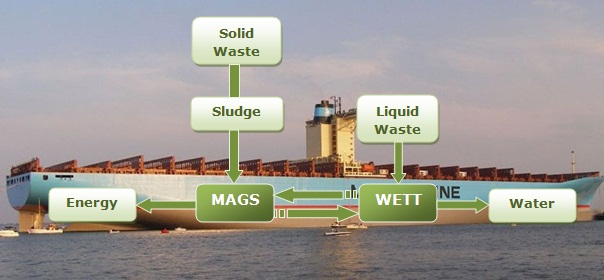
Using STEP in a commercial ship would reduce the number of equipment and processes used for waste management, would reduce the initial capital obligation, would simplify operations and free up valuable labour and would offer the ship valuable water and energy resources. Finally, it would significantly reduce the environmental footprint of the ship.
STEP has the potential to significantly simplify operations and meet environmental impact objectives for many small isolated habitats, beyond ships. For example, STEP, which will come as a "drop-and-play" technology inside a standard 20-foot shipping container, can be used by numerous temporary or mobile habitats, like military outpost and resource exploration camps. STEP could also be useful to emergency relief activities, such as temporary hospitals. Another interesting application of STEP is within Canada`s drive to establish sustainable small habitats in the Arctic.
Presently, SDTC is organizing a team of top performing Canadian companies that can combine their skills to generate an "Autonomous Community Solution" (the Solution) for a habitat of about 150 people. The Solution will be designed to offer the habitat energy, water, and waste treatment from renewable sources, including the generation of resources from waste. Terragon has been selected as a Tier 1 contributor to the Solution. The integrated Solution will be first implemented in the new Canadian High Arctic Research Station (CHARS).
A new technology that enables a group of 150 people to live sustainably off-grid could have important implications for numerous small communities, work camps, the military and many others.