


- Home
- Companies
- Nanjing Tangent Fluid Technology Co. ...
- Products
- TFT - Model FCM-MBR - Membranes System
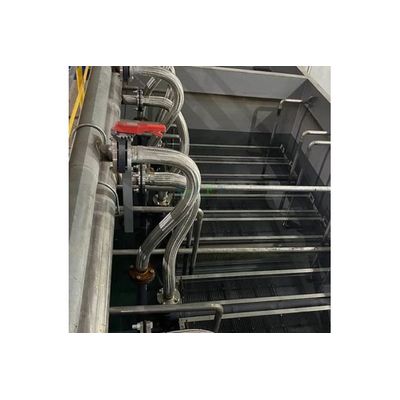
TFT - Model FCM-MBR -Membranes System
When used with domestic wastewater, MBR processes can produce effluent of high quality enough to be discharged to the coastal, surface, or brackish waterways or to be reclaimed for urban irrigation. Other advantages of MBRs over conventional processes include small footprint, easy retrofit, and upgrading old wastewater treatment plants. It is possible to operate MBR processes at higher mixed liquor suspended solids (MLSS) concentrations compared to conventional settlement separation systems, thus reducing the reactor volume to achieve the same loading rate. Two MBR configurations exist: External sidestream MBR, where membranes are a separate unit process requiring an intermediate pumping step,and Internal submerged MBR or Immersed MBR. where the membranes are immersed in and integral to the biological reactor.
Immersed Membrane BioReactor (iMBR)
In the immersed Membrane BioReactor (iMBR) configuration, the filtration element is installed in either the main bioreactor vessel or in a separate tank. The modules are positioned above the aeration system, fulfilling two functions, the supply of oxygen and the cleaning of the membranes. The membranes can be a flat sheet or tubular or a combination of both and can incorporate an online backwash system which reduces membrane surface fouling by pumping membrane permeate back through the membrane. In systems where the membranes are in a separate tank to the bioreactor. individual trains of membranes can be isolated to undertake cleaning regimes incorporating membrane soaks, however, the biomass must be continuously pumped back to the main reactor to limit MLSS concentration increase. Additional aeration is also required to provide air scour to reduce fouling. Where the membranes are installed in the main reactor, membrane modules are removed from the vessel and transferred to an offline cleaning tank. Usually the internal/submerged configuration is used for larger-scale lower strength applications. In order to optimize the reactor volume and minimize the production of sludge, submerged MBR systems typically operates with MLSS concentrations comprised between 12000 mg/Land 20000 mg/L hence they offer good flexibility in the selection of the design sludge retention time.
Immersed MBR has been the preferred configuration due to its low energy consumption level, high biodegradation efficiency, and low fouling rate compared to sidestream MBR. In addit`on.immersed MBR systems can handle higher SSLM concentration, while traditional systems work with a MLSS concentration between 2.5-3.5, iMBR can handle concentration between 4-12 g/L, an increase of 300%. This type of configuration is adopted in industrial sector including textile, food & beverages, oil &gas, mining, power generation, pulp & paper in light of :ts benefits.
Sidestream MBR
In sMBR technology the filtration modules are outside the aerobic tank, hence the name side-stream configuration. Like the iMBR configuration, the aeration system is also used to clean and supply oxygen to the bacteria that degrade the organic compounds. The biomass is either pumped directly through a number of membrane modules in series and back to the bioreactor, or the biomass is pumped to a bank of modules, from which a second pump circulates the biomass through the modules in series. Cleaning and soaking of the membranes can be undertaken in place with the use of an installed cleaning tank, pump, and pipework. The quality of the final product is such that it can be reused in process applications due to the filtration capacity of the micro and ultrafiltration membranes.
Usually, external/sidestream configuration is used for small-scale higher strength applications; the main advantage that the extemal/sidestream configuration shows is the possibility to design and size the tank and the membrane separately, with practical advantages for the operation and the maintenance of the unit. As in other membrane processes, a shear over the membrane surface is needed to prevent or limit fouling; the external/sidestream configuration provides this shear using a pumping system, while the internal/submerged configuration provides the shear through the aeration in the bioreactor, and since there is an energy requirement to promote the shear, this configuration shows this additional cost. Moreover the MBR module fouling is more consistent, due to the higher fluxes involved into this configuration.
Reliable operation and easy maintenance
- FCM ceramic membrane has reliable performance during operation and will not be easily broken or damaged. It can operate under long sludge age and nearly achieve no residual sludge discharge.
High quality and stable filtrated water quality
- The solid-liquid separation efficiency is high, and the separation effect is far greater than that of the sedimentation tank. All SS and turbidity of filtrate are close to zero, and viruses and bacteria can be effectively removed.
Greatly remove ammonia nitrogen and refractory organic matter
- Since the microorganisms are completely rejected in the bioreactor, it is beneficial to the trapped growth of nitrifying bacteria, and the system nitrification efficiency is improved. It can also increase the hydraulic retention time of some refractory organics, which is beneficial to improve the degradation efficiency of refractory organics.
Water reused directly
- Combined with bioloical process, FCM membrane can bring efficient solid-liquid separation for the suspended solids, colloidal substances, and microbial flora . Since the bacteria cannot pass through lOOnm pore, there is no need for disinfection. Therefore, the filtrate can be reused directly without post treatment.
Reduce remaining sludge discharge
- The process can be operated under high volume load. The output of residual sludge can keep extremely low, and even no sludge is produced, which greatly reduces the sludge treatment cost.
Efficient sewage treatment capacity
- FCM ceramic membrane can reject microorganisms in the bioreactor, ensuring high activated sludge, which makes the system withstand impact loads, and at the same time realizes the separation of hydraulic retention time and sludge retention time.
Long service life
- FCM flat ceramic membranes are resistant to acid and alkali. ox:dation, solvent, abrasion, and microorganisms. The service life is more than 15 years under normal conditions.
Remote control by PLC automation
- Industrial automation PLC control can be adopted for remote control with very low failure.
Compact footprint, easy installation
- FCM-MBRflat sheet ceramic membrane bioreactor can maintain a high concentration of microorganisms, greatly saves floor space, which is only 1/2 of the traditional process; The system can be fabricated as ground type, semi-underground type and underground type. 10. Modularized design FCM membrane and module can be modularized and designed to meet different capacity with applicability and feasibility for different waste water.