


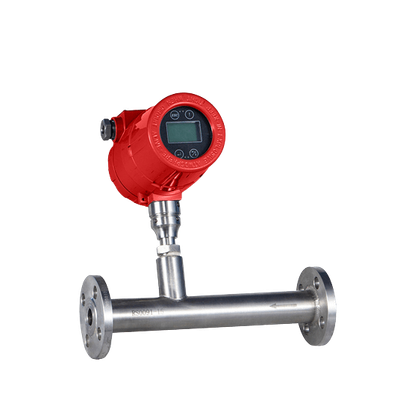
Integral style Thermal Mass Meter
have all of the electrical components and connections located within one enclosure. The enclosure is mounted directly to the insertion probe assembly at the point of measurement. The enclosure includes all of the electrical connections as well as the linearizing electronics and the display/keypad assembly.
Thermal mass meter uses the principle of convective heat transfer to directly measure mass flow. ProFlow’s proprietary thermal mass flow sensors use two ratiometrically matched, reference-grade platinum Resistance Temperature Detectors (RTDs). The platinum sensing element wire is encapsulated in a 316 Stainless Steel sheath or, if specified, a Hastelloy C sheath. Our microcontroller operated smart sensor technology preferentially heats one RTD; the other RTD acts as the temperature reference. The process gas flow dissipates heat from the first RTD, causing an increase in the power required to maintain a balance between the RTDs. This increase is directly related to the gas molecular rate of flow. Our sensors are temperature compensated for a wide process gas temperature range and insensitive to pressure changes, so the output signal is a true mass flow rate signal.
In conclusion, thermal mass flow meters offer several advantages, including a wide range of measurements and direct mass flow measurement. Other advantages are low pressure drop, high accuracy, and compatibility with various fluids. However, they also have limitations related to gas composition changes, initial cost, and dependency on fluid properties. Finally, these flow meters find applications in diverse industries such as oil and gas, chemical and petrochemical. Other industries are HVAC systems, pharmaceutical and biotechnology, and food and beverage. This is contributing to efficient and reliable flow rate measurements throughout these sectors.