


- Home
- Companies
- NETZSCH Group
- Products
- Libra Classic - Model TG 309 - ...
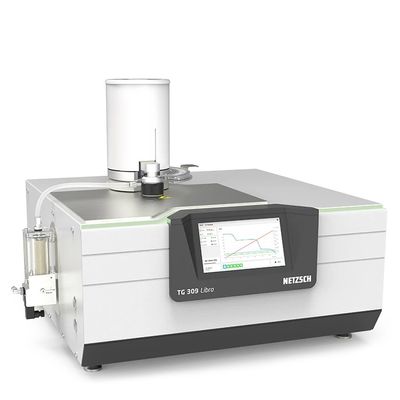
Libra Classic - Model TG 309 -Thermogravimetric Analysis System
Ensure product quality and safety by detecting mass changes. Analyze the unique thermal behavior of materials and their components: TG 309 Libra® Classic: The TG 309 Libra® Classic is the device with the best price-performance ratio in the Libra® series. It is the ideal instrument for Quality Control. The Classic offers a temperature range from 10 °C up to 1025 °C. In addition, it can be equipped with a 20-position ASC (Automatic Sample Changer).
Get Results Faster Without a Baseline Run
To ensure accurate mass change values, a baseline run is typically conducted under test conditions that are identical in terms of heating rate, gas type, and gas flow.
The baseline takes factors such as heating rate, crucible type and geometry into account while also accounting for instrument and buoyancy effects, thus allowing these to be subtracted from the sample measurement.
The TG 309 Libra® typically eliminates the need for a separate baseline run when using the integrated BeFlat® baseline run for typical temperature measurements. This significantly speeds up tests.
20 Times Faster Thanks to High Heating Rates
The TG 309 Libra® has a low-volume furnace. It supports rapid heating rates of up to 200K/min over the entire temperature range and fast ballistic cooling from 1025°C down to room temperature. This allows for faster analysis results, even at high temperatures, with a turnaround time of just a few minutes.
More Comprehensive and Faster Characterization by Patented c-DTA®
In direct contact with the sample crucible, the sample thermocouple measures temperature variations in the material. This enables more thorough characterization of sample properties and determination of Endothermic A sample transition or a reaction is endothermic if heat is needed for the conversion. endothermic (e.g., melting) and Exothermic A sample transition or a reaction is exothermic if heat is generated. exothermic (e.g., Oxidation Oxidation can describe different processes in the context of thermal analysis. oxidation) effects during thermogravimetric investigations. In addition, c-DTA allows for temperature calibration using DSC reference materials.
Thermogravimetric Analysis / Thermogravimetry
What is Thermogravimetry?
Thermogravimetry has the ability for differentiation between individual components based on their distinct thermal behavior. By analyzing weight-loss profiles, users can deduce the composition of complex samples, enabling deeper understanding of their structure and properties.
Revealing the Mysteries of Complex Mixtures and Material Transformations
Thermogravimetry (TG) is renowned for its precision and sensitivity. By subjecting a sample to controlled temperature increments while continuously measuring its weight change, TGA can detect even the slightest alterations in a material‘s mass. This level of sensitivity allows for pinpointing the exact temperatures at which various transformations occur, such as Decomposition reactionA decomposition reaction is a thermally induced reaction of a chemical compound forming solid and/or gaseous products.decomposition, volatilization, or OxidationOxidation can describe different processes in the context of thermal analysis.oxidation. As a result, TGA provides valuable insights into a material‘s composition, providing such information as stability and degradation data for polymers along with data for material characterization and formulation.
Ensuring Product Quality and Safety
For industries like pharmaceuticals, chemicals, and food, ensuring product stability is very important. Thermogravimetry plays a vital role in evaluating the Thermal StabilityA material is thermally stable if it does not decompose under the influence of temperature. One way to determine the thermal stability of a substance is to use a TGA (thermogravimetric analyzer).thermal stability of materials over time. By subjecting samples to extended thermal cycling, researchers can assess their long-term stability, obtain initial information about shelf-life, and identify potential degradation pathways. This information is critical for quality control and regulatory compliance.
Unlimited Versatility: Tailored for Diverse Applications
One of the remarkable qualities of thermogravimetry is that it can be adapted to a wide range of applications. From the polymer industry to materials engineering, and from pharmaceutical research to environmental science, TGA is a versatile technique that transcends disciplinary boundaries. Its capability of providing fundamental insights into materials makes it indispensable for materials characterization, from quality control to industrial research and academic applications.
TGA Information
- Mass changes
- Identification
- Compositional analysis
- Decomposition reactionA decomposition reaction is a thermally induced reaction of a chemical compound forming solid and/or gaseous products.Decomposition
- OxidationOxidation can describe different processes in the context of thermal analysis.Oxidation
- Thermal stability
- Reduction behavior
- Thermal Corrosion StudiesThermal corrosion or high-temperature corrosion is a chemical interaction of a material (typically a metal) with the surrounding gas atmosphere as a result of heating.Corrosion studies
- Determination of filler content
- Influence of aging
- Determination of plasticizer content and other additives
- Determination of moisture content
- Determination of Ash ContentThe ash is a measure of the mineral oxide content on a weight basis. Thermogravimetric analysis (TGA) in an oxidative atmosphere is a well-proven method to determine the inorganic residue, commonly referred to ash, in organic materials such as polymers, rubbers, etc. Therefore, the TGA measurement will Identify if a material is filled and calculates the total filler content.ash content
- Determination of Added Carbon BlackCarbon black acts as a reinforcing filler in tires and other rubber products. In other materials such as plastics, paints, and inks, carbon black is used as a color pigment or as filler to achieve electric conductivity.added carbon black
- Curie temperatures
- Reaction kinetics
Thermogravimetric analysis (TGA) is a precise analytical technique used to track changes in the mass of a sample over time and/or temperature under a defined and controlled environment with respect to heating rate, gas atmosphere, flow rate, crucible type, etc. It can accurately detect weight changes down to fractions of a microgram. This high sensitivity allows for the determination of even the smallest changes in the physical and chemical properties of a material.
Temperature range
RT (10°C) to 1025°C at the sample
Balance resolution
50 ng
Heating and cooling rates
0.001 K/min to 200 K/min
Temperature precision:
0.15 K
Wide measuring range:
2000 mg
Vacuum-tightness:
1 mbar
Sample crucible volume:
up to 350 µl
Atmospheres:
inert, oxidizing, reducing, static, dynamic
Compact 20-Sample ASC on a Removable Sample Carousel
The cost-effective TG 309 Libra® Classic can be equipped with an optional automatic sample changer (ASC) for up to 20 samples and references. The gripper safely removes the crucible from the magazine and gently places it in position on the sensor. The samples are placed in a removable ASC insert which allows for preparation away from the instrument.