


- Home
- Companies
- Fronius International GmbH
- Products
- Fronius - TIG Welding Machine
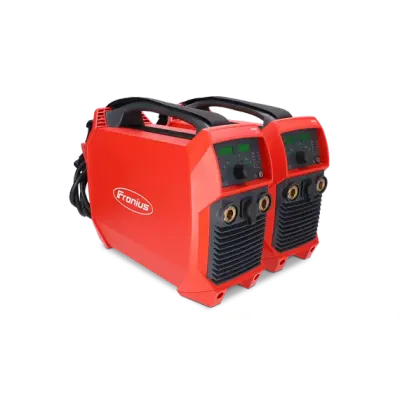
Fronius - TIG Welding Machine
Your craftsmanship, our technology. We provide you with the right technology to allow you to concentrate fully on your TIG weld. Our compact Artis 170/210 product family offers a wide range of functions and helps you to unleash your full welding potential. Our main focus was to ensure that the mobile TIG welding machine makes the best possible use of the input voltage. This not only makes the Artis energy-efficient, but also extremely reliable and productive, which will ultimately make your welding experience more enjoyable!
Ease of use, wide range of settings
Not just packed with technology, the Artis also has a user-friendly operating concept incorporating a simple press-and-turn button and a clear, illuminated function display. Eleven parameters can be selected directly and without a background menu.
Robust, lightweight, and functional
The function carrier is the central element in the structural design of the welding machine, keeping all components in place. Like the housing, it is made of durable plastic and tested for mechanical stresses that far exceed the standard. This guarantees the highest level of robustness possible while keeping the weight to a minimum.
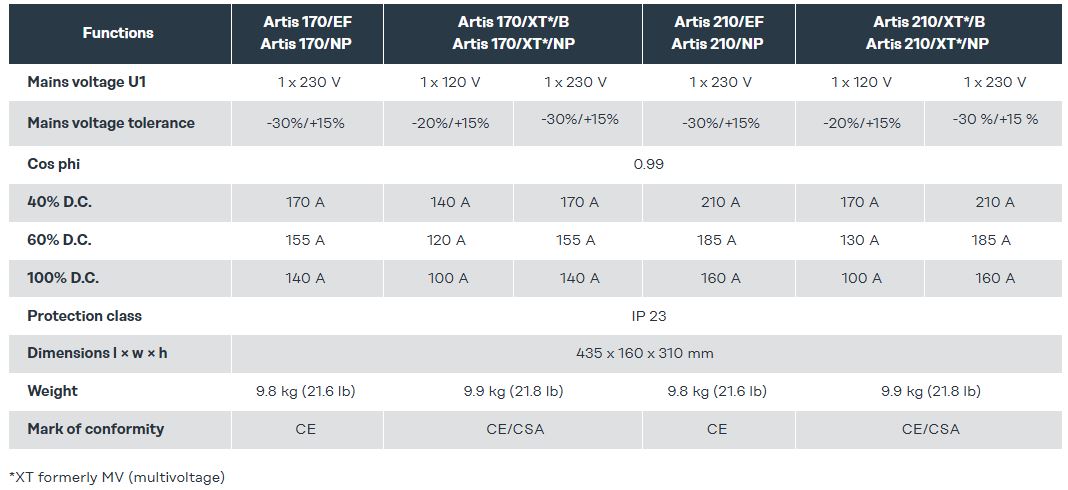
40% duty cycle at maximum output power
Weld for four minutes without a break at 170 or 210 amperes, depending on the model.
30% mains voltage tolerance at maximum output power
This is an enormous advantage, especially in poorly protected grids. The inverter technology perfectly compensates for voltage fluctuations or input voltage that is too low, so that the maximum output power is always supplied.
96–265 V mains voltage supply
The high bandwidth of the power supply makes the Artis 170/210 compatible with almost any grid worldwide
Gas pre-flow time/gas post-flow automatic and manual
The welding machine that thinks with you. Artis automatically calculates the duration of the optimal gas post-flow time according to the set welding current. This improves the gas shield of the end of the weld and tungsten electrode.
Trigger Mode OFF: automatic shutdown
Once the welding process is complete, the welding current switches off automatically after a specific change in the arc length.
TAC function for time savings of up to 50% when tacking materials
The weld pool is made to oscillate by means of pulse currents. This makes it easier to tack components together and reduces tacking time, leaving hardly any or no temper colors on the tacking points.
PTD—pulse/TAC display function curve
This allows you to add two additional welding parameters, “pulse” and “TAC”, to the function curve on the control panel.
TIG Pulse function: Welding even with thin sheet thicknesses
Pulse welding is primarily used for out-of-position welding or when welding especially thin materials. The pulse setting range is 1 Hz to 990 Hz.
Touch high frequency ignition
If, for example, the restricted component accessibility necessitates the use of welding torches without a torch trigger, Touch HF ignition is required. The machine detects contact with the workpiece and
- after a defined period of time has elapsed
- ignites the arc exactly at the desired point.
TIG welding torch with different operating options
We offer TIG welding torches with standard, Up/Down function, long trigger, or potentiometer, depending on your requirements.
Spot and stitch welding: recurring welded joints
The spot welding mode allows you to apply welding spots at even intervals. With the freely adjustable stitch pause time, you can also continue this as stitch welding.
Electrode pulse welding
The electrode pulse mode enables better weld properties in out-of-position welding and increased gap-bridging ability. It is ideal for welding vertical-up seams.
HotStart function when igniting the arc
To make the electrode easier to ignite, the current is increased on the welding machine for a fraction of a second during ignition.
Cellulose electrodes
Optimum characteristic for welding Cel electrodes. This requires a higher open circuit voltage or ignition power.
Arc-force dynamic
If basic electrodes are welded with coarse droplet material transfer at a low current (underloaded), there is a risk of sticking. To rule this out, more current is supplied for split seconds just before sticking. The electrode burns freely, preventing sticking.
Anti-stick
If a short circuit occurs (electrode sticks during MMA welding), the welding current is interrupted. This prevents annealing of the electrode and serious weld faults.