
- Home
- Companies
- Tri-Mer Air Pollution Control Systems
- Products
- Tri-Mer - Wet Scrubbers for Air ...

Tri-Mer - Wet Scrubbers for Air Pollution Control
A Wet Scrubber is an air pollution control device which uses a liquid to remove contaminants from a gas stream.
The removal process is achieved by bringing the gas stream into contact with the scrubbing liquid, which facilitates mass transfer of the contaminants into the liquid. When the water is recirculated, addition of fresh water is necessary to purge contaminants and replace evaporation losses. Fresh water may be added to the recycle continuously or periodically. Tri-Mer has a variety of high-efficiency wet scrubbers for the removal of inorganic gases, odors, fumes, acid fumes, sulfuric acid, chrome, NOx, fine particulate, aerosols, mercury, HCl, Cl2, SO2, and HF.
Applications include a broad range of manufacturing and process industries; semiconductor, metal finishing, and chemical industries generating corrosive fumes and gases.
5 Scrubber design factors are influenced by the type of pollutant being removed:
- Packed Bed Height: relates to the required contact time between the pollutant-laden gas stream and the scrubbing liquid to achieve mass transfer. The packed bed height is sized according to the type of pollutant and efficiency requirements.
- Scrubbing Liquid Type: When scrubbing acidic pollutants, a caustic (e.g. NaOH) may be added to the scrubbing liquid to aid in acid absorption. Likewise, an acid (e.g. H2SO4) may be added to the scrubbing liquid if the pollutant is caustic.
- Liquid Flow Rate: The flooding factor of the packed bed.
- Target Gas Velocity: 250 to 450 fpm through a scrubber vessel. Design velocity differs based on the pollutant.
- Materials of Construction: Chemical compatibility, also cost, are two considerations.
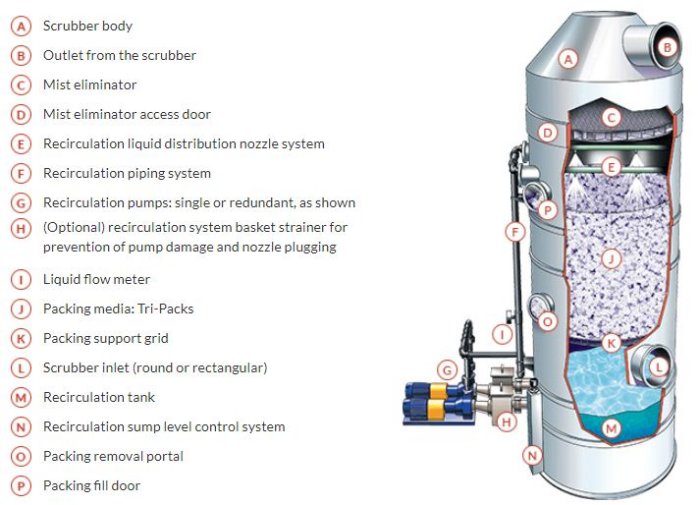
- Gas flow is counter-current to the liquid flow.
- Smaller footprint required at the expense of increased height requirements.
- Generally, less costly from both capital and operational perspectives.
- Scrubber vessel is round (generally).
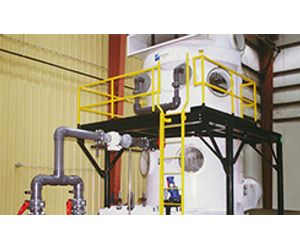
- Gas flow is cross-current (perpendicular) to the liquid flow.
- Sacrifices footprint for height.
- Slightly less efficient due to cross-current flow, although this disadvantage is minimized when treating the more water-soluble acids (e.g. H2SO4, HCl).
- Scrubber vessel is rectangular
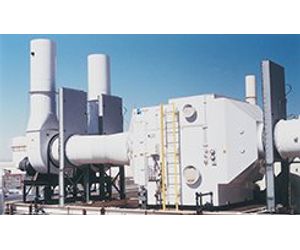
Tri-Mer wet scrubbers have numerous modules, including packed towers, mist eliminators, ducting and exhaust stacks, all of which are manufactured on Tri-Mer’s Michigan campus.