


- Home
- Companies
- William Boulton Ltd.
- Products
- Ultra Fine Grinding
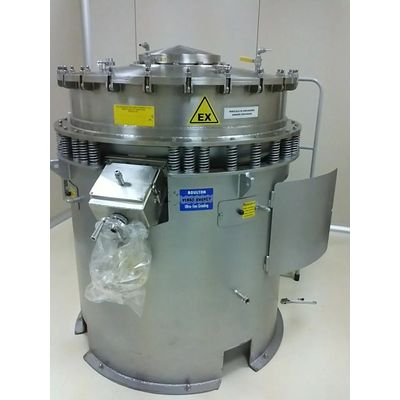
Ultra Fine Grinding
- Minimal Product Contamination.
- NO Ferrous Contamination.
- Narrow Particle Size Distribution of Products.
- Easy to Install with Minimal Maintenance Time & Costs.
- Low Power Consumption & Noise Levels.
- All Mills are designed to be readily convertible from Batch to Continuous and vice versa.
- Inherently safe in Operation – NO Guarding Required
Boulton Vibro-Energy® Grinding Mills offer versatile, low cost, controlled particle size reduction with minimal wear and product contamination. No other type of mill has so few mechanical moving parts. Power consumption is low as there are no rotating impellors or drums.
The mills utilize inert high density sintered ceramic or carbide grinding media for iron-free grinding. The media is cylindrical or ball shape and is subjected to a high frequency, high amplitude vibration producing a vibrating and tumbling vortex action within the annular shaped grinding chamber. The process material fills the void spaces within the media mass.
Grinding is carried out in the Mill by the use of high density Ceramic Media.
The requirements for ultrafine grinding are that relatively small forces need to be applied at very high frequencies to thin layers of the process material.
Not only is it unnecessary to apply large forces in fine grinding but it is undesirable, since these would damage the grinding media and the grinding mill lining, resulting in considerable product contamination.
The grinding forces must be applied to thin layers of material otherwise energy is expended in re-arranging the particles without producing breakage.
The easiest method of ensuring thin layers of process material is to distribute it throughout a large contact area within a close packed mass.
Cylinders can be shown to possess the further advantage in that since only line and plane contact is possible, they will grind coarse material preferentially, see Figure 1.
Thus, milled products will usually have a narrower particle size distribution than products from other mills and in most industries this can be of vital importance.
The standard grinding media for the use in the Grinding Mill chamber consists of High Density sintered Alumina or Zirconium cylinders. Other Types of media are used where appropriate.
The Grinding Mill chamber is lined with Resistant Rubber or Polyurethane. Carbon or Stainless Steel Grinding chambers are available.
The Mills can also be operated under Vacuum or Pressure.
The material to be ground fills the interstices between the grinding media. Chamber movement is in turn generated by a specially designed double ended electric motor having out of balance weights.
Springs at the periphery of the grinding chamber provide a restoring force and also substantially damp out vibration to the mill base.
Only very small forces are required for ultra-fine particle size reduction and these are produced as the pieces of grinding media impact against each other.
The design of the William Boulton Vibro-Energy Grinding Mill ensures the correct relationship between centre of gravity balance and the mode of vibration which causes the media to close pack.
The packed mass of media slowly gyrates in the horizontal plane while in the vertical plane it rises in proximity to the outer wall and descends as it approaches the inner wall of the chamber, see Figure 2.
The motion assists in distributing the charge and the wet grinding mill helps maintain the solids in suspension. The degree of motion is readily controlled by varying the position of the out of balance weights on the motor shaft.